A right granted by the state, an application rejected by the Cadastre, and a dispute that reached the courtroom doors…
This single sentence should have put an end to the discussions in Khiva. However, several months later, citizen Lochin Ibragimov appealed to the Effect.uz editorial office regarding this case. According to him, although the court decision was considered executed, he has still not been able to exercise his rights.
Effect.uz, during the preparation of this material, studied more than 80 pages of court documents, official responses from government agencies, archival data, and materials provided by the applicant. All facts presented in the material are based on existing documents. At the same time, the editorial office is also awaiting official responses from all responsible state agencies regarding this matter.
Who enforces the court decision?
According to the Constitution of the Republic of Uzbekistan, the judicial power is independent. Decisions rendered by courts that have entered into legal force are mandatory for all state bodies, officials, organizations, and citizens. This rule is clearly defined in the laws.
However, a case studied by Effect.uz in the Khorezm region raises serious questions about how this rule works in practice. This investigation is not about land. This investigation is not about 300 square meters either.
This investigation is about what the actual enforcement of a legally binding court decision means.
It all started in 2001…
According to the documents, on January 5, 2001, decision No. 3 of the Khiva district hokim (governor) was adopted. This decision stipulated that citizen Lochin Ibragimov should be allocated a 300-square-meter land plot in place of his demolished house. This is not just an ordinary service letter. It is a legal document adopted by a state agency.
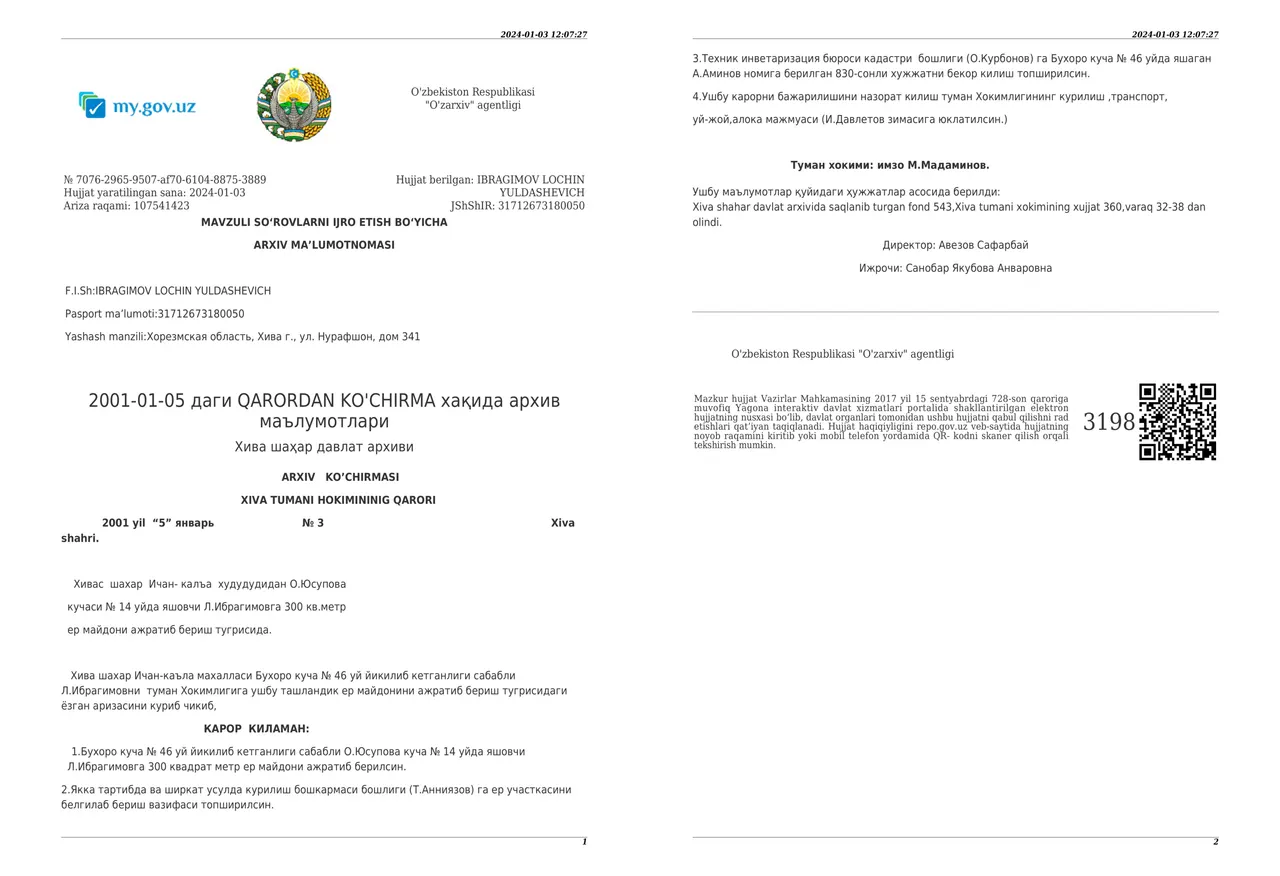
Why is this document important?
Because all subsequent events in this case stem precisely from this decision. Had this decision not existed, neither the dispute with the Cadastre nor the court proceedings would have arisen later.
The archive also confirms the existence of this decision
Years pass. The citizen applies to the relevant authorities to exercise his right. It is then that the archival materials are also reviewed.
According to the official certificate from the archive, the 2001 hokim's decision truly exists. This circumstance was later evaluated as an important piece of evidence in the court proceedings.
Nearly a quarter of a century has passed...
Years later, the citizen applied to the State Cadastres Chamber to formalize cadastral documents based on this decision. Logically, the process of formalizing the previously adopted decision should have begun. However, events unfolded differently.
Cadastre's response: «No«
The citizen applies. But the State Cadastres Chamber rejects his application.
Objections related to title documents and the information in the application are cited as the basis for the refusal. This refusal later became the reason for the entire case reaching the court.
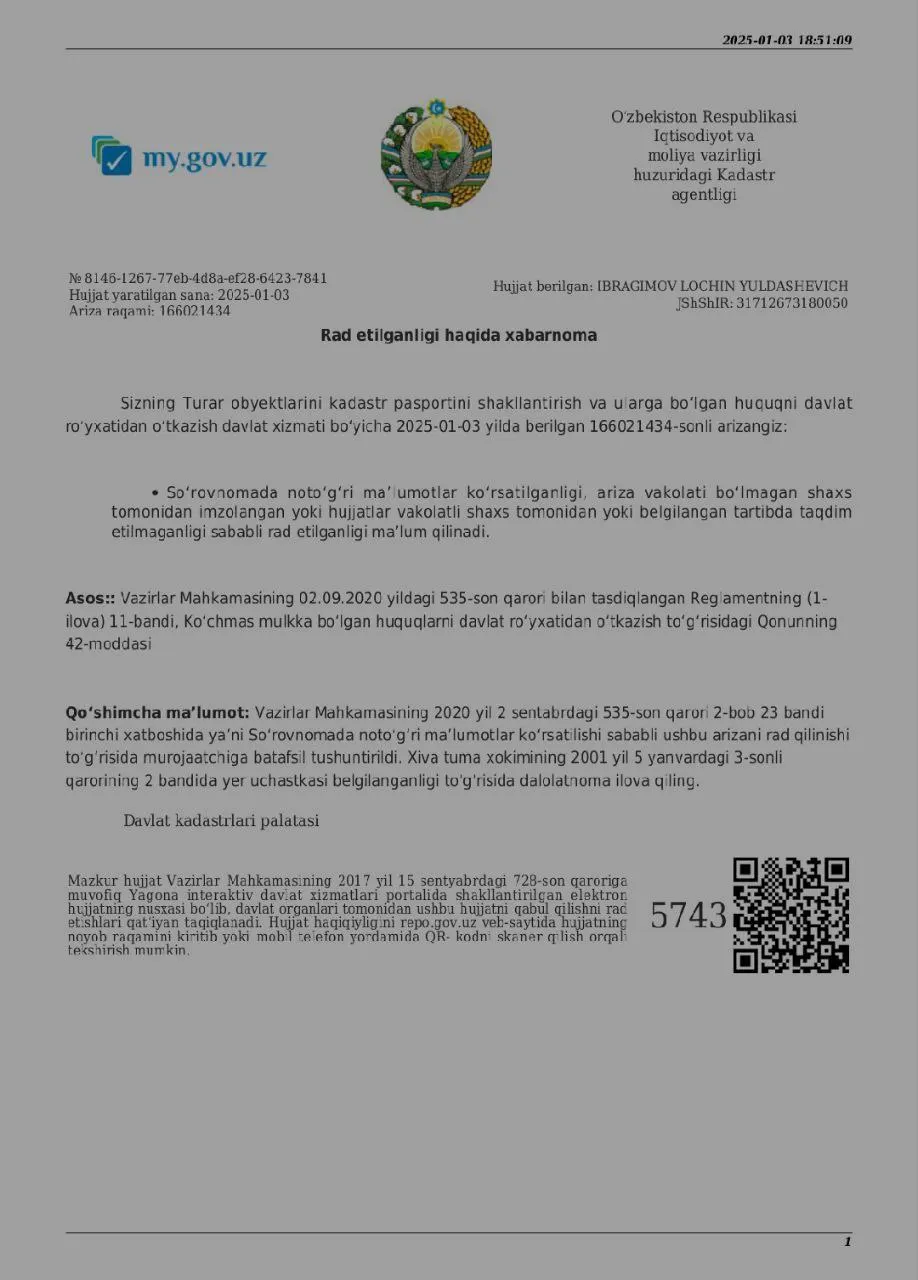
Why is this document important?
It was precisely this refusal that forced the citizen to apply to the court. The grounds given in this document were subsequently legally evaluated by the court.
The dispute that reached the court
Thus, the dispute moved to the administrative court. Now the question was framed as follows:
Is the decision adopted by the state itself in 2001 considered a sufficient legal basis for subsequently formalizing cadastral documents or not?
The court now had to provide an answer to this question.
The court made a different decision
Following the Cadastre's refusal, the citizen decided to protect his rights through the court. Thus, the case was considered in the Urgench Interdistrict Administrative Court.
The main question before the court was simple: Do the 2001 hokim's decision and archival documents confirm the citizen's right or not?
To answer this question, the court studied the explanations of the parties, archival data, and the grounds presented by the Cadastre.
According to the documents examined during the investigation, the court evaluated the case from several aspects. First of all, the court took into account that the 2001 decision of the Khiva district hokim was indeed adopted. Secondly, it noted that this decision was also confirmed by an archival certificate.
Thirdly, it analyzed the grounds given in the Cadastre's refusal from the perspective of legislative requirements.
The court did not find the Cadastre's refusal to be lawful
In its verdict, the court legally evaluated the grounds presented by the Cadastre. According to the court's conclusion, the grounds stated in the refusal were not found sufficient to reject the citizen's claim. As a result, the court deemed the State Cadastres Chamber's refusal to be unlawful. This became a turning point in this case, because now the dispute was no longer just about the refusal, but about the obligation of a state agency.
The court imposed an obligation on the Cadastre
The most important part of a judgment is its final part, because it is precisely here that the court determines how a state agency must act. In this case, too, the court did not limit itself merely to annulling the Cadastre's decision. The court imposed an obligation on the Cadastre to perform a specific action.
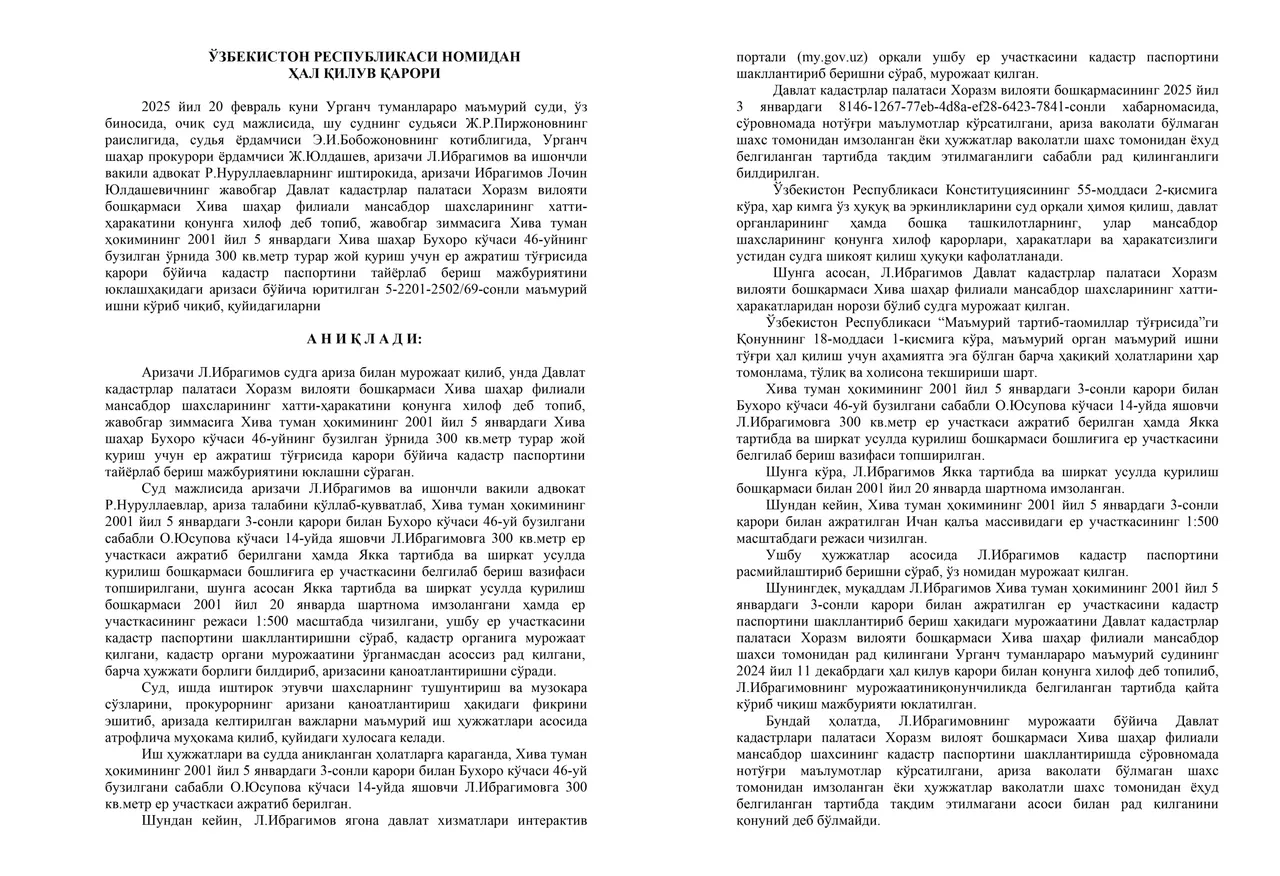
This subsequently served as the legal basis for initiating enforcement proceedings.
«...An obligation shall be imposed on the State Cadastres Chamber to issue a cadastral passport...«
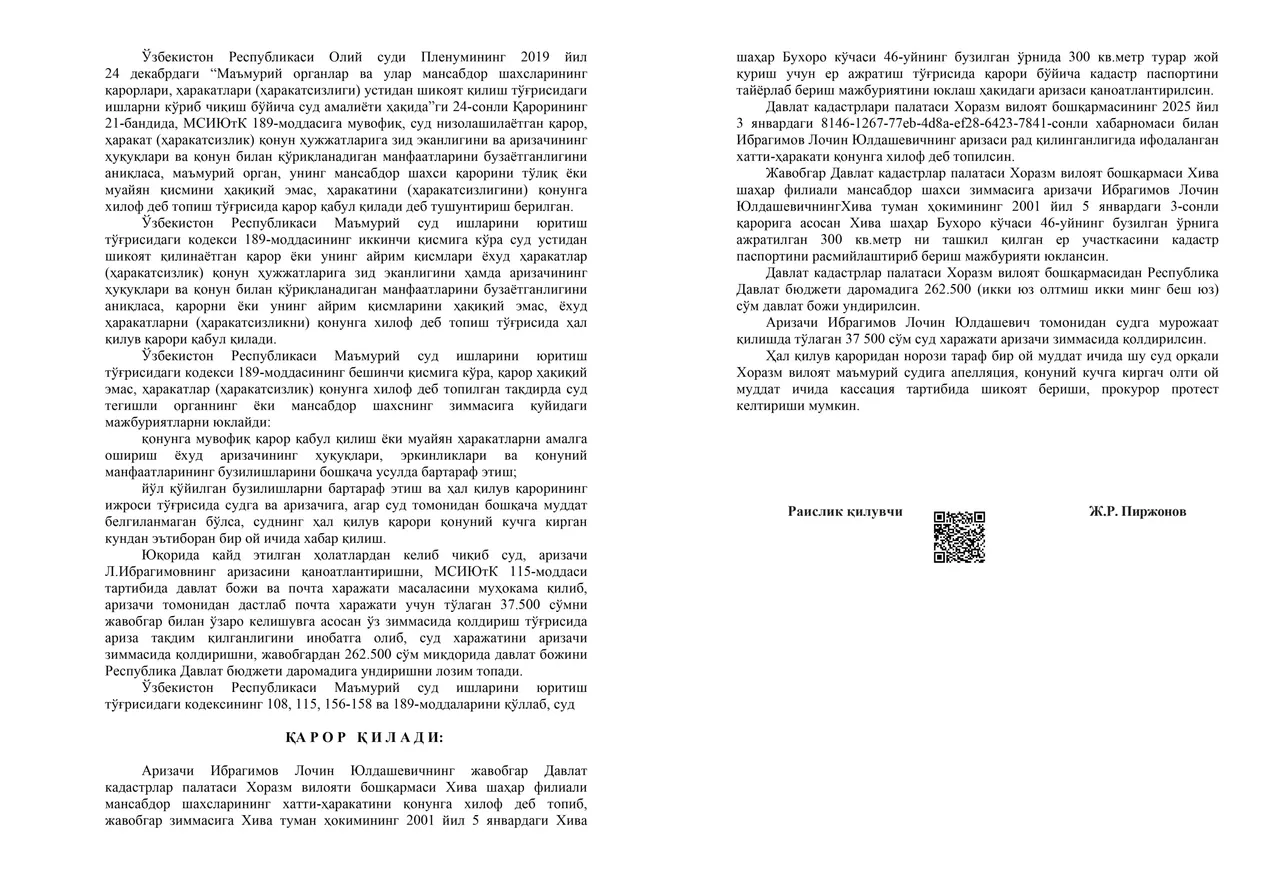
Both the Cadastre and all subsequent state agencies were supposed to execute this exact judgment.
Was the court decision not appealed?
According to the documents, no appeal was filed against the judgment within the prescribed period.
This caused the court decision to enter into legal force. According to the law, a legally binding court decision is mandatory for all state agencies.
Thus, at this stage, the dispute was no longer in court. The dispute had now shifted to the issue of how to enforce the decision.
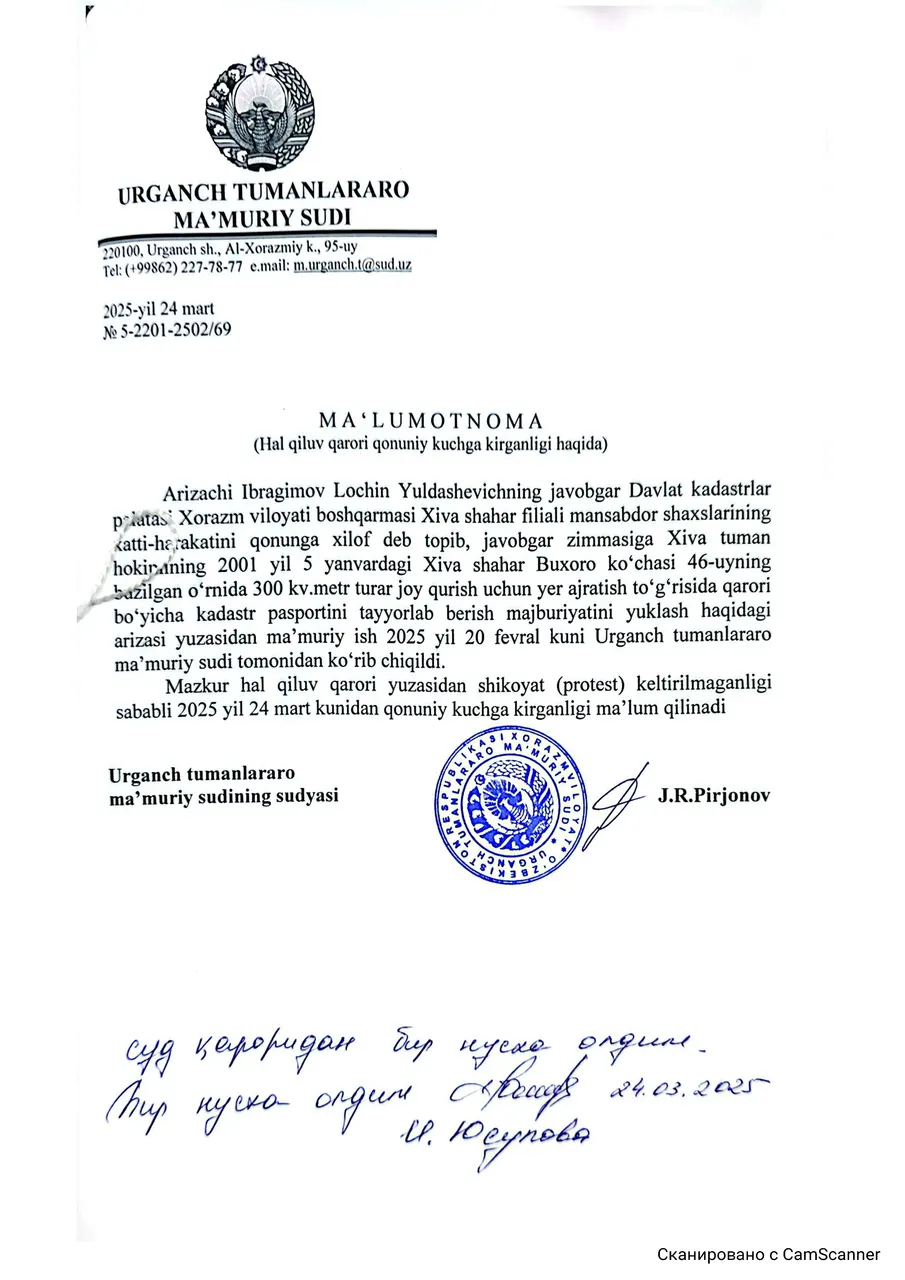
However, the question arises here...
If the court decision was indeed executed... Why is the applicant appealing to the media even today?
Why does he state that the cadastral documents have still not been formalized?
How can these two circumstances exist at the same time?
On one side, the state bailiff says:
«It has been executed.«
On the other side, the citizen says:
«I have still not achieved the result of the court decision.«
How was the court decision actually executed?
So far, it is known from the documents available to the editorial office that the case did not go to the Bureau of Compulsory Enforcement (MIB), because it is an administrative case.
To get a precise answer to this question, the editorial office sent an official inquiry to the Bureau of Compulsory Enforcement. In particular, answers were requested to the following questions:
Which clause of the court decision was executed?
On the basis of which documents was the conclusion «executed« reached?
How is it confirmed that the citizen achieved the outcome of the court decision?
However, events did not end there...
This time, the discussion was no longer about the archive.
The talk began to concern:
neighbors' objections;
sanitary protection zone;
Ichan-Kala conservation area;
engineering communications. This raises a new question.
If these circumstances existed, why were they not evaluated as decisive grounds during the court proceedings?
Why did new grounds appear after the court decision?
Even after the Bureau of Compulsory Enforcement considered the court decision executed and terminated the enforcement proceedings, appeals regarding this case continued.
During the study of subsequent documents provided to the editorial office, another noteworthy circumstance was observed.
After the court decision, some official responses from state agencies began to cite a number of circumstances that had not been discussed previously.
In particular:
neighbors' objections;
sanitary protection zone;
the protection zone of the Ichan-Kala State Museum-Reserve;
engineering communications.
For now, the editorial office does not draw a definitive conclusion on whether these circumstances were evaluated or not evaluated during the court proceedings.
However, these very circumstances raise the following questions:
were these grounds also present during the court proceedings?
if they were present, what legal evaluation did they receive?
if they were not present, on what basis were they cited later?
Yet another document...
During the investigation, another important document came into the possession of the editorial office. In it, «Khorezm Water Supply« JSC expressed its stance regarding this matter.
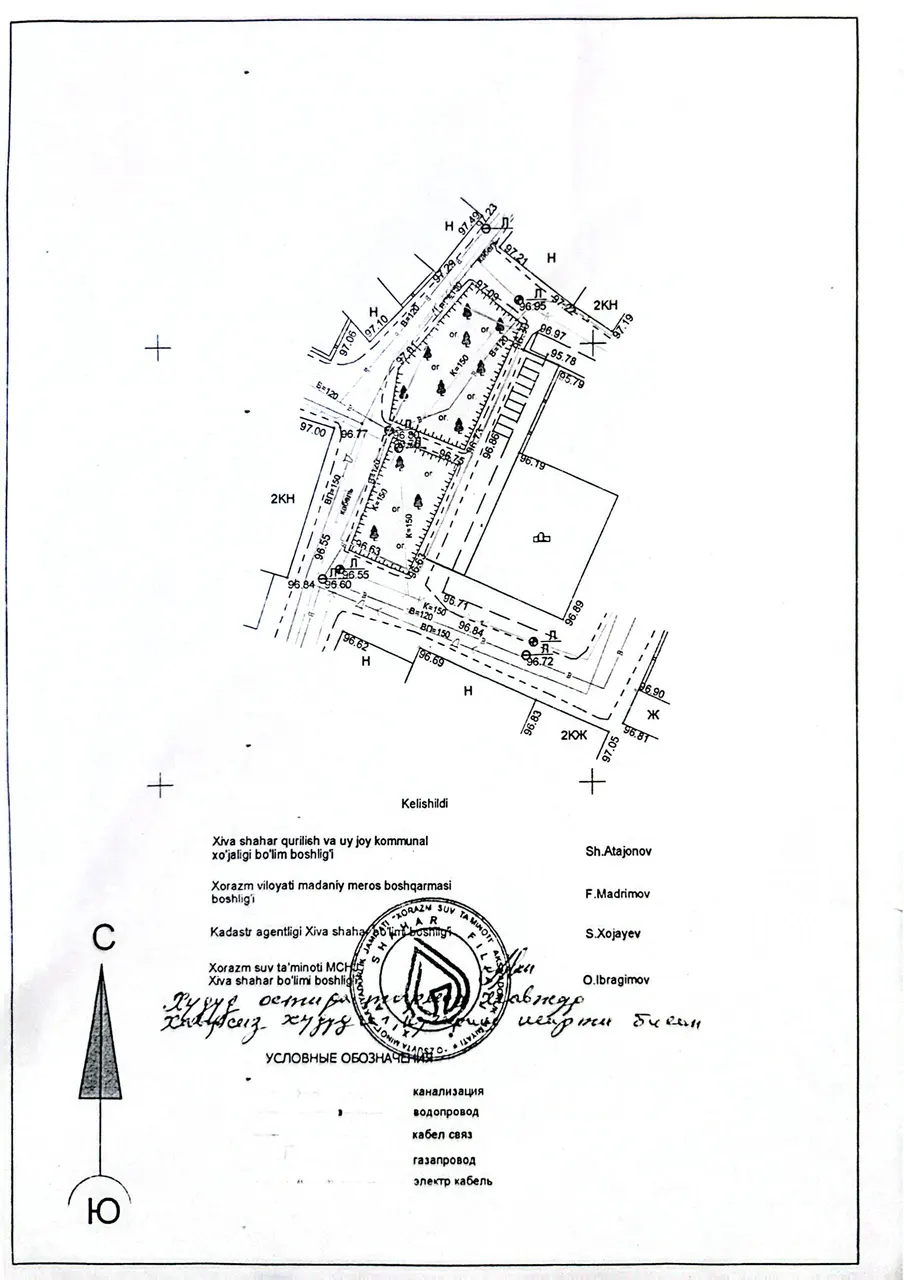
If this organization truly did not raise objections, this situation also requires a legal explanation.
What does Effect.uz mean to say?
The purpose of this investigation is not to accuse any state agency. The editorial office does not possess such authority.
However, the duty of the editorial office is to raise questions that are important to the public and to hear the official stances of all parties.
In this case, too, the main questions remain unanswered.
If:
the 2001 hokim's decision exists;
the archive has confirmed this decision;
the court found the Cadastre's refusal to be unlawful;
the court decision has entered into legal force;
and the Bureau of Compulsory Enforcement has considered it executed...
Why does Ibragimov state that he has not achieved the result of the court decision to this day?
This question is important not only for this case, but for any citizen. Because when every person applies to court, their greatest hope is that the adopted decision will be fulfilled in practice.
Effect.uz awaits official responses
Regarding this situation, the editorial office will send official journalistic inquiries to:
the State Cadastres Chamber;
the Bureau of Compulsory Enforcement;
the Khiva city hokimiyat;
and, where necessary, other authorized state agencies.
All incoming responses will be published without edits.
CONCLUSION
This investigation began with an appeal by a citizen regarding a 300-square-meter land plot. However, as the documents were studied, it became clear that the matter is much broader. The main question here is not about who owns the land.
The main question is about what the enforcement of a legally binding court decision means in practice.
If the court decision was executed, where is its result? If it was not executed, what is the legal reason for this?
Answering these questions is important not only for the participants in this case, but for all state agencies ensuring the enforcement of court decisions.
A court decision can be discussed.
A court decision can be appealed.
A court decision can also be overturned in a higher instance.
However, failing to execute a legally binding court decision or the emergence of various interpretations regarding its enforcement naturally raises questions in the public mind.
Well...
Is there a decision stronger than a court ruling?
Author: Effect.uz investigative team