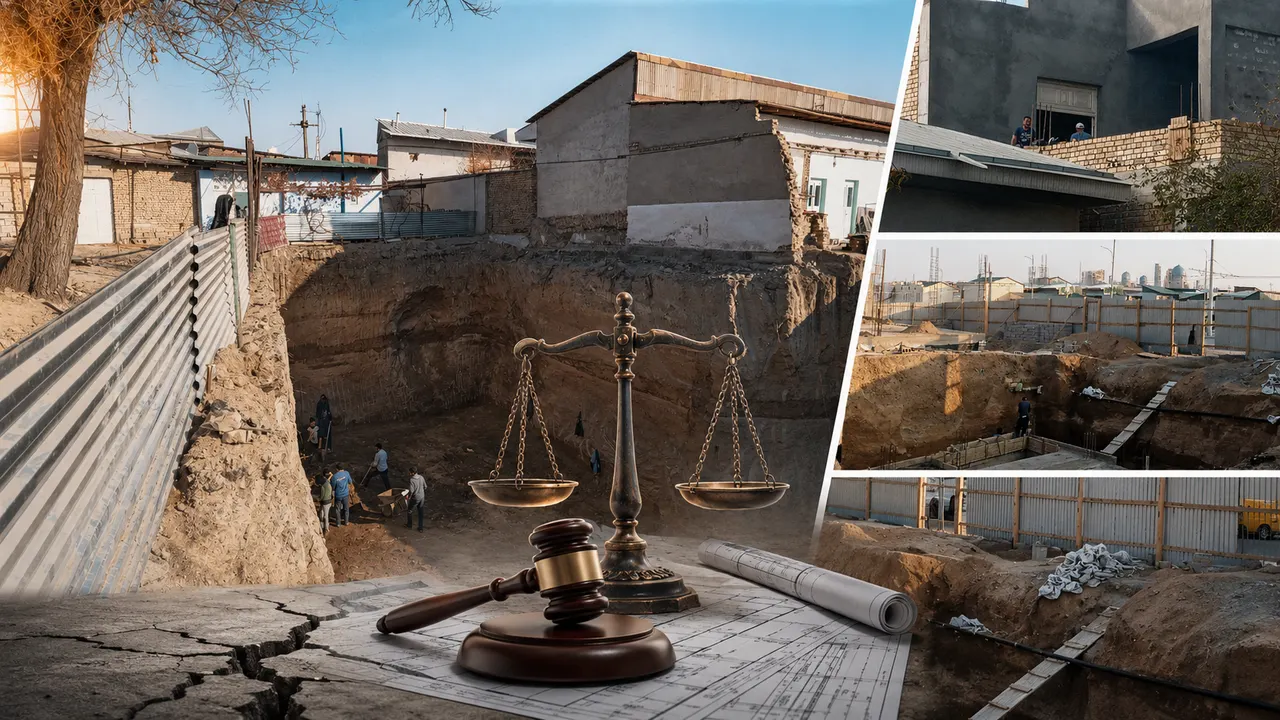
There is a method called investigative journalism. In this approach, the author studies a topic through personal experience, feeling the situation on their own skin.
Suppose illegal construction is rampant, the requirements of UCNP (Urban Construction Norms and Rules) are violated the most, and I intentionally buy a house in a neighborhood that is also a historical area of Samarkand, and then analyze it based on my inner observations — what of it?
However, in reality, I didn't buy my house to write an article. It is the place where I was born and raised. It is my neighborhood where my loved ones are by my side. We built our home with good intentions. Frankly, I never imagined that one day a business facility built by an entrepreneurial neighbor would turn my life upside down.
...Before I rushed back to Samarkand from Tashkent (I was working in Tashkent at the time), the entrepreneur at the address 85 Shohi Zinda Street (285 Rudaki Street) had already dug more than three meters deep. The distance left to our wall doesn't even measure a single step.
That day was November 8, 2021. The owners of the address did not have a single document related to construction! Mavluda Pulatova, who was over sixty and whose name was on the residential house where the business facility was being built, and her son Olim, the actual owner of the non-residential building under construction, insisted without backing down, "If we are digging, we are digging our own territory." They didn't have a single document regarding construction! Ozodjon Rahmatov from the Samarkand Regional Construction Administration and Farrux Xalilov, a specialist from the Samarkand City Construction Department, joined the entrepreneur, trying to convince us of some project that actually had nothing to do with this place. We didn't draw up papers, we talked about neighborliness. Although they bought the house in 2016, this was the first time I was seeing the homeowners. We asked them to quickly reinforce the precipice with concrete so that no damage would be done to our house.
On December 7, I returned to Samarkand again. By then, a gigantic trench had been dug even deeper, to nearly 10 meters. To make matters worse, this trench had been widened further towards our side, and the promise to cover up the precipice had not been kept. "This place is part of UNESCO's 'Afrosiyob' archaeological reserve area," was all I could say. "This time, go and complain to the prosecutor's office," said the person in charge. Apparently, it was Olim's father.
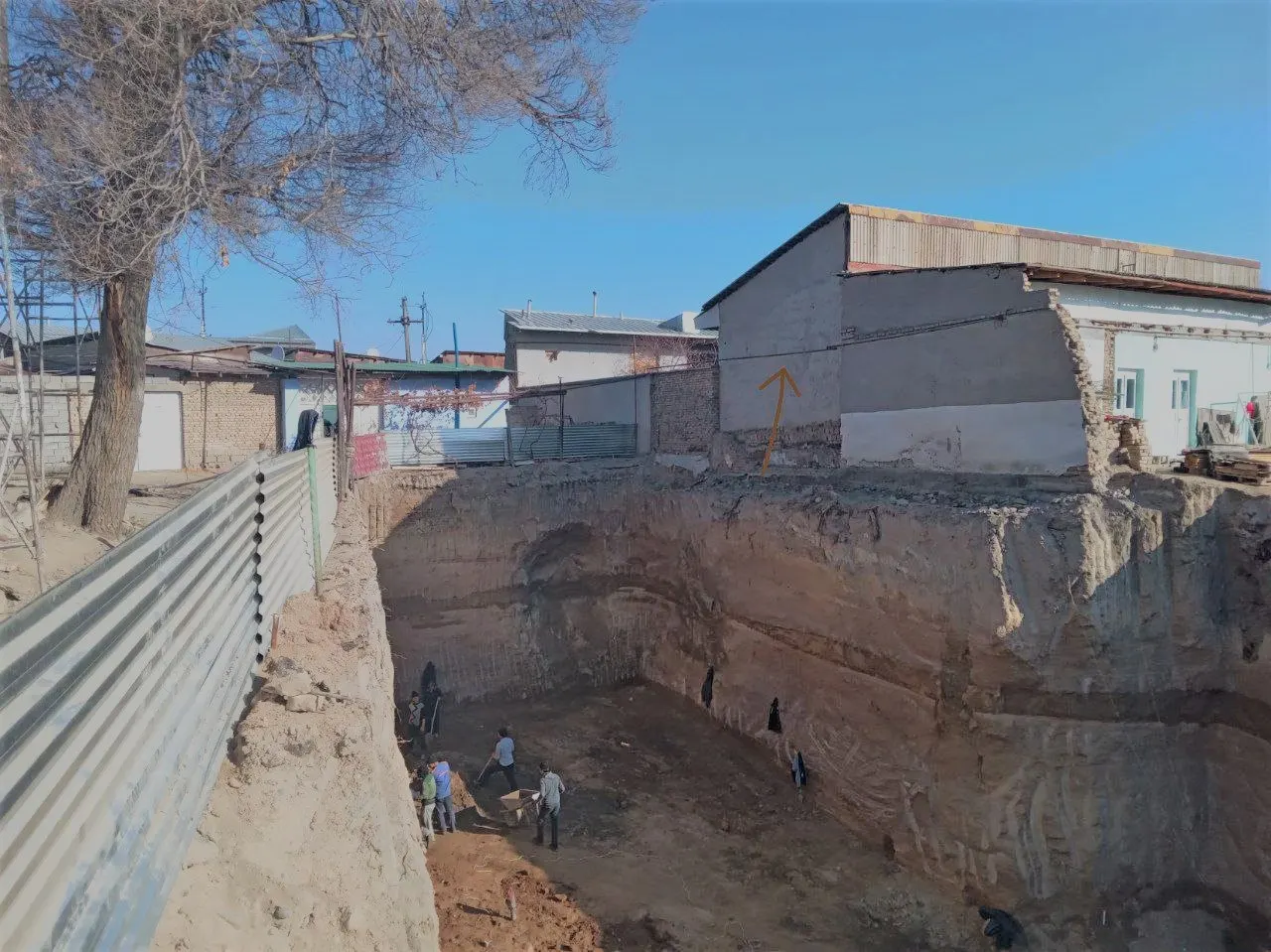
Luckily, our house did not collapse. Because it was single-story and sturdy. However, the first hair-thin cracks signaled deformation sooner or later, and to some extent. Error upon error, and code violation upon illegality, the construction of the business facility continued. As alarming situations arose, I appealed to various responsible organizations one after another. Dozens of agencies wrote back asserting that the business facility was being constructed in accordance with urban planning norms. Later on, they started advising me to go to court.
AM I SOMEONE WHO GETS PLEASURE FROM DEMOLISHING A NEIGHBOR'S HOUSE?
Not only were the cracks on the walls of our 120 sq. meter building increasing and widening, but cracks also appeared in the foundation, prompting me to file a lawsuit. I submitted a claim to the Civil Court of Samarkand City "to demolish the construction that caused damage to the neighbor in violation of UCNP norms, and to recover material and moral damages.
Demolishing a neighbor's construction sounds harsh, of course. I even asked myself. Am I someone who gets pleasure from demolishing a neighbor's house? No! When the lives of my family, my other neighbors (and perhaps those who will be in the built trade and consumer services house) are in danger, when about ten norms defined in the UCNP have been grossly violated and no opportunity is left to correct them, I considered the demand to demolish the building to be justified.
So, which norms of the UCNP (Urban Construction Norms and Rules) were violated in the construction at 85 Shohi Zinda Street, Samarkand?
1. Regarding asking for consent from neighbors, both the UCNP and Article 6 of the "Urban Planning Code" state the importance of obtaining written permission. However, permission was not obtained from the five surrounding neighbors.
2. According to the standard "Fire safety of buildings and structures" in UCNR 2.01.02-04, a distance of at least 6 meters must be maintained between category 2 buildings according to fire safety requirements. In practice, the distance between the non-residential and residential buildings is 40 cm. The huge two-story basement (4.5 and 3.5 m high) has no windows or ventilation system. It is also unclear what is stored in this basement of the business facility, which is a mere two spans away from my house, or what purpose it is used for. Given that the 1st floor is said to be a trade and consumer services house and there is no additional fire safety exit on the 2nd floor, living as a neighbor to such a building is alarming.
3. The distance between the business facility and utilities does not comply with the norm!
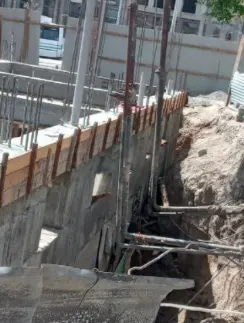
In UCNR 2.07.01-03, Chapter 7 and relevant clauses, the distance between a certain type of communication and an object must be at least 1.5-2 meters. In practice, at 85 Shohi Zinda Street, this indicator is around 20 cm. To make matters worse, gas, water, and electricity networks are all located side by side in the same direction. On a freezing winter day, we experienced a day when the two-story basement filled with gas, and through the basement, our house and the house of another neighbor, Matluba Mamatova, filled with carbon monoxide. Aside from the neighbor's chained dog being poisoned, the rest of us were saved by pure coincidence, it seems. The explosion that caused the death of 7 people in Samarkand on the night of May 8 to May 9, 2025, was the exact result of this very situation.
4. It is clearly visible that the business facility building at 85 Shohi Zinda Street fails to meet the requirements of the BCS (Building Codes and Regulations) in several instances. The dimensions of the building do not match standards. The building plan is in the shape of a truncated trapezoid, the sides are of disproportionate lengths, and it rises from its base in a hexagonal manner. Samarkand is considered a seismic zone of 8-9 points.
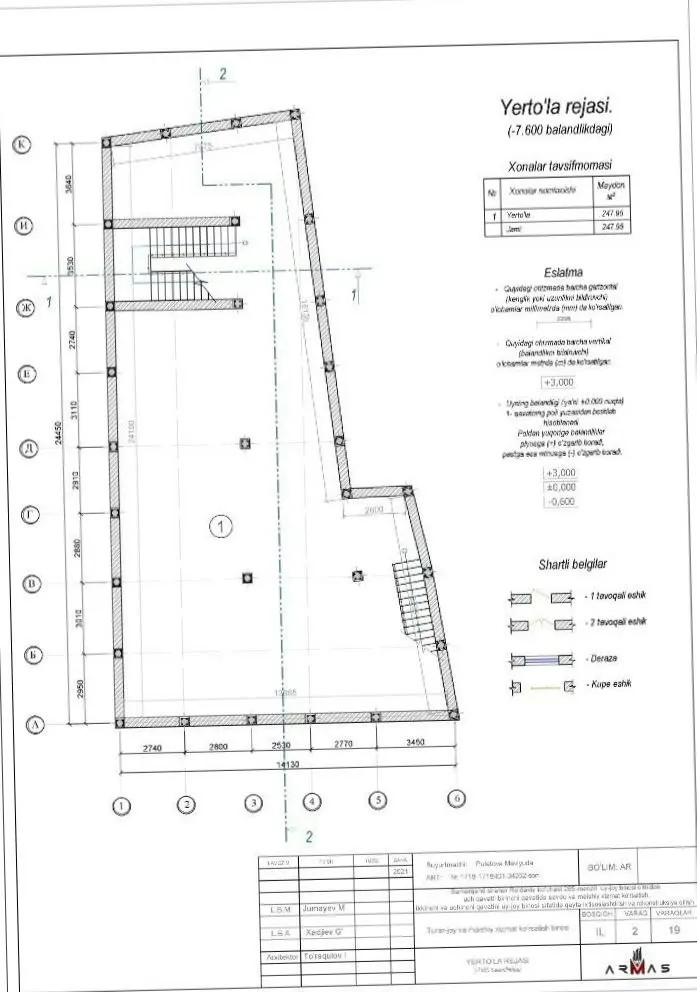
5. The footprint area has been unlawfully expanded. According to clauses 7.1, 7.3–7.6 of UCNR 2.07.01-03*, construction is allowed only on a part of the land plot. (On no more than 30 percent of a residential plot, and around 30-60 percent for non-residential areas).
In practice, leaving no green areas or paving on the plot, 100 percent of the 320 sq. meter plot has been occupied by construction. If the norm had been followed, there would have been no construction on the slope adjoining us.
6. Privacy from neighboring plots has not been ensured. Clauses 7.8–7.9 of UCNR 2.07.01-03 stipulate that the windows of living rooms in residential buildings must not directly face the windows of living rooms in other buildings, which is ensured through minimum distances between buildings.
On the second floor of the business facility, at a distance of 40 cm, an open balcony-area was installed, along with a gate providing access to the 2nd-floor building. Instead of windows, this created an opportunity to freely observe every movement in our courtyard and rooms at any time.
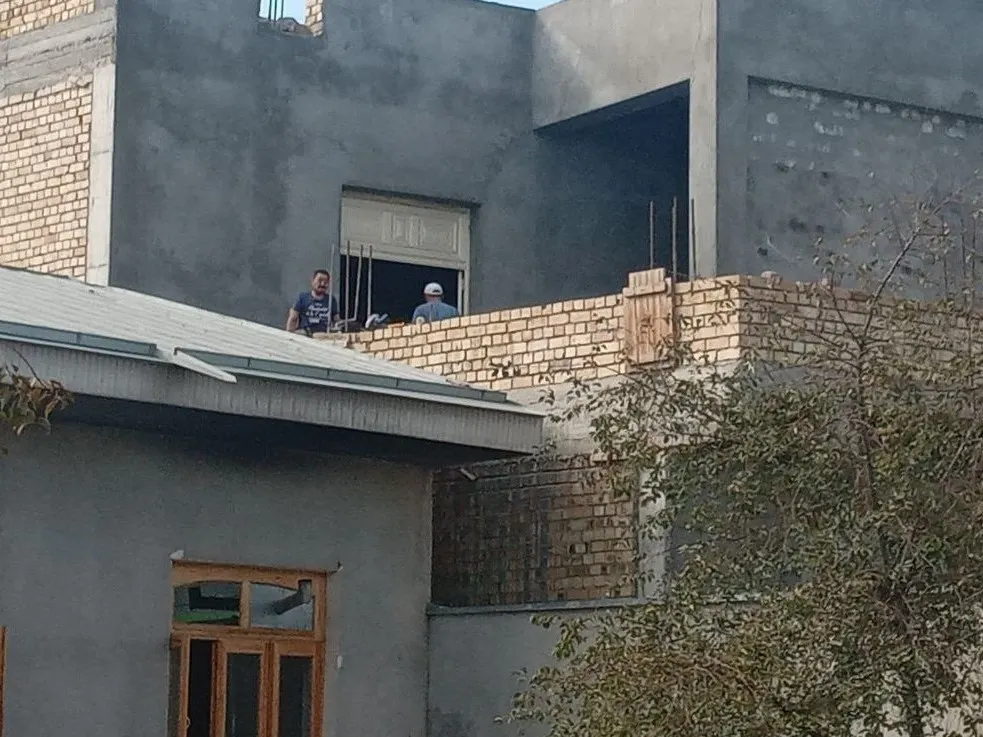
7. Permission was not obtained from the Cultural Heritage Agency in the UNESCO-listed area.
UCNR 2.07.01‑03* contains a separate clause regarding construction in cultural heritage areas. Permission had to be obtained from the relevant organizations. But would those organizations have allowed digging about 10 meters deep anyway? Shouldn't every handful of soil removed by the huge buckets of an excavator from the territory of the "Afrosiyob" archaeological reserve, INCLUDED IN THE UNESCO WORLD HERITAGE LIST, actually have been brushed and studied with a delicate brush?
A depth of 10 meters is probably a layer from 10 centuries. Moreover, this place is directly adjacent to the Timurid-era part of the "Afrosiyob" reserve. The object is in the cultural heritage corridor of the Hazrati Khizr Mosque, a mere 500-600 meters away from it. The architectural monuments of Shohi Zinda and Bibi-Khanum are similarly close.
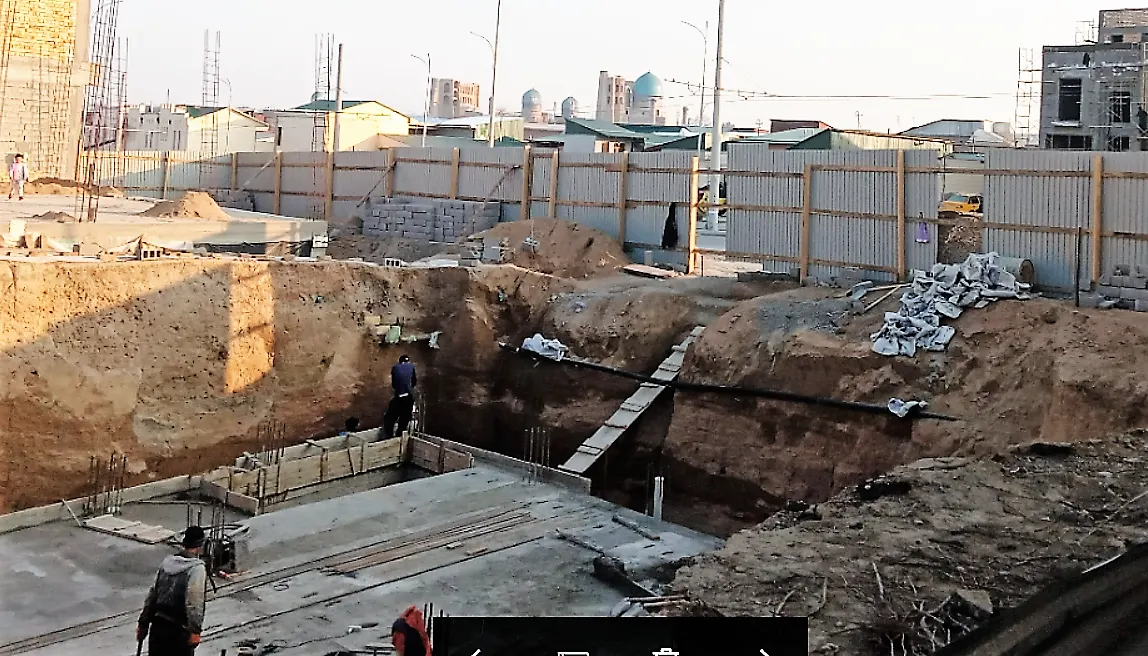
8. Underground voids will eventually make themselves felt.
The biggest root cause of the problem is that the space behind the basement wall and the cliff created by the excavation was left as a void without being filled with gravel and compacted, and was covered up in that exact state. Due to this very condition, soil erosion under our house started from about 10 meters below and continues to erode.
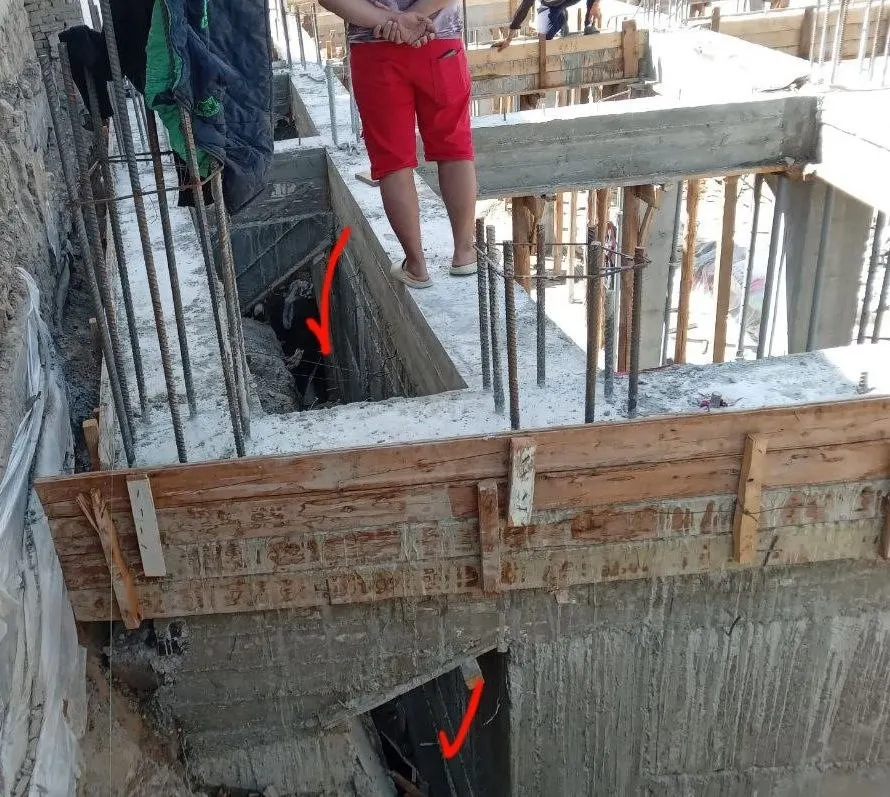
9. Hidden space. When looking from inside the business facility, an additional wall was erected to create the impression that the building was constructed maintaining a distance of about 1.5 meters from the neighbors. The enclosed area between the inner and outer walls, shaped like an elongated corridor — a hidden room without any vents or air holes — is alarming for the sanitary-epidemiological situation.
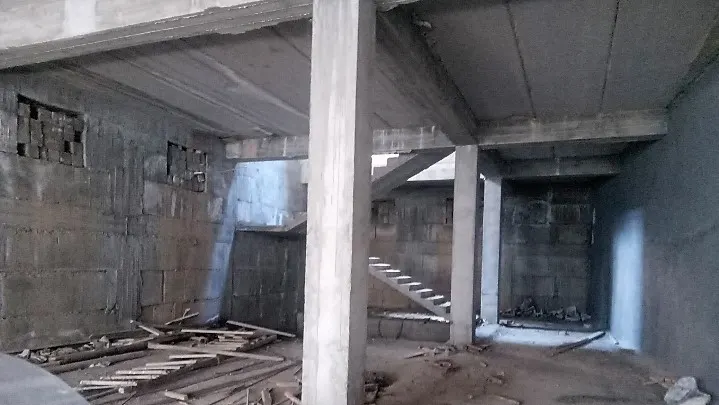
10. The western and northern walls of the basement are not monolithic; they were raised using one-and-a-half-meter concrete blocks (!)
WHY WAS MY CLAIM REJECTED IN SAMARKAND?
The civil court trial began in June 2024. Judge Aziza Ismatova. In court, a number of documents were attached stating that the business facility belonging to the respondent at 85 Shohi Zinda Street was constructed in accordance with urban planning norms. Neither the "Permit for the reconstruction of the object" No. 1718401-26549 dated 18.12.2021, nor the "Architectural and Planning Assignment (APA)" No. 1718-1718401-34262 dated 22.12.2021, nor the "Conclusion of the working body of the Architecture and Urban Planning Council on the coordination of design estimates" No. 45127 dated 28.05.2022, nor the "Project Expertise Conclusion" MENTIONS DIGGING A HUGE BASEMENT with a volume of approximately 3000 cubic meters in the territory of UNESCO's "Afrosiyob" archaeological reserve! Therefore, it was repeatedly stated during the court trial that the Project itself is illegal.
We hoped that the court construction expertise would find a precise answer to the discrepancy between the trial materials and the actual situation.
The court construction-technical expertise was conducted by the Samarkand-based non-governmental LLC "INVEST EXPERT PRO". On December 24, 2024, they came to our house at 11 Samarkand Street, inspected it, measured it, and used laser equipment. When I received the expertise conclusion dated January 3, 2025, I was astonished...
The expertise was biased and suspicious. They seemingly failed to see the 6-7 cm settlements in the rooms (which today have dropped by almost twofold), and no answer was given as to why these settlements lean specifically towards the respondent's object when drawing a perpendicular line.
"As a result of detailed inspections, no defects and deformations were detected," the report stated. The cracks on the wall were explained as being "due to the lack of heating equipment installed in the rooms." On the day the expertise organization team visited our house, the stove was turned on both in the room closest to the business facility that suffered the most damage, and in the middle room. Only the large living room at the very end had its heating system temporarily turned off because there was no need for it.
Moisture, yes, precisely moisture, is the absolute reason causing our house to settle! However, the expertise conclusion did not say a single word about the dampness appearing on the wall between the two plots after the entrepreneur's construction, which in some places reaches human height!
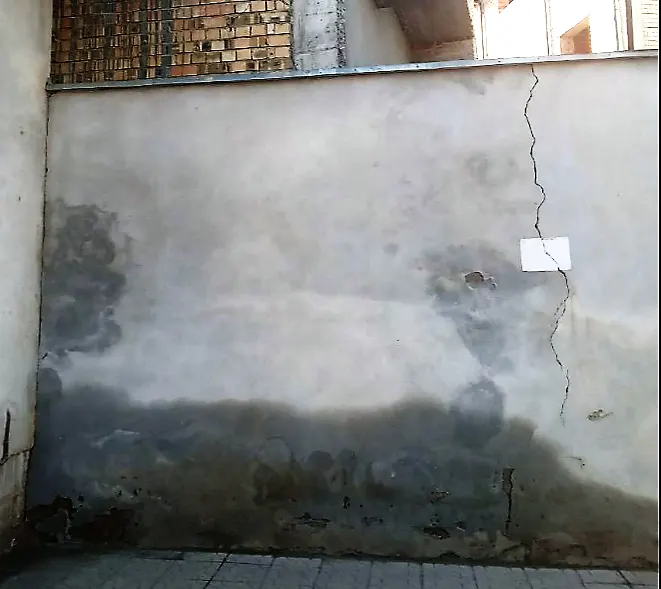
They did not answer the question of whether the condition of the courtyard wall adjoining the entrepreneurial neighbor could be caused by the fact that a basement was excavated nearly 10 meters deep right behind the wall, that it was excavated at a 90-degree angle, that the cliff wall was not reinforced with concrete, and to make matters worse, the space between the foundation wall and the "cliff" created by the excavation was left empty and porous without being filled with gravel (concrete or soil) and compacted before being covered up. Or is water seeping under the buildings as a result of the ditch where sewage from several households flowed being buried right during the respondent's construction? Since the conclusion of the Samarkand Regional Ecology Department states that groundwater emerges from 10 meters below, the question also arose whether this moisture is from groundwater. Unfortunately, these questions remained open.
Considering that the continuation of this wall consists of rooms, you can imagine the exact same picture under the floor of the rooms reached by five steps. Starting this year, a peculiar smell of moisture also appeared...
In the expertise conclusion, describing that the spaces between the raw bricks were exposed as a result of cracking (moreover, the expert even dug the wall himself with a tool resembling a pointed rebar the length of a skewer), it was described as "bricks laid without filling the gaps." If they had gently uncovered an uncracked part of the wall as well, they would have seen how the bricks were actually laid. The expertise conclusion of "INVEST EXPERT PRO" did not mention foundation cracks at all! However, the phrase "concrete work was performed incorrectly" was added to the conclusion. Without taking a concrete sample or studying its composition, how can one know whether concrete work was performed correctly or not?
In short, the expertise closed the case with the calculation that compensating our house with six and a half million sums would be sufficient. The team of Invest Pro LLC did not even step foot into the respondent's building. Is it possible to determine whether this construction affected the neighboring building without researching the condition of the business facility? The conclusion stated that the distance between the residential and non-residential buildings is 40 cm, but did not note that this situation fails to meet fire safety requirements. They photographed the obvious violation of the clear-sight requirement, but did not show it in the conclusion...
In the final decision, the rejection of my claim was mainly based on the conclusion of Invest Pro LLC. We paid 8,500,000 soums to "Invest Pro LLC" to conduct the construction-technical expertise.
Why did I apply to "Invest Pro" LLC?
Back in summer (on August 20), I had submitted my cadastral documents to the court so that the Samarkand regional branch of the Republican Forensic Examination Center named after Khadija Sulaymonova could conduct the construction-technical expertise. Exactly one month later, on September 20, the court sent a ruling to this effect to the Samarkand branch of the RFEC. It turns out the regional branch of the RFEC sent a petition on September 23 requesting the submission of several other documents as well.
This letter sent via e-mail disappeared in court (!) A. Djurayev, the head of the Samarkand regional branch of the RFEC, issued a letter regarding this and wrote, "Prior to October 23, 2024, the above-mentioned petition of the court expert was not fully satisfied by the court." (Court compilation, page 87). With similar situations, October and November passed, and as December was ending, they said that things would go faster with a non-governmental expertise. I must have been foolish to listen to that advice...
Just when I thought the court of first instance proceedings were completely over, another twist emerged. After the court issued its decision on February 12, 2025, the presiding judge, in violation of the norms of the Civil Procedure Code of the Republic of Uzbekistan, sent a summons for the court session scheduled for March 5, 2025, at 12:30, to discuss the application "COMMENTS on the civil case record" submitted by the respondent's representative Sh. Shirinov on February 26, 2025. Naturally, I did not go. (The issue at the session is a separate topic).
Appellate Instance
During the appellate stage, the judicial panel was changed 3 times without the consent or desire of the claimant or the respondent.
On April 1, the first session of the appellate stage was chaired by the panel led by N. Rahmonova (G. Vohidov, Sh. Toshpolatov). Despite the respondent party failing to appear, they asked me for details. Clarifications were made regarding the photographs.
On April 10, unexpectedly, a new panel introduced themselves: G. Esanova, F. Anarov, A. Asqarov. Meanwhile, the representatives of the respondent party expressed surprise, stating they were unaware of the session on April 1.
That very day, we submitted two petitions to the court: "On appointing a complex court expertise in the fields of construction-technical and engineering" and "On clarifying whether the controversial construction address is located in a reserve or buffer (defense) zone included in the UNESCO World Heritage List." However, these petitions were groundlessly dismissed. Although during the circuit session (April 23) they saw the settlements, cracks, and deformations in our house with their own eyes, and listened when we pointed out the inaccuracies in the documents, nothing about what they witnessed was recorded in any document.
On June 3, when we arrived in response to the summons, yet another new panel! The Esanova trio, who had been studying the case for nearly 2 months, went on annual leave starting June 2. The new panel chaired by Judge O. Temirov issued a ruling right during that very session, without even a thirty-minute delay.
Even though our main objection in appealing to the appellate court was that the initial expertise was biased, expert A. Shirov read out the very same conclusion that served as the basis for the first instance decision once again, and based solely on the expert's word, without examining a single document in the court materials, the court issued a final ruling right on the spot.
Meanwhile, Article 18 of the Civil Procedure Code of the Republic of Uzbekistan states that a case whose hearing has begun by a single judge or judicial panel must be completed by that same judge or judicial panel, and if it is impossible to hear the case on time due to a judge's absence, ... after replacing the judge, the hearing of the case must start from the beginning.
Worst of all, they interrupted the female lawyer just as she started speaking during the debates and went inside to deliberate.
Cassation Stage
We submitted a petition to the cassation instance as a primary issue to re-examine the controversial buildings through a state court construction complex expertise. After the respondent party stated in the cassation court session that they were against a re-expertise (!), the panel brushed the expertise issue aside and issued a ruling based on another aspect, yet another groundless aspect.
Namely, regarding the single-story house built on our own plot in 2009-2011, they argued that "...housing built on land plots not allocated for construction purposes in the manner established by legislation (Here and throughout the quote, the emphasis is ours — M.T.) is considered an unauthorized structure. This person does not have the right to dispose of the structure they built — to sell it, gift it, lease it, or conclude other transactions regarding the structure," thereby instructing that I allegedly have no right to file a claim, and furthermore indicating that our house must be demolished by court decision.
The cassation panel (Presiding T. Qurbonov, panel members F. Karimov and X. Abdiyev) provided no evidence to call a courtyard-housing where people have lived for decades (perhaps hundreds) an "unallocated land plot for construction." True, in our cadastral documents, the construction of our damaged building is registered as an unfinished building. There is no provision in the legislation of Uzbekistan stating that when a cadastre is semi-formalized, the property owner "has no rights regarding the building on their territory." Even in the absence of a right of ownership, I have the right to protect my property rights.
The house which the regional court's cassation panel emphasized "has no right to be sold, gifted, leased, or have other transactions concluded regarding the structure" was gifted to me by my younger brother and registered with the state on that basis. This very document was repeatedly attached in the court compilation.
It turns out that the claim regarding my lack of right to sue arose behind a false certificate issued by Sh. Talimov, the head of the Samarkand city branch of the Cadastre Agency.
DOCUMENTS, DOCUMENTS...
Documentary evidence is important in court. At first glance, all documents related to the respondent's construction seem to be in order. But...
Let's start from the beginning. On December 18, 2021, when Mavluda Pulatova was issued a "Permit for the reconstruction of the object" to demolish her residential house at 285 Rudaki Street and replace it with a trade, consumer services, and residential building, a giant trench had already been dug. The permit makes no mention of a huge basement in the area of UNESCO's archaeological reserve.
How appropriate is the term reconstruction when the address is being fully demolished and rebuilt from scratch? The permit indicates the plot area as 421.27 sq. m. However, subsequent technical inspections reveal that the total area of the plot is around 320-330 sq. m. This construction was registered as residential in the permit.
The text of the Architectural and Planning Assignment (APA) dated December 22, 2021, mentions UCNP norms regarding asking permission from neighbors, fire safety, creating a green area on the plot, epidemiological conditions, etc. However, the drawing attached to the document shows that 100 percent of the plot is occupied by construction. That is, the drawing reflects a situation where not even a single tree was left space to be planted, and the distance required by fire safety was not taken into account. The stamp under the drawing states that it was agreed upon on November 21, 2021. The question arises: what was agreed upon when the permit had not yet been obtained (the permit was issued on December 18) and the APA had not been prepared? Another aspect is that the document shows the name of the previous owner of the address, who had passed away long ago, as the customer. And the location was incorrectly indicated as being far away from the cultural monument.
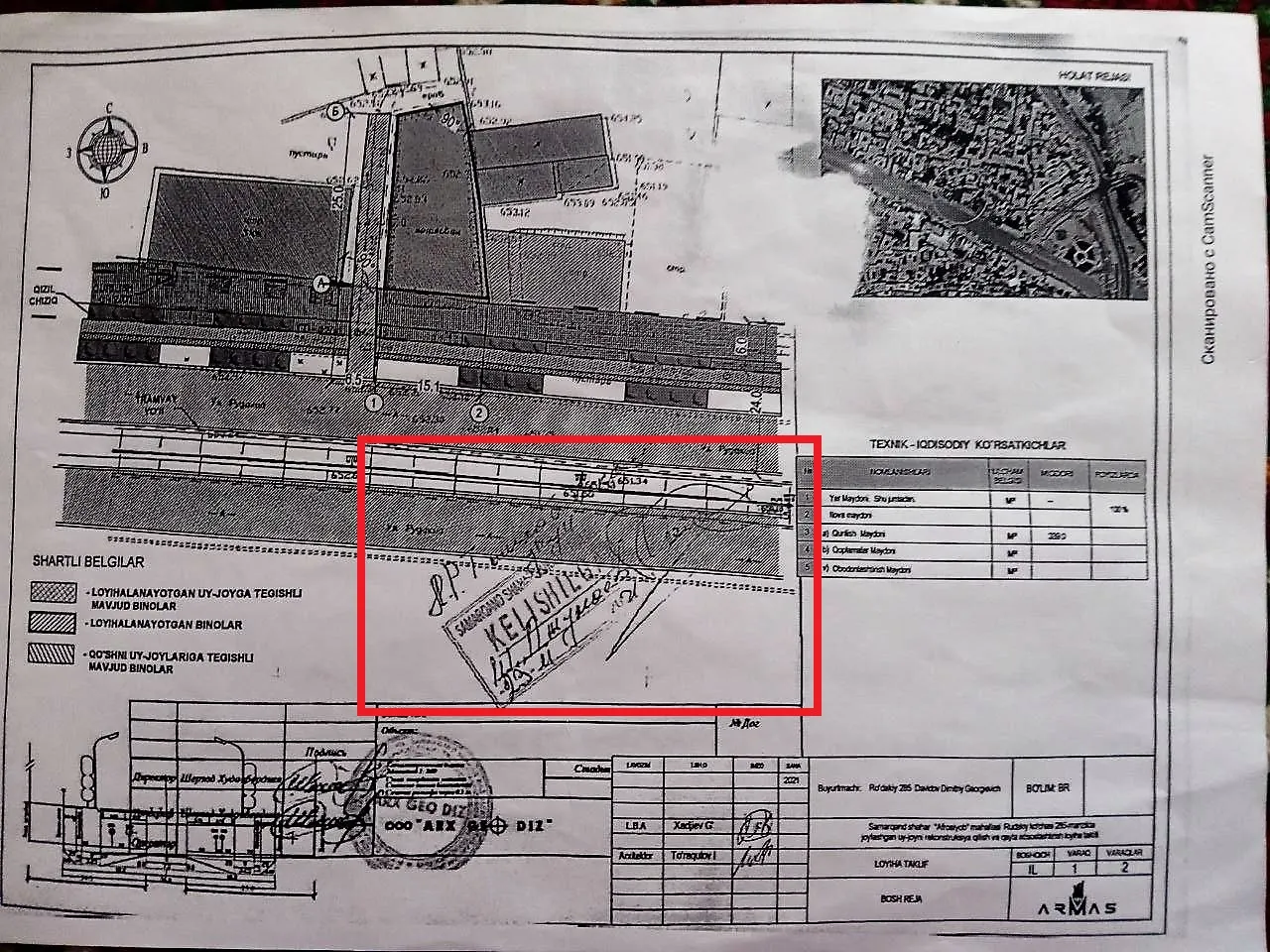
When the conclusion of the working body of the Architecture and Urban Planning Council on the coordination of design-estimate documents was issued on May 28, 2022, the structure was already finished... You see, construction was moving forward, not documents. (By the way, this document also has a stamp showing it was agreed upon on 21.11.2021, with the above page attached).
In the court documents, the Project's expert conclusion is recorded as having been conducted twice: on June 8, 2022 (No. 06/06-2022) and on May 5, 2023, and was submitted as two separate documents in the court materials. Even without this, the 2022 Project expert conclusion had been formalized after the building was completed. What is the purpose of re-examining the project of a completed structure a year later (or creating a new document claiming it was examined)? Whereas, according to the regulations of the Cabinet of Ministers Resolution No. 200 on construction, project expertise is conducted only once.
Meanwhile, on the my.gov.uz platform, these two documents with the same name regarding the address at 85 Shohi Zinda Street are indicated as being the exact same thing.
What is the difference between two documents with the same name?
The 2023 Project Expert Conclusion mentions a two-story basement, which was not mentioned in the previous one. Although its volume of around 3000 cubic meters and its intended purpose were not written, for the first time it was recorded as consisting of "2 floors of basement and 2 floors above." A number of organizations, including D. Adilov, Deputy Minister of Construction and Housing-Communal Services of the Republic of Uzbekistan, in his reply letter dated November 2023, make no mention of the repeated project expertise allegedly conducted in May of that year.
While construction was already completed in May 2023, and the object was allegedly registered by the regional inspection for control in the sphere of construction and housing-communal services of the Samarkand region, D. Adilov in the above-mentioned letter does not write that it was registered, but emphasizes that "since the construction object carried out by citizen Pulatova Mavluda is carrying out construction and installation work without being registered with the inspection in the established manner, the inspection issued a warning and a written instruction to stop construction and installation work..."
Regarding the 2023 project expertise, Shuhrat Jumayev, head of the Samarkand city construction and housing-communal services department, responds as if it did not exist in one of two certificates with the identical request: from the certificate dated June 19, 2024: "According to the approved design-estimate documents, the expertise conclusion was obtained on June 8, 2022." However, a week before the issuance of the decision, in his certificate dated February 4, 2025, he writes that the expertise conclusion No. 06/06-2022 was obtained from "Urban Planning Project Expertise" LLC on May 5, 2023.
The 2023 Project Expert Conclusion also mentions another document that was never mentioned before and does not appear in other documents — a geological conclusion conducted by the laboratory of the Samarkand branch of "UZGAZGASHKLITI" SUE.
The geological conclusion conducted by the laboratory of the Samarkand branch of "UZGAZGASHKLITI" SUE, which was absent in the first of the two aforementioned certificates signed by Jumayev, suddenly appears in the subsequent one.
Among the court materials, the 10-page document said to have been conducted in the laboratory of the Samarkand branch of "UZGAZGASHKLITI" SUE lacks a date and a stamp. The geological expertise talks about a 3-story building above ground, but does not mention the two-story basement (!). If no basement is excavated, why is a geological conclusion needed? How did a construction drawing prepared nearly 2 months after the excavation appear in geological survey documents conducted before excavation work began? The URB-2.5 equipment said to have been used in conducting research at 85 "Shohi Zinda" Street is quite large in volume. Because the access road into the area where several households live was narrowed precisely by the entrepreneurs, it is impossible for the URB-2.5 equipment to enter this street. Neighbors live at the points indicated as having been sampled, and they deny that anyone came to their homes for such research. The research said to have been conducted in the laboratory of the Samarkand branch of "UZGAZGASHKLITI" SUE was actually never carried out; it appeared following questions raised about geological expertise during the court trial.
This exact "document" said to have been conducted in the laboratory of the Samarkand branch of "UZGAZGASHKLITI" SUE was taken as a basis by the court in its Decision and by Invest Pro LLC, which conducted the construction-technical expertise, in its conclusion.
Several other documents among the court materials are undated. In particular, the conclusion based on a 2020 (!) document approved by the signature of Gayrat Khodjayev, director of "ARMAS" LLC, who prepared the project, was involved in the construction of the business facility, and consequently was a leading figure in the circumstances of the court trial (page 77); the certificate signed by Sh. Oʻktamov, a specialist of the regional inspection for control in the sphere of construction and housing-communal services of the Samarkand region (page 188); the document signed by Sattarov from that same organization; and the Conclusion approved by S. Khojamov, a junior researcher at the Institute of Archaeology named after Yahyo Gulomov, lack dates. The absence of a date, which is one of the mandatory requisites, raises justified questions about the evidentiary value of the document.
Even when some documents have dates, false information and numbers were used.
In the certificate issued by Sh. Talimov, head of the Samarkand city branch of the Cadastre Agency, a few days before the issuance of the Decision, it is stated that "it became known that today this residential building of the claimant has been completely demolished and rebuilt." The implication is that the building we say is damaged — the one finished in 2011 — is different, and that we demolished it before 2021 and rebuilt a building of the exact same size and shape. Talimov's certificate implied that we have no right to sue regarding the damaged building. The regional civil cassation panel rejected my claim despite the fact that I have a cadastre for my courtyard as a right of ownership and an unfinished building.
It turns out that the narrative about my lack of right to sue arose behind the false certificate issued by Sh. Talimov, the head of the Samarkand city branch of the Cadastre Agency.
DOCUMENTS, DOCUMENTS...
Evidence documents are important in court. At first glance, all documents related to the respondent's construction seem to be in order. But...
Let's start from the beginning. On December 18, 2021, when Mavluda Pulatova was issued a "Permit to reconstruct the object" to demolish her residential house at 285 Rudaki Street and replace it with a trade, consumer services, and residential building, a giant trench had already been dug. The permit does not mention a huge basement in the area of the UNESCO archaeological reserve.
How appropriate is the term reconstruction when the address is being fully demolished and rebuilt? The permit indicates the plot area as 421.27 sq. m. However, subsequent technical inspections reveal that the total area of the plot is around 320-330 sq. m. This construction was registered as a residential house in the permit.
The text in the Architectural Planning Assignment dated December 22, 2021, mentions UCNP norms regarding asking permission from neighbors, fire safety, creating a green area on the plot, epidemiological conditions, etc. However, the drawing attached to the document shows that 100 percent of the plot is occupied by construction. That is, the drawing reflects a situation where not even a single tree was left space to be planted, and the distance required by fire safety was not taken into account. The stamp under the drawing states that it was agreed upon on November 21, 2021. The question arises: what was agreed upon when the permit had not yet been obtained (the permit was issued on December 18) and the APA had not been prepared? Another aspect is that the document shows the name of the previous owner of the address, who had passed away long ago, as the customer. And the location was incorrectly indicated as being far away from the cultural monument.
When the conclusion of the working body of the Architecture and Urban Planning Council on the coordination of design and estimate documents was issued on May 28, 2022, the structure was already finished... You see, construction was moving forward, not documents. (By the way, this document also has a stamp showing it was agreed upon on 21.11.2021, with the above page attached).
In court documents, the Project's expert conclusion is recorded as having been conducted twice, on June 8, 2022 (No. 06/06-2022) and on May 5, 2023, and was submitted as two separate documents in the court materials. Even without this, the 2022 Project expert conclusion had been formalized after the building was completed. What is the purpose of re-examining the project of a completed structure a year later (or creating a new document claiming it was examined)? Whereas, according to the regulations of the Cabinet of Ministers Resolution No. 200 on construction, project expertise is conducted only once.
Meanwhile, on the my.gov.uz platform, these two documents with the same name regarding the address at 85 Shohi Zinda Street are indicated as being the exact same thing.
What is the difference between two documents with the same name?
The 2023 Project Expert Conclusion mentions a two-story basement that was not mentioned in the previous one. Although its volume of around 3000 cubic meters and its intended purpose were not written, for the first time it was recorded as consisting of "2 floors of basement and 2 floors above." A number of organizations, including D. Adilov, Deputy Minister of Construction and Housing-Communal Services of the Republic of Uzbekistan, in his reply letter dated November 2023, make no mention of the repeated project expertise allegedly conducted in May of that year.
While construction was already completed in May 2023, and the object was allegedly registered by the regional inspection for control in the sphere of construction and housing-communal services of the Samarkand region, D. Adilov in the above-mentioned letter does not write that it was registered, but emphasizes that "since the construction object carried out by citizen Pulatova Mavluda is carrying out construction and installation work without being registered with the inspection in the established manner, the inspection issued a warning and a written instruction to stop construction and installation work..."
Regarding the 2023 project expertise, Shuhrat Jumayev, head of the Samarkand city construction and housing-communal services department, responds as if it did not exist in one of two certificates with the identical request: from the certificate dated June 19, 2024: "According to the approved design-estimate documents, the expertise conclusion was obtained on June 8, 2022." However, a week before the issuance of the decision, in his certificate dated February 4, 2025, he writes that the expertise conclusion No. 06/06-2022 was obtained from "Urban Planning Project Expertise" LLC on May 5, 2023.
The 2023 Project Expert Conclusion also mentions another document that was never mentioned before and does not appear in other documents — a geological conclusion conducted by the laboratory of the Samarkand branch of "UZGAZGASHKLITI" SUE.
The geological conclusion conducted by the laboratory of the Samarkand branch of "UZGAZGASHKLITI" SUE, which was absent in the first of the two aforementioned certificates signed by Jumayev, suddenly appears in the subsequent one.
Among the court materials, the 10-page document said to have been conducted in the laboratory of the Samarkand branch of "UZGAZGASHKLITI" SUE lacks a date and a stamp. The geological expertise talks about a 3-story building above ground, but does not mention the two-story basement (!). If no basement is excavated, why is a geological conclusion needed? How did a construction drawing prepared nearly 2 months after the excavation appear in geological survey documents conducted before excavation work began? The URB-2.5 equipment said to have been used in conducting research at 85 Shohi Zinda Street is quite large in volume. Because the access road into the area where several households live was narrowed precisely by the entrepreneurs, it is impossible for the URB-2.5 equipment to enter this street. Neighbors live at the points indicated as having been sampled, and they deny that anyone came to their homes for such research. The research said to have been conducted in the laboratory of the Samarkand branch of "UZGAZGASHKLITI" SUE was actually never carried out; it appeared following questions raised about geological expertise during the court trial.
This exact "document" said to have been conducted in the laboratory of the Samarkand branch of "UZGAZGASHKLITI" SUE was taken as a basis by the court in its Decision and by Invest Pro LLC, which conducted the construction-technical expertise, in its conclusion.
Several other documents among the court materials are undated. In particular, the conclusion based on a 2020 (!) document approved by the signature of Gayrat Khodjayev, director of "ARMAS" LLC, who prepared the project, was involved in the construction of the business facility, and consequently was a leading figure in the circumstances of the court trial (page 77); the certificate signed by Sh. Oʻktamov, a specialist of the regional inspection for control in the sphere of construction and housing-communal services of the Samarkand region (page 188); the document signed by Sattarov from that same organization; and the Conclusion approved by S. Khojamov, a junior researcher at the Institute of Archaeology named after Yahyo Gulomov, lack dates. The absence of a date, which is one of the mandatory requisites, raises justified questions about the evidentiary value of the document.
Even when some documents have dates, false information and numbers were used.
In the certificate issued by Sh. Talimov, head of the Samarkand city branch of the Cadastre Agency, a few days before the issuance of the Decision, it is stated that "it became known that today this residential building of the claimant has been completely demolished and rebuilt." The implication is that the building we say is damaged — the one finished in 2011 — is different, and that we demolished it before 2021 and rebuilt a building of the exact same size and shape. Talimov's certificate implied that we have no right to sue regarding the damaged building. The regional civil cassation panel rejected my claim despite the fact that I have a cadastre for my courtyard as a right of ownership and an unfinished building.
Talimov's certificate also altered a number of figures in favor of Pulatova regarding the respondent's property. Regarding the respondent's house purchased in 2016, it was indicated that "according to the purchase and sale agreement, the footprint area is 182.63 sq. m." To reinforce this idea, additional rooms were "added" to the drawing. However, the number 182.63 does not appear in either the respondent's purchase and sale agreement or their cadastre passport.
182.63 SQ. M. IS ACTUALLY THE CONSTRUCTION AREA INDICATED IN THE BUSINESS FACILITY RECONSTRUCTION PERMIT!
It was repeatedly emphasized in the courtroom that the area of the business facility should actually be 182.63 sq. m., and if the footprint area of the business facility had been 182.63 sq. m. as indicated in the permit, the entrepreneur's building would not have reached the boundary of our house... Meanwhile, the cadastre document and drawing indicating on which part of the plot the respondent's building should be located were not submitted to the court.
After the regional cassation stage of the court, I submitted an application addressed to the leadership of the Samarkand Regional Department of the Cadastre Agency regarding Talimov's certificate. No one could object to my application. However, my application was handed over for review to Talimov himself (!)
He wrote that clarifying cadastre information for the specified addresses falls under the competence of the Cadastre Chamber department, not the Cadastre Agency. Then why did Judge Ismatova send the petition specifically to the agency? Since he had no jurisdiction, why didn't Talimov transfer the letter to the city department of the Cadastre Chamber working in the same building? Where did he get the number 182.63 belonging to the newly constructed building, and why did he mix it in?
There is no conclusion from the Fire Safety Department among the court documents! The pages referred to as "The 2023 Urban Planning Project Expertise Conclusion" state that "The project has been coordinated with the regional fire prevention control service," but such coordination has not been submitted. Clause 3.5 of this exact document is dedicated to fire safety. According to it,
- The road surface is concrete and suitable for fire engines.
- The project provides for a security and fire alarm system.
However, the requirement of the relevant clause of the UCNP stating that a distance of at least 6 meters must be maintained between category 2 buildings was not recalled. Moreover, God forbid, in the event of a fire (resulting in an explosion or other incidents), a fire safety vehicle cannot even enter the back part of the building (because the entrepreneurs have encroached on the land from the street side and narrowed the road), and where would there be a security and alarm system in a basement where a simple ventilation system is not installed?
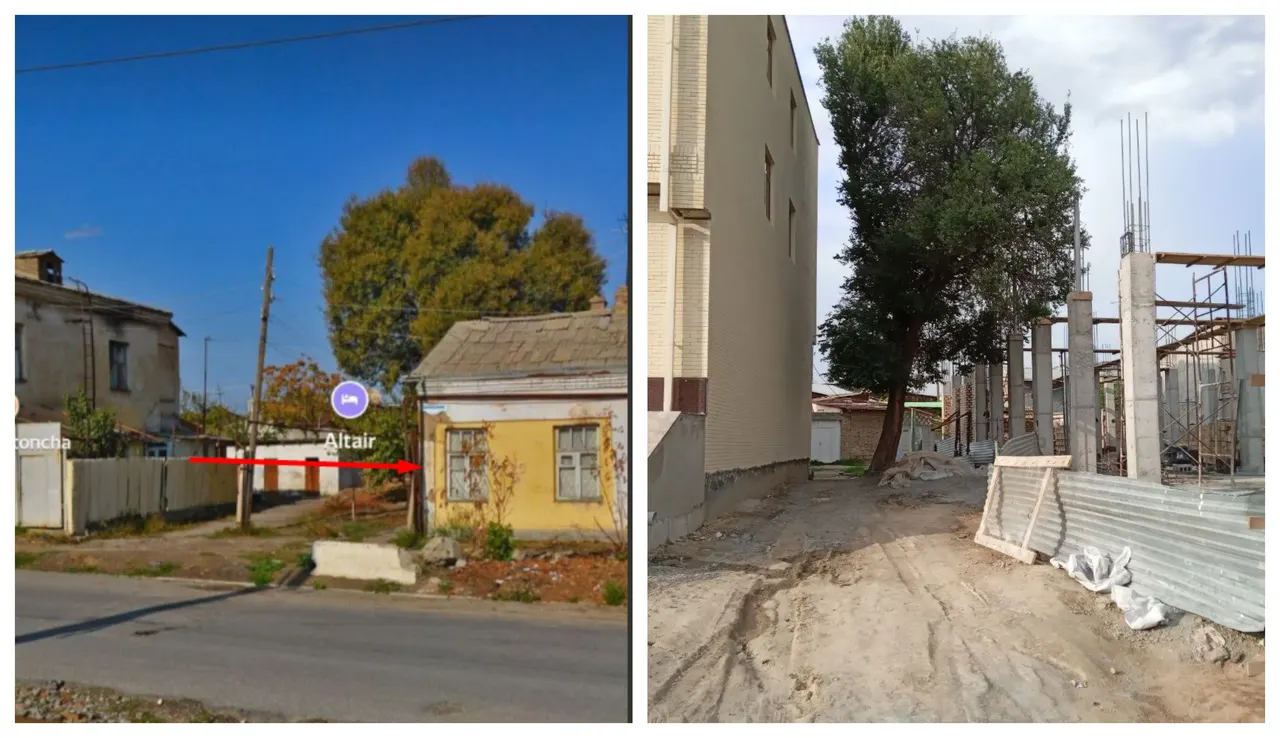
{Photo: Taken in 2022}
In conclusion No. 33-2023 "...on the technical condition of the building" dated February 21, 2023, by the Samarkand Regional Inspection for Construction Supervision, clause 2.4 "Compliance with BCS requirements and assessment of the technical condition of structures" (BCS — Building Codes and Regulations) provides incorrect information regarding the seismic resistance of the building. Namely, the building dimensions are indicated as 25.35 mx 14.8 m, rectangular. In fact, the width, which is the facade part, is 14.8 m, and the back part is 7.5 m. Due to a recess in between, the building rises in a hexagonal shape.
The fact that the basement walls on the western and southern sides were built not with monolithic concrete, but with one-and-a-half-meter concrete blocks, is not mentioned in any source.
While more than 10 organizations and departments were required to issue a Conclusion (permission) regarding the compliance of the structure to be built with a specific field prior to the project, only the Samarkand Regional Department of Ecology and Environmental Protection provided such a document, and that too after the construction was completed.
The "State Ecological Expertise Conclusion" of the Samarkand Regional Department of Ecology and Environmental Protection dated May 15, 2023, does not state that because the plot was fully occupied by the building in violation of the established norm, no space was left for a green area (not even to plant 1 tree). Several clauses only write about household waste disposal.
Because the location was incorrectly indicated in the construction documents, employees of the Samarkand Regional Department of Cultural Heritage reported that the business facility address is not located within the territory of the "Afrosiyob" reserve included in the UNESCO World Heritage List, but in the buffer (protection) zone of the reserve. Requirements differ for these two categories of construction.
Among the court materials, there is also a letter written in response to our request by Sh. Qilichev, head of the Samarkand Regional Cultural Heritage Department of the Cultural Heritage Agency of the Republic of Uzbekistan. Quote: "We inform you that by the minutes of the meeting held on March 2, 2021, No. 1 … the historical-buffer zones were divided into 20 LOTs (the LOT includes Rudaki Street), and projects developed for all existing residential and non-residential buildings were reviewed and approved."
According to our legislation related to cultural heritage, constructions in reserves and protection zones of historical monuments must first be approved by the Scientific Council under the Ministry of Tourism and Culture. Only then is the matter considered by the urban planning council. Neither 85 Shohi Zinda Street nor the term LOT is on the list of constructions approved by the Republican Scientific Council in Samarkand. Moreover, the respondent's construction began nearly a year after the mentioned meeting. At this time, it was possible to complete all procedures properly...
Different figures are recorded in the court documents regarding the same situation related to the business facility. In various documents, ranging from the total area of the plot to the footprint area and the dimensions of the building, there are large discrepancies.
A WORD OF COURTESY
Samarkand has always been a center of culture, always bustling with guests and tourists. The blessings brought by their footsteps have always pleased the local people. The idea that one can intentionally start construction just a few months before an event and then violate construction norms as much as desired is very wrong. After all, as event participants drove through the streets of the old city, weren't there many entrepreneurs and ordinary people who raised walls only on the facade and completed the rest of the work leisurely and flawlessly later? Moreover, among the court documents, the 2020 document regarding the construction at 85 Shohi Zinda Street is taken as a basis.
Most importantly, this is about artificially created risks related to human life. Although talking about a single business facility or a neighbor's ordinary house might seem trivial now, after an incident occurs, there is no use in saying that established norms and requirements are important for any object. Samarkand is considered an 8-9 seismic zone. And nature does not consult with humans.
THINGS THAT MUST BE SAID...
After exactly two years, the case moved to the Supreme Court. At the first session, the judge asked, "Why did they say you don't have a cadastre when you do?" "I'm surprised too," I said. My face lit up. You have a cadastre, she said! With that, I got rid of the opposing lawyer's phrase every time, "Your illegal construction.
Before filing the application for the court of first instance, when the lawyer I chose said, "Your case won't make it to court, they won't accept the application," I wrote the application myself and submitted it to the court. Until the appeal, I had to work without a lawyer. Every time I spoke out and talked about the deviations in construction norms and rules and illegalities, the opposing counsel would ask what my profession is. "I am a journalist!" I say. At the next session, there were instances of "She threatened by saying she is a journalist."
Here I am, writing. Not to threaten, but so that mistakes are not repeated. I even feel sorry for the respondent party. Because their mistakes were not explained to them in time, nor were they stopped. I am writing so that other entrepreneurs don't make the same mistake as them.
A leaning house. In this house, you can neither do renovations nor host guests. Every time the wooden ceiling makes a creaking sound, you jump outside...
Currently, the case has been suspended at the Supreme Court. We have submitted a petition for a complex expertise. What kind of conclusion will the expertise give this time? Once bitten, twice shy, as the saying goes. Will regional-level court events not continue in other forms, hopefully? Will it be possible to get answers to our questions from specialists of the Ministry of Construction and Housing-Communal Services of the Republic of Uzbekistan, the Cadastre Agency under the Ministry of Economy and Finance of the Republic of Uzbekistan, and the Cultural Heritage Agency of the Republic of Uzbekistan? How much longer will the case drag on?
Mustahkam Tangriyorova,
journalist