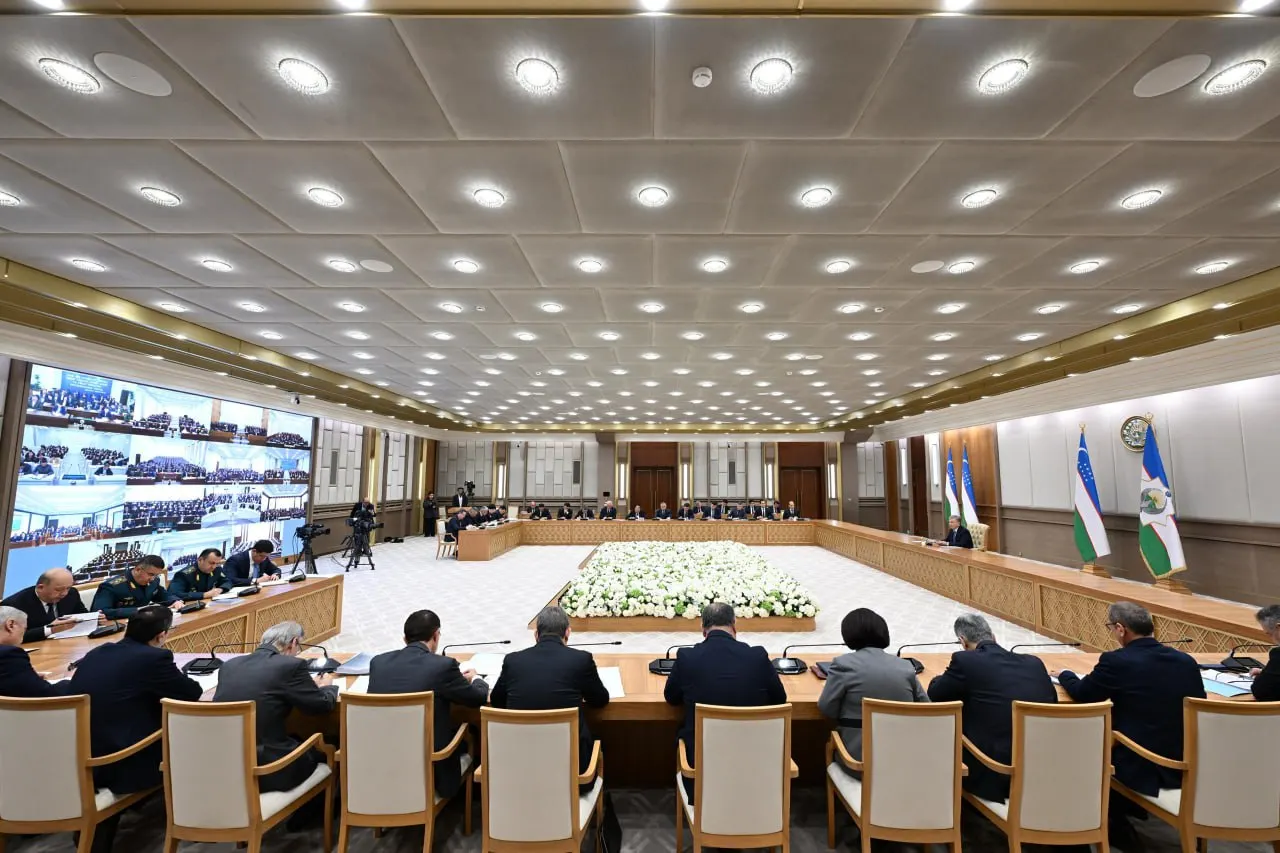
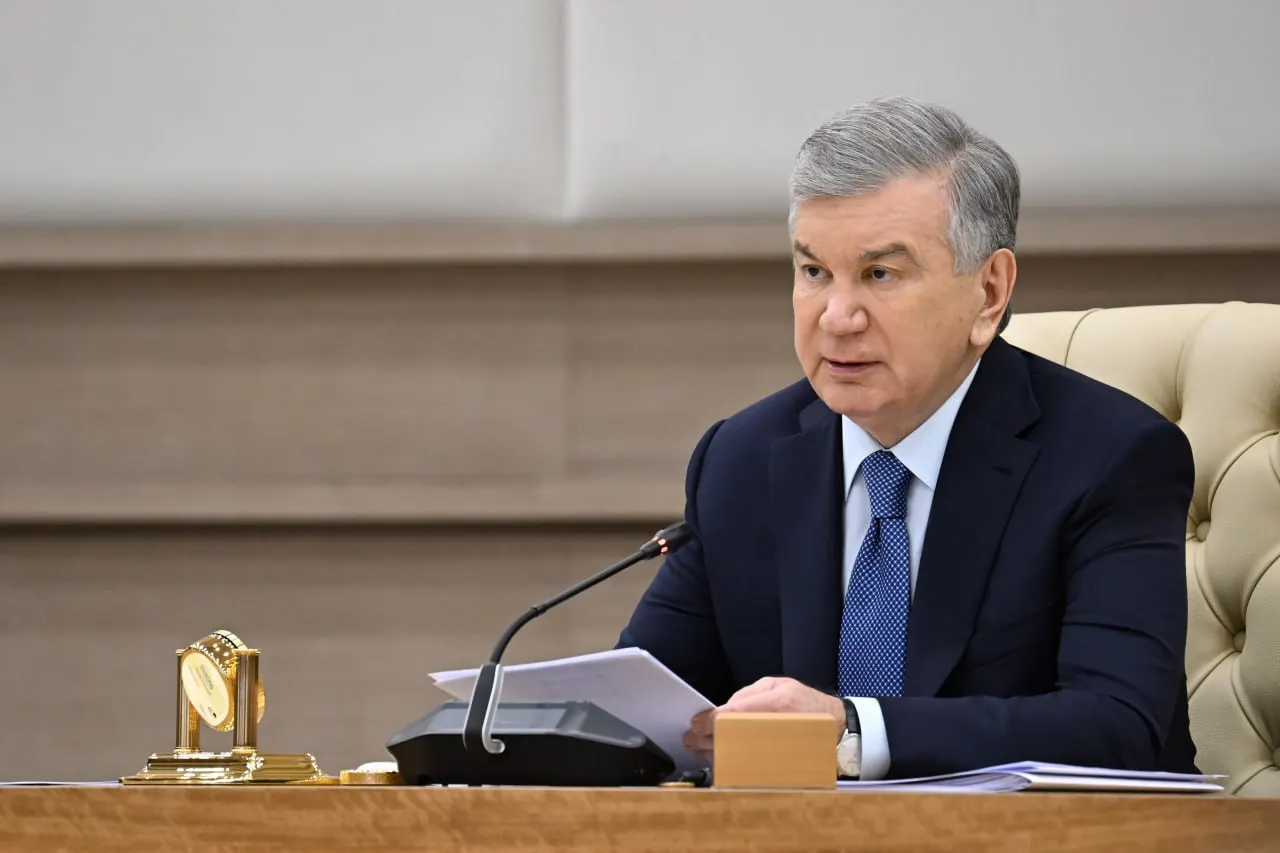
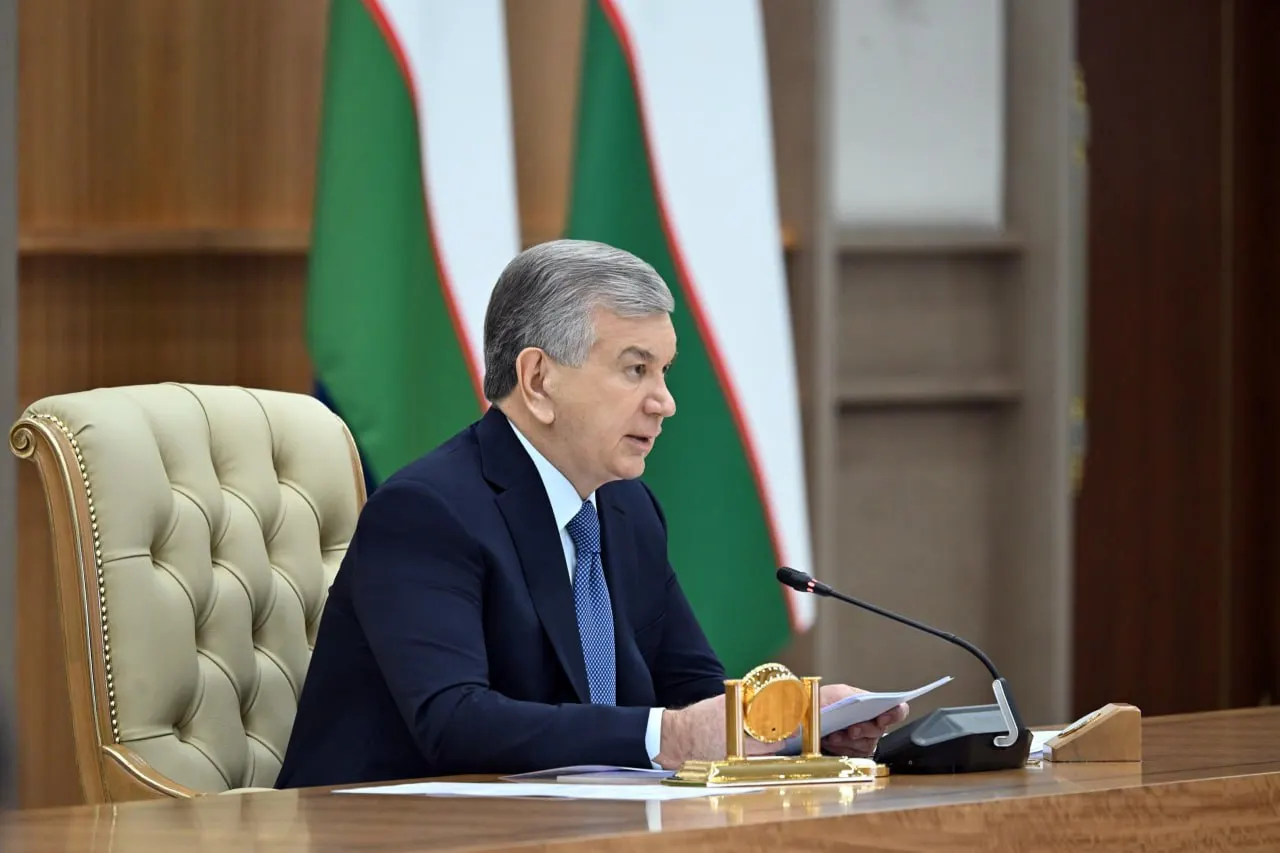
A video selector meeting was held under the chairmanship of President Shavkat Mirziyoyev to improve the system of working with public appeals.
The population of our country has exceeded 38 million, the able-bodied population has surpassed 20 million, and population incomes have doubled over the past nine years.
A system has been created where ministers and hokims (mayors/governors) go down to the makhallas (neighborhoods) to make life easier for the people and find solutions to the issues they raise. This year, 56 trillion soums are being allocated to improve living standards in makhallas.
“Now, ministers and hokims should ask themselves: despite having so many opportunities, are the issues raised by the population being solved in a timely manner? When People's Reception Offices were established nine years ago, one goal was set: to bring state agencies closer to the people.
True, People's Reception Offices worked effectively at the time. However, the time has come to transform this institution to meet the current demands of the people,” the President said.
It was noted that hereafter, the motto “I must know the problems of every person and household and provide timely assistance” must become the core rule for every district, city, and regional hokim, minister, and head of regional organizations.
It was noted that in the country, there is an average of 319 applications and complaints per ten thousand people.
However, this indicator stands at 535 in Tashkent city, 462 in Navoi region, 452 each in Sirdaryo and Surkhandarya, 430 in Jizzakh, 368 in Kashkadarya, and 350 in Tashkent region.
It was pointed out that the number of applications per ten thousand residents in Dehqonobod and Mirobod districts, as well as the cities of Navoi, Ohangaron, and Yangiyer, is twice as high as in other districts.
Or, while the total number of appeals in the republic decreased by 16 percent, it increased by up to 50 percent compared to the previous year in Karovulbozor, Nurota, Konimex, Tuproqqal'a districts, and the city of Namangan.
The hokims of Bukhara, Karmana, Uchquduq, Sardoba, Xovos, Bostonliq districts, and the cities of Angren and Go‘zgon were criticized for talking to just 4-5 people in makhallas “for show” and claiming they held mobile receptions.
Last year, hokims themselves were appointed as heads of People's Reception Offices.
It was noted that because leaders personally handled matters in Karakalpakstan, Andijan, Kashkadarya, Khorezm, and Sirdaryo, appeals in their regions decreased by 25-30 percent, and 60-70 percent of the issues raised by the population were positively resolved. However, it was pointed out that other hokims and certain ministers have not yet made a drastic change in this regard.
For instance, more than half of the 170,000 appeals in Tashkent city and 110,000 appeals in Tashkent region have not found a solution. Repeat appeals have increased in Surkhandarya, Samarkand, and Tashkent city.
For example, in January, a citizen reported that a school student had fallen into the “Junariq” canal flowing through Sergeli, and asked to rebuild the broken bridge. Not a single responsible official paid attention to this issue for two months, and a superficial response was given to the appeal.
Funds were found and the bridge was built only after the situation spread on social media. It was pointed out that such shortcomings in working with appeals undermine public trust in the state.
It was noted that a large portion of the appeals coming to People's Reception Offices pertain to the Ministry of Internal Affairs (148 thousand), Compulsory Enforcement Bureau (134 thousand), Ministry of Energy (88 thousand), Ministry of Employment (60 thousand), and the Ministry of Health (56 thousand).
Last year, 70 thousand appeals related to alimony were received.
It was pointed out that while the Compulsory Enforcement Bureau collects alimony when an application is filed, 30 percent of the appeals remain unresolved because the alimony payer has no official income.
In this regard, hokims were criticized for failing to analyze how many alimony payers have a profession but are unemployed, or how many need training, and consequently failing to set clear tasks for the employment department and the “makhalla seven”.
It was noted that if work is organized in the regions in this manner, appeals regarding alimony could be halved.
A system has been created to train people based on organized migration and send them to high-paying jobs abroad. However, people with alimony obligations cannot use this opportunity because to travel abroad, a citizen must pay 5 years of alimony in advance or obtain written consent from the alimony recipient.
Responsible officials were instructed to thoroughly study this issue and submit appropriate proposals.
As noted at the meeting, 448 people applied regarding the bureaucracy involved in formalizing birth certificates for children who did not receive them for various reasons.
“These are the ones who applied out of necessity because a certificate was requested when placing their child in kindergarten and school; how many more haven't applied yet?” – the head of state asked.
The Ministry of Justice was instructed to develop a simple solution to this issue. Last year, more than 148 thousand appeals were received regarding matters within the jurisdiction of internal affairs. In particular, it was noted that there are many complaints about the rude behavior of internal affairs officers and the quality of investigations.
It was pointed out that system officials must visit Denov, Urgut districts, and the cities of Samarkand, Karshi, Namangan, Jizzakh, Fergana, and Chirchiq—where the highest number of applications per 1,000 people are received—to listen to the population's problems and train proactive inspectors and investigators in professional and communication culture.
Appeals regarding energy, road, and water infrastructure in 2025 exceeded 109 thousand. In particular, infrastructure-related appeals have increased in Asaka, Shahrixon, Izboskan, Pastdargom, Sho‘rchi, Denov, G‘uzor, Qamashi, Dehqonobod, Sharof Rashidov districts, and the cities of Samarkand, Namangan, Termiz, Karshi, and Andijan.
This year, 20 trillion soums have been allocated to solve these issues. It was noted that if hokims direct these funds primarily to the makhallas receiving the most complaints, the people will be satisfied and appeals will decrease.
It was emphasized that the “Initiative Budget” program is yielding great results in easing the burdens of makhalla residents.
However, 2,000 makhallas, from which 25,000 infrastructure applications were received, have never posted a project in the “Initiative Budget”.
It was pointed out that if responsible officials had analyzed the appeals coming to the People's Reception Office and helped these makhallas create projects, many issues could have been resolved on the spot.
It was noted that instead of providing solutions to 64 percent of appeals, the Ministry of Higher Education, Science and Innovations, 61 percent by the Inspection for Control in Construction and Housing and Communal Services, and 58 percent by the Ministry of Transport limited themselves to superficial responses, and generally, such examples exist in all ministries.
While 90-95 percent of appeals were in the form of complaints when People's Reception Offices newly opened, today it has dropped to 60-65 percent.
“Today, people's worldviews are changing, and instead of personal issues, they prefer to make proposals to improve conditions in their makhalla. However, people whose problems remain unresolved are asking the President to organize receptions with leaders. Now this system will change. Hokims will not limit themselves to merely solving the issue raised in the application. On the contrary, they must work with the root cause of the problem,” the head of state said.
Therefore, a new system is being introduced in the field, determining that People's Reception Offices will not just be bodies that accept applications, but centers that diagnose problems in the region.
The President explained how the new system will work using the example of Karshi city.
The 11,000 appeals received from the population of Karshi city to the People's Reception Office last year were analyzed.
For example, when studying the reasons why 255 people in Karshi city were evading alimony payments, it was found that 193 of them were unemployed despite having a profession, and another 62 were underreporting their income.
In this process, the hokimiyat, banks, hokim assistants, and the city employment and CEB (MIB) departments will work together to involve citizens in entrepreneurship, and place the unemployed into vacant positions in regional industrial and service enterprises. For alimony payers wishing to work abroad, tripartite agreements will be concluded to teach them the language and profession and send them to high-paying jobs abroad.
The city tax inspection, together with the General Prosecutor's Office Department, will bring the activities of those hiding their income out of the “shadow”. It was emphasized that this will change the financial provision of about 700 children dependent on alimony payers.
146 appeals in Karshi city are related to delayed salaries.
The first deputy hokim will analyze the financial condition of organizations failing to pay wages and solve issues related to raw materials, working capital, infrastructure, and finding markets together with the hokim's deputy for investment and banks.
Wages from enterprises that unjustifiably withhold them will be forcibly collected in the established manner.
Today, there are 930 multi-story residential buildings with 35,000 apartments in Karshi city. They are served by 40 management service companies. 111 complaints expressing dissatisfaction with their activities were received.
It was determined that the hokim's deputy for construction will visit Cho‘lquvar, Nuriston, and Oydin makhallas, which received the most appeals, to meet with the population and management companies. If the management companies are struggling with money, working capital will be found for them.
If there are problems related to electricity, roads, water, or sewage, this issue will be forwarded to the Reforms Headquarters to be additionally included in the investment program, and the Compulsory Enforcement Bureau will assist in recovering the receivables of management companies.
124 appeals were received from the residents of Karshi regarding housing provision.
It is planned to build multi-story residential buildings with 3,700 apartments in Karshi city this year.
The hokim's deputies, together with banks and developers in the city, will meet individually with those who applied for housing. They will offer newly built housing and promptly resolve issues related to loans and subsidies.
More than 1.5 thousand employees work in state agencies in the city. 794 complaints were received regarding their activities. For example, 281 applications were filed regarding the behavior of internal affairs officers and the quality of investigations.
The regional internal affairs chief's deputies for personnel and public security will dedicate one day of the week to training young investigators, preventive inspectors, traffic and patrol officers, and teaching them communication culture.
It was noted that the heads of the Compulsory Enforcement Bureau, tax, electricity, water and gas, medical, and educational agencies—against whose employees there are many objections—must organize their work in the exact same manner.
877 appeals regarding allowances were received by the People's Reception Office from Karshi city.
It was noted that the problems of women who applied on this issue must be viewed comprehensively, not just from the perspective of paying allowances, but alongside their other difficulties.
The city hokim's deputy for social issues, together with the preschool and school education department, will place the children of 309 women in kindergartens. Together with hokim assistants and women's activists, 82 unemployed women will be trained in professions and provided with conditions to work right in their makhalla.
90 out of 159 single mothers will be assisted in obtaining preferential loans to start businesses, and another 69 to expand their activities. Social services will be established for 34 people with disabilities in cooperation with the “Inson” Social Services Center.
The hokim of Karshi city was instructed to analyze each application and complaint in this manner, distribute them to responsible officials, and turn the city into a model region in terms of working with appeals in the first half of the year. It was determined that the regional hokim, his deputies, and the heads of regional organizations will closely assist him in this process.
In general, all regions and the 208 district and city hokims were tasked with effectively establishing the system mentioned in the example of Karshi city to ease the burdens of the people. They will have their work plans in this regard approved monthly by local Councils of People's Deputies and address the population.
Similarly, all ministers will approve a “roadmap” to reduce objections in their respective fields, hold a briefing, and convey their plans to the people.
The President defined measures to further strengthen the activities of People's Reception Offices.
The Presidential Administration, together with hokims, was instructed to gather modern personnel who understand the essence of problems into People's Reception Offices and establish the activities of a separate monitoring group for systematic analysis of appeals.
The Communications Department of the Presidential Administration will analyze and summarize the appeals received by People's Reception Offices every month, forward them to ministers and hokims, and monitor their execution. It will hear reports from leaders on issues affecting people's moods and submit proposals on the most problematic issues to the Government.
An Emergency Headquarters consisting of executive staff from ministries and agencies will be established within the Government. The raised issues will be resolved on-site, broken down by region and sector.
People's Reception Offices will be granted the authority to issue mandatory instructions to agencies that violate the procedure for reviewing appeals.
The Communications Department was instructed to launch a rating of state agencies in working with appeals and publish it every six months.
The task of strictly monitoring the implementation of all instructions in this regard was assigned to the Deputy Prosecutor General for Compliance.
The responsibility of the “makhalla seven” in working with appeals will be increased.
A separate cabinet will be opened for each makhalla in the President's Virtual Reception. The youth leader and the makhalla chairman will be responsible for running it. They will study the causes of incoming appeals and submit daily information to the hokims.
Responsible officials were instructed to fully integrate the “Digital Makhalla” system into the President's Virtual Reception. Hereafter, harsh measures will be taken against agency heads who groundlessly send appeals to lower systems for review. Penalties for violating the requirements of legislation regarding appeals will also be tightened.
The President emphasized today that the results of socio-sociological research should determine the main directions of state policy and reforms. Therefore, sociology has been revived as a science, and the training of sociologists has been launched in universities.
As a logical continuation of this work, the scope and quality of socio-sociological research will be increased.
From now on, rather than one-off surveys, continuous monitoring and analysis will be conducted on where trust is growing or weakening, which decisions are fair, and which are not bringing benefits to the people.
The Communications Department of the Presidential Administration and the Institute for Strategic and Regional Studies were instructed to develop a methodology for rating regional and sectoral leaders, form ratings based on analyses, and regularly submit them to the President. Executive discipline issues were also reviewed.
The task was set to establish daily monitoring of the actual implementation status of each given instruction, and to submit critical, open, and objective information regarding leaders who fail to feel a sense of responsibility and allow sluggishness. Reports from responsible officials were heard at the meeting.