Sh.R., a driver from Vobkent, was deprived of his driving license for three years and fined 16.48 million soms. The only laboratory conclusion in the case confirmed that there was no alcohol in his blood and urine. Nevertheless, the district court, the regional court, and a Supreme Court judge upheld the punishment solely based on the 0.155 mg/l reading of a breathalyzer that was not authorized for use.
This case is not about the fate of a single driver. It is about how courts are evaluating evidence not based on the requirements of the law, but on the convenience of the prosecution.
How the case was reviewed
The error began on the first day and, instead of being corrected at each instance, was reinforced.
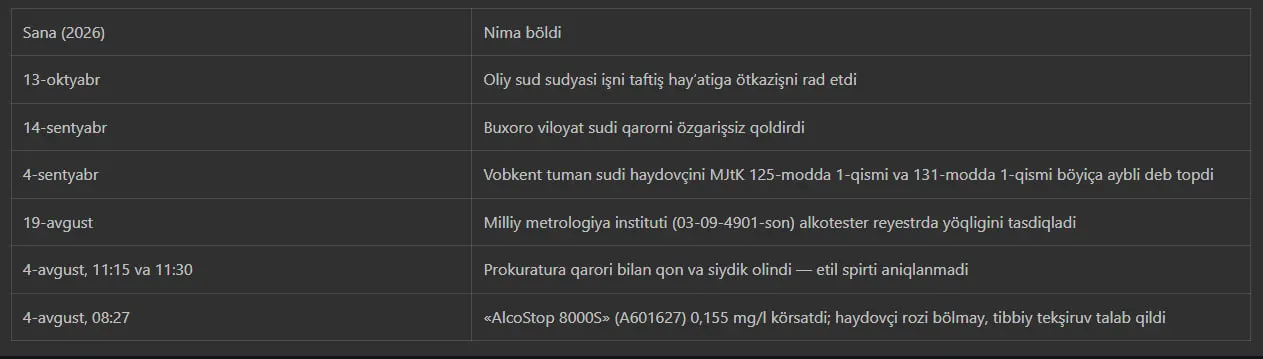
Pay attention: the official response from the Institute of Metrology was available before the court of first instance. The court had the opportunity to review it, but did not give it an assessment.
Six violations of the law committed by the courts
Each violation is sufficient to overturn a separate decision. Together, they show that the courts reviewed the case unilaterally.
1. The reading of a device not listed in the register was accepted as evidence
What the law says: Paragraphs 2 and 23 of the Regulation on the procedure for determining intoxication (Registered by the Ministry of Justice No. 3099) require only certified, authorized for use, and inspected measuring instruments.
What the court did: The Institute of Metrology officially confirmed that the «AlcoStop 8000S» (A601627) was not in the register on the day of the incident and could not be used. Neither court gave a legal assessment to this letter — they neither rejected it nor accepted it. A reading obtained in violation of the law became the sole basis for the prosecution.
2. The laboratory conclusion was ignored
The Bukhara branch of RSTEIAM's forensic chemistry department did not find ethyl alcohol in the driver's blood and urine. This is the only laboratory evidence in the case, and it was obtained in a legal manner by a prosecutor's decision.
Expert L. Tukhtayev stated in court that traces of alcohol remain in blood and urine for up to three days. The samples were taken approximately 3 hours after the test. If alcohol had been present, it would have been detected. The courts placed the reading of a device of dubious quality above this scientific evidence without justifying it.
3. The device's margin of error was not taken into account
If the margin of error established by the manufacturer is taken into account, intoxication is not proven even if the device was in working order:
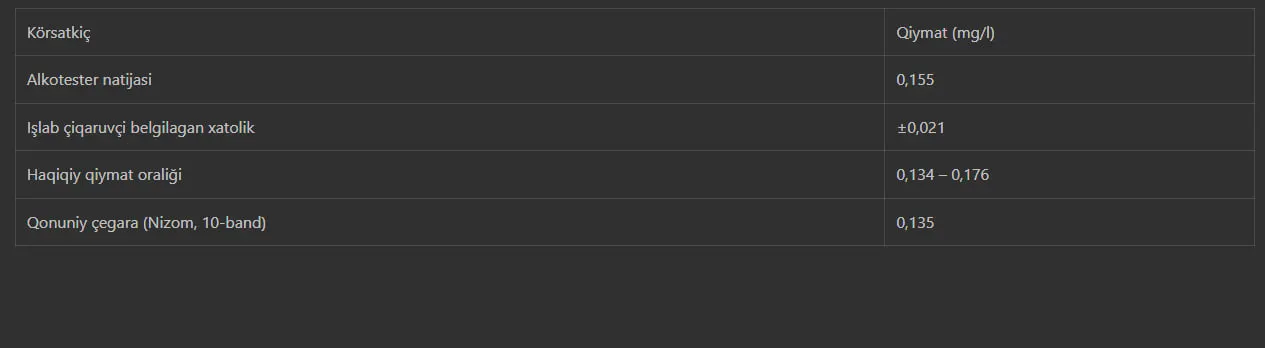
The lower point of the range is below the limit. The expert also stated that such a reading could result from garlic or vinegar-containing products; the driver regularly consumes garlic on a doctor's recommendation. The courts did not respond to this arithmetic either.
4. The traffic safety department officers' violation of the law was shifted onto the driver
According to paragraph 11 of the Regulation, if the driver expresses disagreement, the officer must take him to a district medical prevention facility. According to paragraph 17, the examination must be conducted within one hour.
The appeal decision itself states that the driver was taken to the regional multidisciplinary medical center, which lacks the authority to determine intoxication. In other words, the court wrote that the law was violated, yet placed the consequences of this on the driver. Time lost through the fault of the officers cannot serve as evidence against the citizen.
5. The appellate court relied on an irrelevant norm
The regional court stated that «the two-hour re-examination period in paragraph 33 of the Regulation has expired.» However, paragraph 33 concerns objections to a medical conclusion. In this case, no lawful medical examination was conducted in the first place, and the objection was raised against the breathalyzer. This situation is regulated by paragraph 11. Applying the wrong norm is a blatant violation of substantive law norms.
6. The expert's testimony was misrepresented in the decision
The appeal decision states as if the expert said «alcohol may not be detected.» In fact, he said the opposite: traces of alcohol persist for three days, and 0.155 mg/l can even come from food. Distorting the content of evidence in a court act is a serious procedural defect. This can be verified with the court session minutes and audio recording.
Why was the doubt resolved against the driver?
Article 28 of the Constitution is clear: unresolved doubts regarding guilt are resolved in favor of the individual. In this case, three court instances turned this constitutional guarantee upside down in practice.
On one side is the reading of a device that is not in the register and falls within the margin of error. On the other side is a laboratory conclusion obtained in a legal manner showing no alcohol. Out of two contradictory pieces of evidence, the courts took only the one against the driver and did not explain why they did so.
This approach directly contradicts two normative requirements:
Resolution No. 19 of the Plenum of the Supreme Court dated June 25, 2024 (paragraphs 16–17) — the requirement to evaluate evidence and substantiate the decision.
Article 321 of the Administrative Responsibility Code (ARC) — a decision must be canceled when the case has been reviewed unilaterally and the decision does not correspond to the actual circumstances.
Instead of correcting the error of the first court, the appellate instance added new ones to it: an irrelevant norm was applied, and the expert's words were distorted. Meanwhile, the Supreme Court judge did not even provide the opportunity to review these circumstances in the cassation panel. As a result, the judicial oversight system did not correct the error; it endorsed it.
Thousands of drivers undergo breathalyzer tests every day. If courts continue to place the reading of an unregistered device above a laboratory conclusion, any accidental error will decide a person's fate. Here, trust in judicial impartiality is put at risk.
Conclusion and demands
In reviewing the case, the law was violated at how many stages: in collecting evidence, in evaluating it, and in applying the norm. Decisions rendered under such circumstances cannot be considered lawful and well-founded.
Currently, an application has been sent to the first deputy chairman of the Supreme Court. The demands are:
To cancel the rejection ruling dated October 13.
To impartially re-examine the case in the cassation panel.
To terminate the proceedings in accordance with paragraph 1 of Article 271 of the ARC.
The duty of the court is not to endorse the indictment, but to ascertain the truth. In this case, the truth is already written in official documents — one only needs to open and read them.
Author: lawyer Sh. Mavlonov