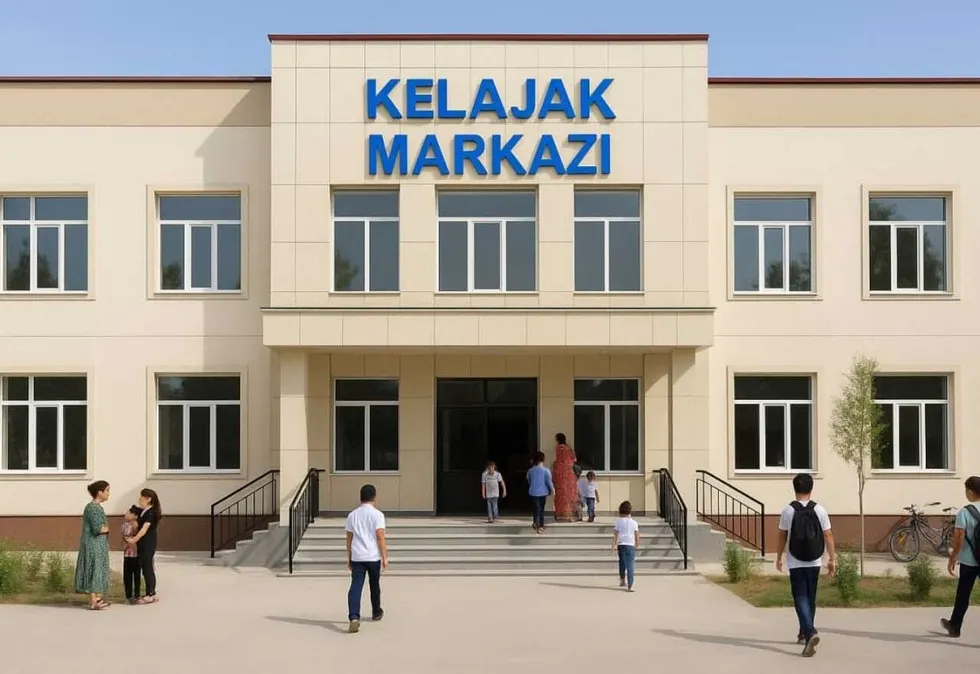
Questions surrounding the “Kelajak” centers are constantly increasing. In our previous materials, we raised questions about the funds formed from parent contributions, the issue of directing 10 percent of them to the Republican “Kelajak” Center fund, and financial calculations in the Samarkand region. Later, we also brought to the attention of the public the claims made in a collective appeal involving employees and directors during the transition from the “Barkamol Avlod” system to the “Kelajak” centers.
And now it is necessary to draw attention to another important aspect of the issue. This time, the talk is not about where the money is directed, but how the result is evaluated.
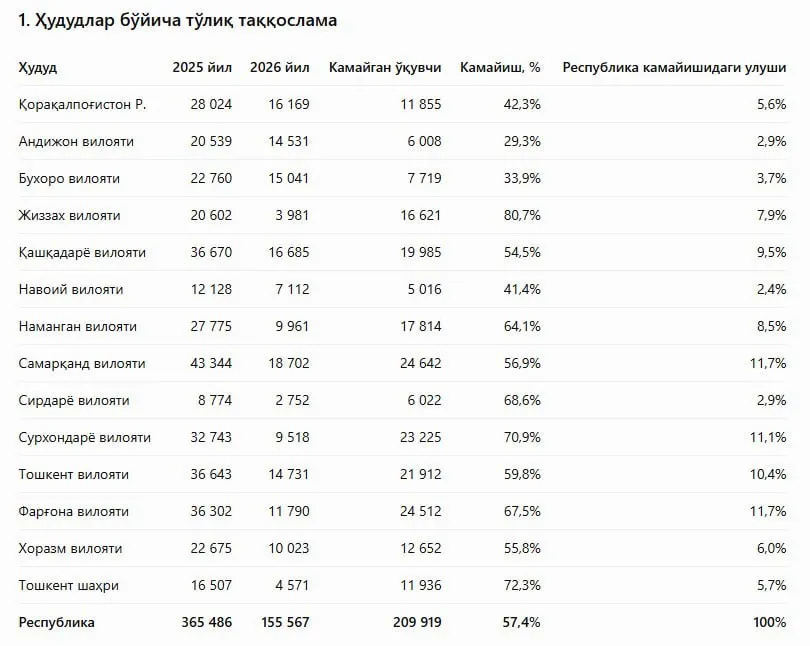
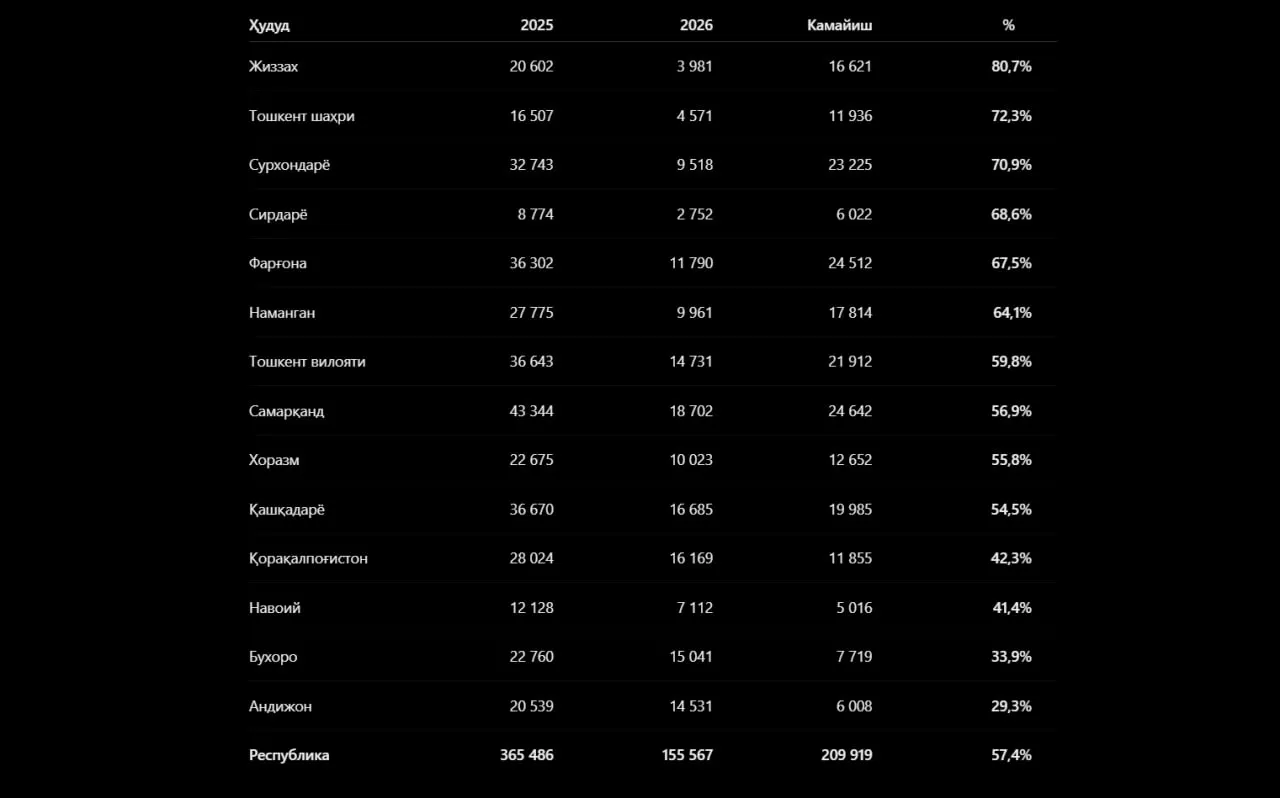
Because when comparing the indicators of September 2025 with September 2026 in the official statistics, the number of students involved in clubs across the republic dropped from 365,486 to 155,567. That is, a decrease of 209,919 students or 57.4 percent was recorded in one year. After all, these are not simple numbers.
Especially considering that one of the main tasks of the new system is the broad involvement of children in extracurricular education, the reasons for such a sharp change must be seriously studied.
But another question arises here:
At a time when child coverage has decreased so sharply, how was the performance of the heads of “Kelajak” centers evaluated?
Did indicators decline after Kholdorova became head: Is there a specific reason?
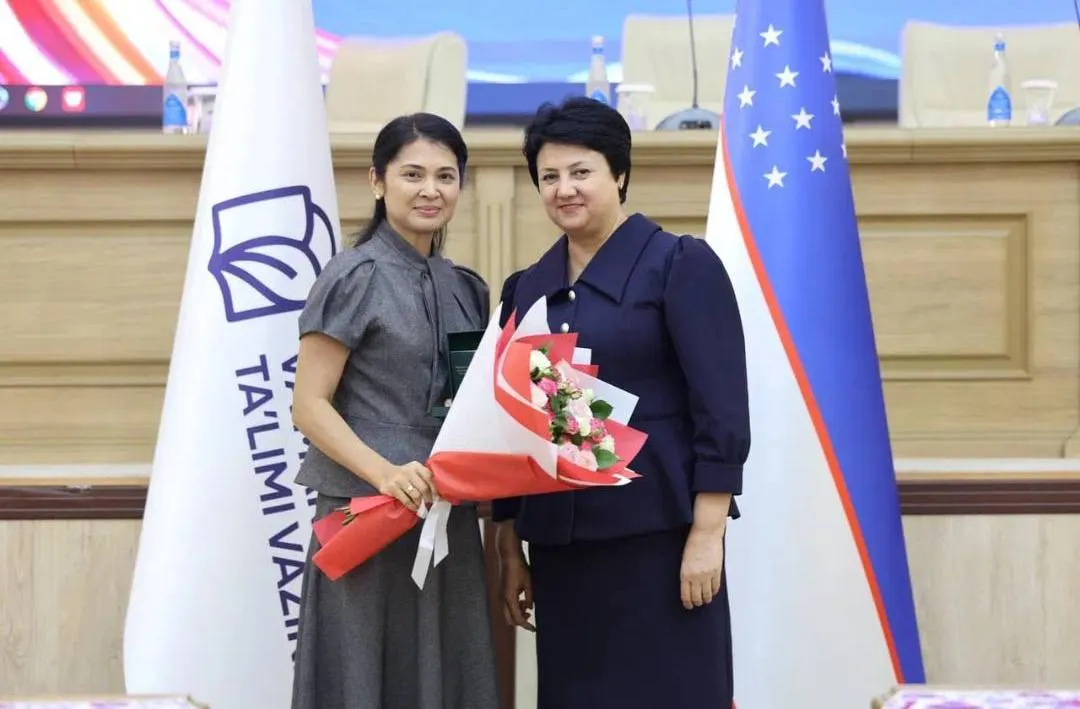
Indira Kholdorova was appointed to the position of director of the Republican “Kelajak” Center on September 18, 2025. After that, the system of “Kelajak” centers actually began to work throughout 2026. However, when comparing our indicators for September 2025 and 2026, the number of students involved in clubs nationwide dropped from 365,486 to 155,567.
That is, in one year, 209,919 students decreased — a 57.4 percent decline was recorded.
Of course, this figure alone does not prove that Indira Kholdorova's leadership activity caused this decline. For this, the working mechanism of the centers, changes by regions, club activities, and other factors must be analyzed separately. But the numbers themselves give a sufficiently serious signal to ask about leadership efficiency.
Has the rise in fees also affected coverage?
There is another important factor here — parent payments. In the President's resolution No. PQ-277 dated September 8, 2025, the opportunity was given to increase the parental payment set for “Kelajak” centers above the minimum amount in agreement with parents. The same resolution set the revision of the minimum amounts of payments starting from January 1, 2026.
By the Cabinet of Ministers resolution No. 776 dated December 10, 2025, payment amounts were precisely determined. In particular, while starting from January 1, 2026, it was set at 30 percent relative to the BRV in Tashkent city and 25 percent in regional centers, starting from September 1, 2026, these indicators were increased to 60 and 50 percent, respectively.
This is a very crucial point. Because we are comparing the exact indicators of September 2025 and September 2026. Thus, by the end of the compared period, the payment amount for parents increased again.
Therefore, the question arises:
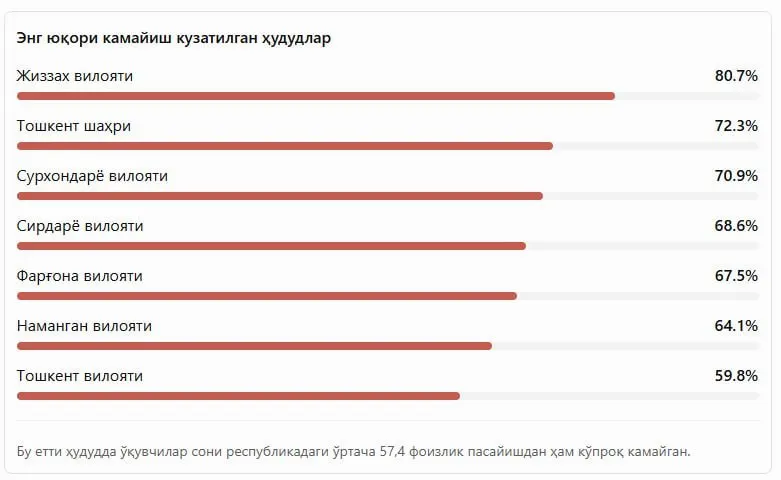
has the increase in payments affected the sharp contraction of student coverage? If it did affect, what was its impact by regions? For example, coverage decreased by 80.7 percent in Jizzakh, 72.3 percent in Tashkent city, 70.9 percent in Surkhandarya, 68.6 percent in Syrdarya, and 67.5 percent in Fergana.
Which part of these declines is related to organizational changes, which part to the increase in payment amounts, and which part to other factors? The center's analysis should show this.
Where did 209,919 students “disappear”?
Although the average decline across the republic was 57.4 percent, the situation in the regions is not the same. In some regions, the decrease was around 30–40 percent. In other regions, the indicator exceeded 70–80 percent. The most severe result was recorded in the Jizzakh region. The 20,602 students involved in clubs in September 2025 remained at 3,981 students in September 2026.
The decrease is — 16,621 students or 80.7 percent.
In Tashkent city — 72.3 percent.
In Surkhandarya — 70.9 percent.
In Syrdarya — 68.6 percent.
In Fergana — 67.5 percent.
In all these regions, the decline is higher than the national average indicator of 57.4 percent.
A natural question arises:
For what reason?
Did clubs shrink during the transition to the new system? Was there a problem in providing pedagogues? Did interruptions occur in club activities? Did reporting methodology change? Or did the approach to child coverage itself change? The numbers themselves do not answer these questions. But the numbers provide sufficient grounds for a serious check.
Where is the largest decrease?
Percentage is one criterion. But the absolute number is also important. A large part of the total 209,919 decline across the republic falls on certain regions.
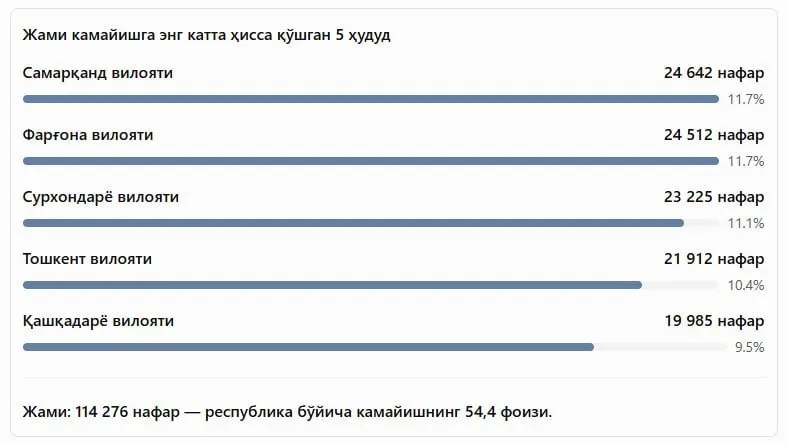
For example, in each of the Samarkand and Fergana regions, more than 24 thousand students decreased. In Surkhandarya, the decline made up 23,225 people. These three regions alone account for nearly 34.5 percent of the total decline across the republic.
Therefore, when studying the situation, serious attention should be paid not only to the 80.7 percent decline in Jizzakh, but also to Samarkand, Fergana, Surkhandarya, Kashkadarya, and Tashkent regions where the number of children decreased the most.
And the situation in Andijan raises another question
Interestingly, the decline is not at the same level in all regions. In the Andijan region, the number of students involved in clubs dropped from 20,539 to 14,531.
The decrease is — 29.3 percent. This is the lowest decline indicator in the republic.
In Bukhara — 33.9 percent,
In Navoi — 41.4 percent,
In the Republic of Karakalpakstan — 42.3 percent.
Especially the example of Andijan is noteworthy. Because here the number of clubs increased from 633 to 833, but the number of children involved in clubs conversely decreased by 6,008.
Therefore, the increase in the number of clubs does not automatically mean that child coverage has increased. This shows us another thing: it is impossible to draw a conclusion by looking only at the number of clubs when evaluating the effectiveness of “Kelajak” centers.
Now the most important question: KPI?
The main point of the issue is right here. By the President's resolution No. PQ-277 dated September 8, 2025, evaluating the activities of “Kelajak” center directors based on key performance indicators — KPIs was determined.
That is, the leader's activity should not be evaluated by a subjective conclusion that they simply “worked well” or “worked poorly,” but based on specific indicators. Therefore, at a time when child coverage across the republic has decreased by 57.4 percent, a very important question arises for the public:
Based on which KPI indicators were the directors of “Kelajak” centers evaluated in 2026?
How much were their KPI results?
Is coverage included in these KPIs?
If included, what is its share in the general evaluation?
If not included, why?
If KPI is high — the bonus is also high
The importance of this question is that we are not just talking about a rating on paper.
By the Cabinet of Ministers resolution No. 776 dated December 10, 2025, the mechanism for material stimulation of directors and pedagogical staff of “Kelajak” centers was also determined.
Accordingly, at the expense of Fund funds, a monthly bonus of up to 5 times the official salary can be given to directors and deputy directors, and up to 8 times to other employees.
There is another important aspect here. The bonus should not be given automatically.
The resolution stipulates that a Working Group must be formed for this process and applications of regional centers for assigning bonuses must be reviewed by this group. Therefore, behind every bonus, there must be a specific basis:
which result?
which KPI?
which evaluation?
which Working Group decision?
which minister's order?
Is it possible to get a high KPI despite an 80.7 percent decline?
For example, let's take the Jizzakh region. In one year, the number of students involved in clubs dropped from 20,602 to 3,981. This is an 80.7 percent decline.
Now the question:
How was the KPI result of the leaders of “Kelajak” centers in the Jizzakh region evaluated?
Did they achieve a high KPI indicator? If they achieved it — at the expense of which indicators? If coverage dropped by 80.7 percent, what weight did this indicator have in the KPI?
If coverage was not one of the main indicators — on what basis was the leader's efficiency measured?
This exact question can also be posed regarding the leadership of Tashkent city, Surkhandarya, Syrdarya, and Fergana.
“Up to 5 times” — but to whom and for what?
Another important aspect must be emphasized here. Resolution No. 776 does not state that the director will be given exactly a 5-times bonus. The resolution sets the limit of “up to 5 times.”
Therefore, if a bonus is set in the amount of 2 times, 3 times, 4 times, or 5 times, there must be a basis for each of them.
That's why:
In 2026, what amount of bonus was given to the director of which region's “Kelajak” center, and based on which KPI result was this amount determined?
Disclosing this information is not an excessive demand. On the contrary, it is a simple requirement of accountability to the public regarding state funds and the incentive mechanism in the state system.
Where are the decisions of the Working Group?
If the Working Group needs to make a decision to grant a bonus, then another series of questions arises.
Who are the members of the Working Group?
How many applications were reviewed for which regions in 2026?
What amount of bonus was recommended for which director?
Which KPI result was the basis for this?
Are the decisions of the Working Group formalized?
What orders of the minister were issued based on them?
If these documents exist, they can be presented to the public in an understandable form. Then numbers and documents will answer all questions.
Coverage dropped — did efficiency increase?
Here we are not blaming anyone. On the contrary, we are asking to clarify the issue. Because the decline in coverage does not automatically prove that the leader worked poorly. The reporting methodology may have changed during the transition to the new system.
The order of calculating clubs may have changed. There may have been problems in providing pedagogues.
Coverage may have dropped during a certain period due to the reorganization of institutions. All of these need to be studied.
But precisely for this reason, KPI criteria must be open. Because if child coverage drops in the system and leaders' KPI results are high, the public has the right to understand the difference between these two situations.
Questions to the Ministry and the “Kelajak” Center
EFFECT.UZ sends the following questions:
1. What do the approved KPI criteria for “Kelajak” center directors for 2026 consist of?
2. What share does each of these KPIs have in the general evaluation?
3. Is the coverage of involving children in clubs included in the KPI composition?
4. If included, what is its share?
5. At a time when coverage across the republic decreased by 57.4 percent, what were the KPI results of regional directors?
6. With coverage in Jizzakh dropping by 80.7 percent, what was the director's KPI score?
7. What amount of bonus was set for each regional director in 2026?
8. Where are the decisions of the Working Group regarding the establishment of bonuses?
9. Which KPI result was each bonus based on?
10. If high bonuses were given to leaders in regions where coverage dropped sharply, how is this explained by criteria?
It's not about the bonus. It's about the criterion.
Not much time has passed since the establishment of “Kelajak” centers. Therefore, it is not right to harshly evaluate all shortcomings of the system based on one year of statistics. But since a new mechanism has been introduced in the state system, its result must also be measured.
If bonuses are being given to leaders — why they are being given must be understandable.
If they are evaluated based on KPIs — what the KPI is must be open.
If child coverage has decreased — why it decreased must be explained.
If a 70–80 percent decline is observed in some regions — what stands behind these numbers must be studied.
Because in the state system, the most important thing is — not the bonus itself, but its criterion.
The only question interesting the public:
At a time when child coverage has dropped sharply, for which result are the leaders of “Kelajak” centers getting high KPIs and bonuses?
The best answer to this question is not a statement. KPI criteria, evaluation results, Working Group decisions, and documents serving as the basis for setting bonuses. EFFECT.UZ awaits the official response of the relevant agencies on this issue.