Documents received by Effect.uz from Samarkand region raise a number of questions requiring answers regarding the activities of the Kelajak centers. On one side is the requirement to transfer 10 percent of the funds generated from parental fees to the Republican Kelajak Center Foundation. On the other side is the drop in student coverage from over 48 thousand in December 2025 to 18.7 thousand by September 2026. Most importantly, it is indicated that the 10 percent calculation began on October 1, 2025. This raises serious questions about when the legal and financial activities of the Kelajak centers actually began.
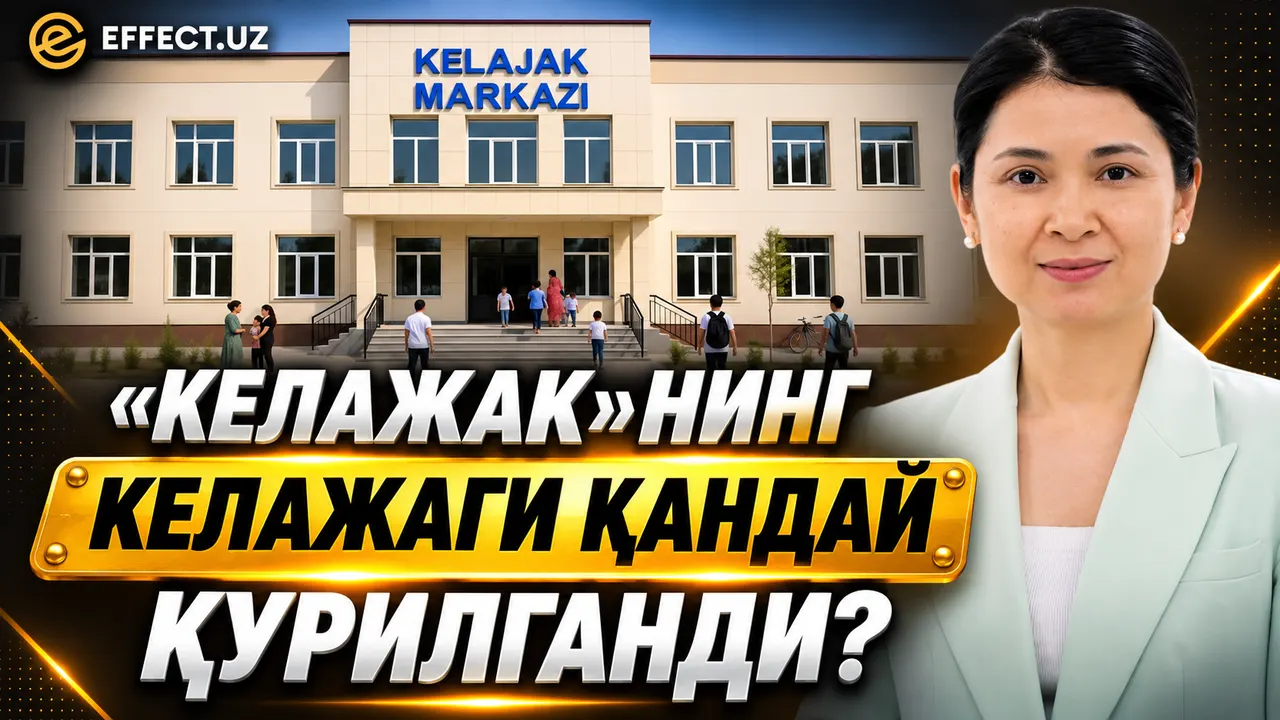
The idea of establishing Kelajak centers in the extracurricular education system was put forward to meaningfully organize children's free time, broadly involve them in clubs, and take the system to a new level, but what results did the center show in practice? Can center director Indira Kholdorova report to the public on this matter?
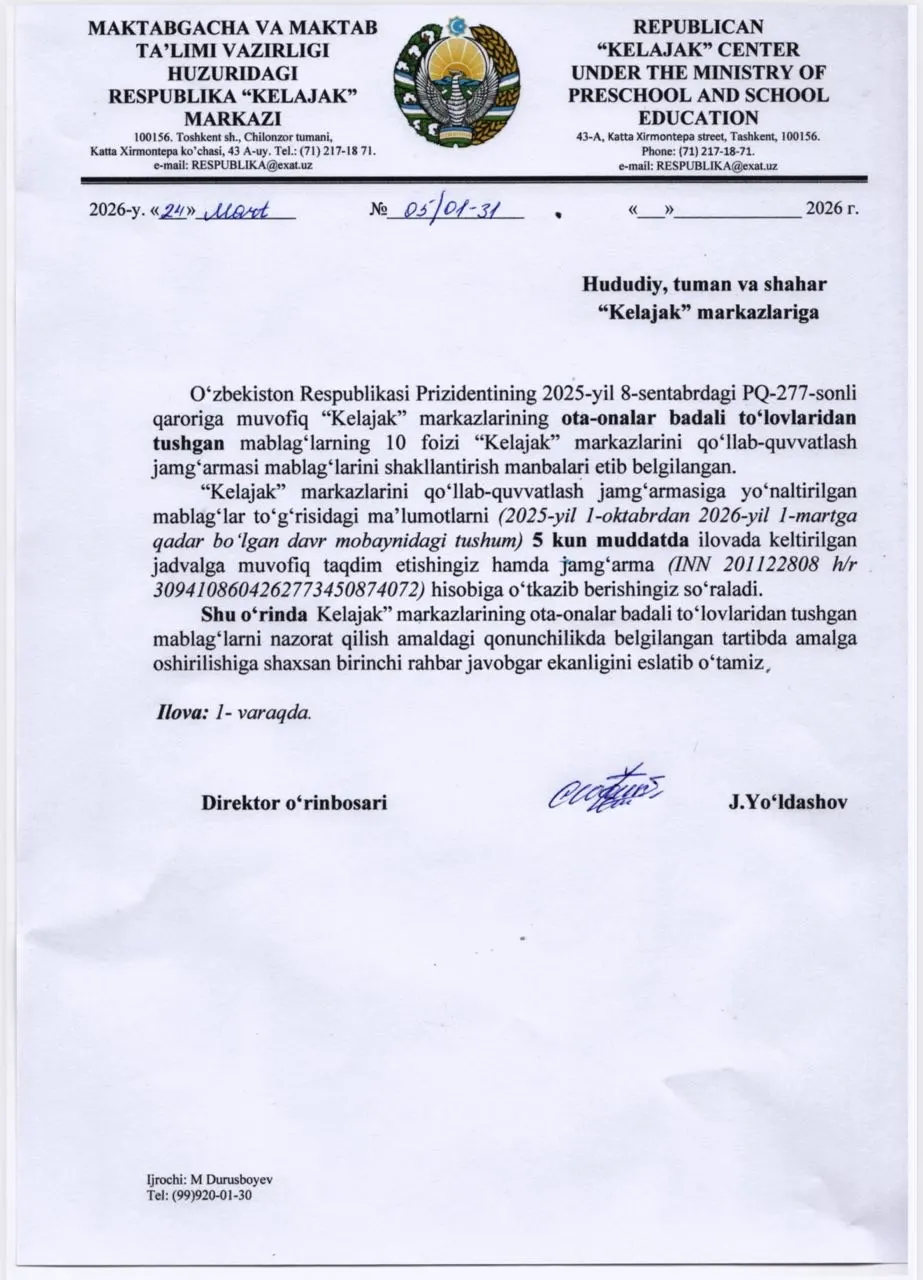
Presidential Decree No. PQ-277 adopted on September 8, 2025, envisages the establishment of respective regional and district-city Kelajak centers on the basis of Barkamol Avlod children's schools. The same decree specifies that 10 percent of funds received from parental fee payments to centers is among the sources for forming the funds of the Kelajak Centers Support Foundation.
Thus, the 10 percent deduction itself is provided for in legislation. However, this is not the most crucial point of the matter.
The point is which period and which organization's received funds this 10 percent was calculated against.
The 10 percent calculation starting from October 1, 2025
A letter sent to the Kelajak centers in Samarkand region requested information about funds received from parental fees during the period from October 1, 2025, to March 1, 2026.
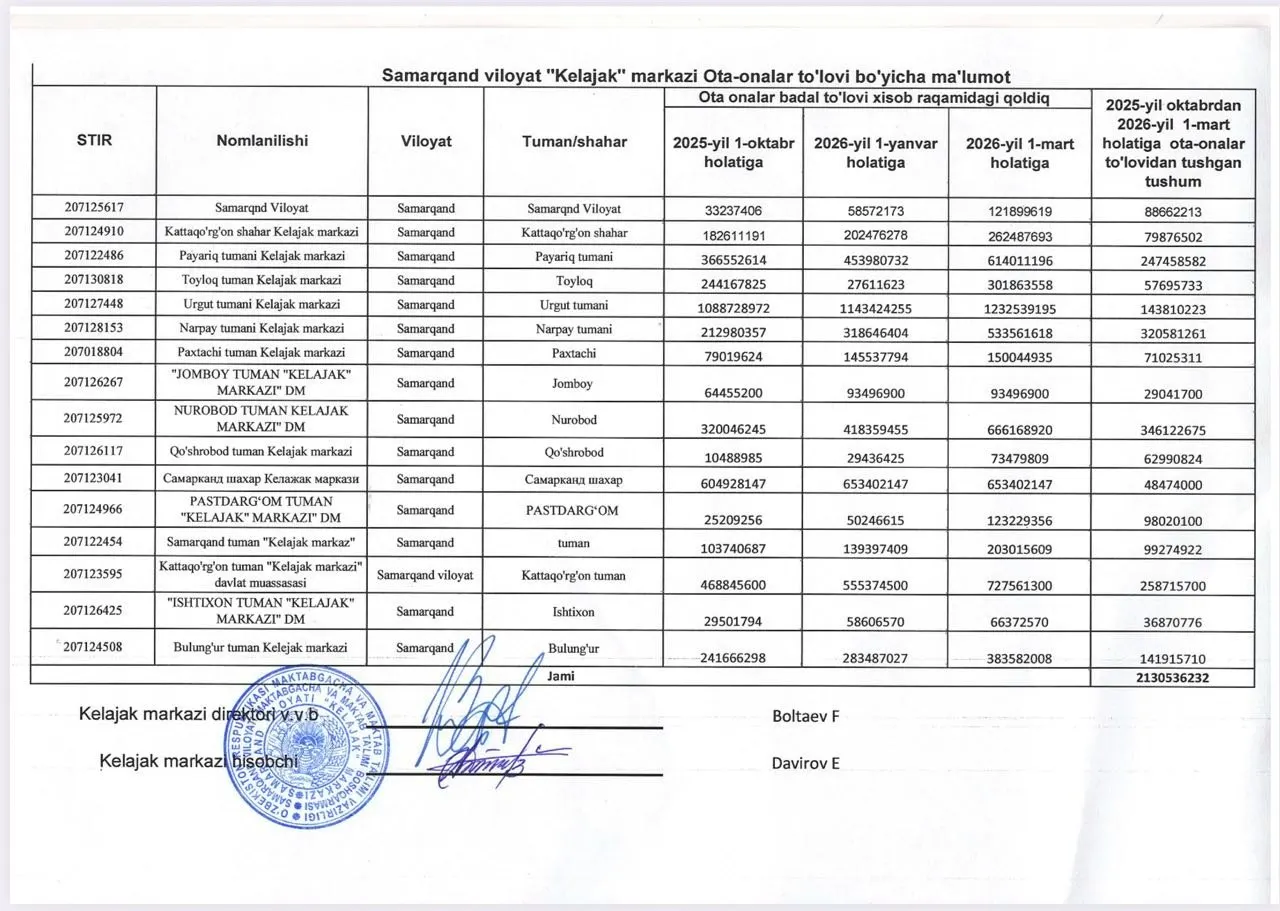
In the table attached to the letter, the total amount of funds received from parental fees across Samarkand region for the specified period is indicated as:
21 billion 305 million 36 thousand 322 sums.
10 percent of this:
Around 2 billion 130 million 503 thousand 632 sums.
That is, nearly 2.13 billion sums must be transferred to the foundation under the Republican Kelajak Center. The notable aspect here is that the calculation period in the letter started from October 1, 2025.
Meanwhile, the main mechanisms regulating the activities of Kelajak centers were detailed later, specifically by Cabinet of Ministers Decree No. 776 dated December 10, 2025. This decree approved the establishment of Kelajak centers on the basis of Barkamol Avlod children's schools, the support foundation for the centers, and the procedure for using parental payments in the centers. Furthermore, the established amounts of parental payments were implemented starting January 1, 2026.
At this point, a natural question arises:
What was the legal status of funds received from parental fees during the period from October 1 to December 31, 2025?
If these funds were formed during that period within the framework of the activities of Barkamol Avlod children's schools, what is the exact legal basis for subsequently transferring them as a 10 percent deduction to the Kelajak Centers Support Foundation?
This question must be answered.
And the numbers raise even more serious questions
In the main indicators table of the Samarkand regional Kelajak center prepared as of September 2026, student coverage in 2025 and 2026 is compared.
It shows:
December 2025 — 48,134 people;
January 2026 — 37,750 people;
September 2026 — 18,702 people.
Thus, from December 2025 to September 2026, coverage by Kelajak centers in Samarkand region decreased by 29,432 people. In percentage terms, this means a decline of approximately 61.1 percent.
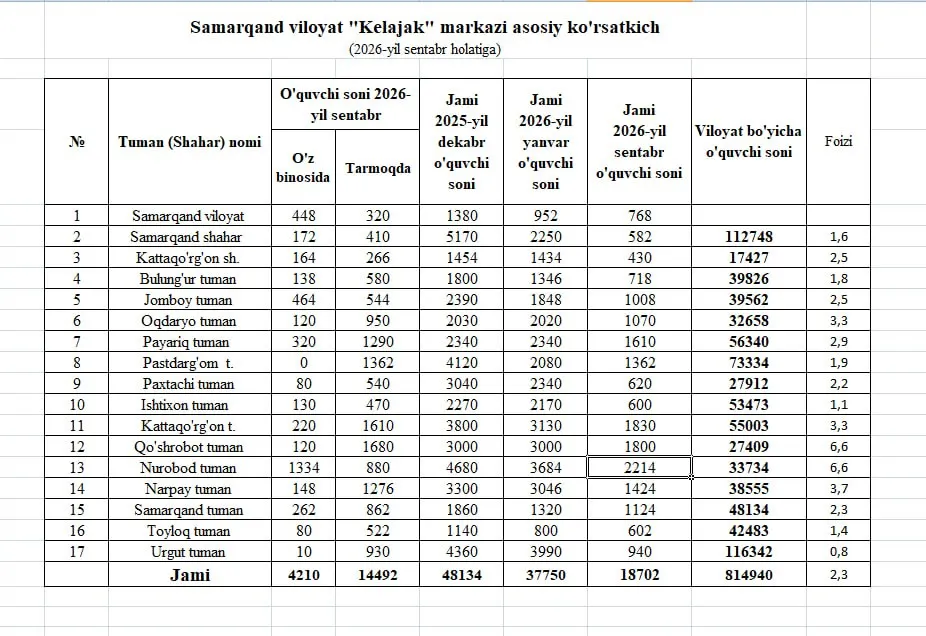
Another figure draws attention: in January 2026 alone, coverage dropped to 37,750 people. That means a decrease of 10,384 people was recorded within a single month. By September, the figure shrank even further.
The difference in certain regions is very large
For example:
Samarkand city — dropped from 5,170 to 582 people;
Urgut district — from 4,360 to 940 people;
Pastdargom district — from 4,120 to 1,362 people;
Pastdargom (note: duplicated district name in original text) — from 3,040 to 620 people;
Ishtikhan district — from 2,270 to 600 people;
Kattaurgon district — from 3,800 to 1,830 people;
Narpay district — from 3,300 to 1,424 people.
These figures require a separate explanation if the statistics for the two periods were formed on the basis of the same calculation methodology.
Why did coverage shrink two to three fold in certain regions during the transition to the new system?
What is the reason for this?
Did students actually leave the clubs?
Did the increase in the amount of parental fees have an effect?
Were organizations re-registered?
Or did the methodology for calculating the 2025 and 2026 statistics change?
If the methodology changed, this should also be openly explained. Interestingly, this is not even the republic — it is just Samarkand
The most important aspect is that we are currently reviewing figures for only one region. In Samarkand region alone, coverage that was over 48 thousand in December 2025 dropped to 18.7 thousand by September 2026.
Now it is interesting to see what picture emerges if the exact same data across the republic — broken down by Karakalpakstan, Tashkent city, and all regions — is compared.
If a similar trend exists on a national scale as well, this is not a simple statistical change, but rather requires a serious analysis regarding the effectiveness of the transition process to the Kelajak centers.
After all, the presidential decree stipulated that one of the main goals of the system is to more broadly involve children in extracurricular education. The decree also envisages the systematic formation and maintenance of a database on the enrollment of students in extracurricular education institutions.
Therefore, the sharp decline in coverage after transitioning to the new system is an issue that must be explained to the public.
Another question: there is money, but where is the result?
Decree No. 776 established the Kelajak Centers Support Foundation and specified that 10 percent of funds received from parental payments should be directed to this foundation. It is intended that foundation funds be spent on purposes such as updating the material and technical base of the centers, constructing and repairing buildings, and providing equipment, computers, and other necessary tools.
Here, too, there are questions that should be open to the public:
How much funds entered the foundation during 2026?
How much of them was returned to the regions?
How much funds were allocated to which centers?
What equipment was purchased?
Which buildings were repaired?
By whom is the effectiveness of these funds monitored?
Because the money collected from parents is not just a small amount. This is the money of a family paying for their child's education. Therefore, it is the legitimate demand of the public for it to be open where every single sum goes.
The personnel issue also remains open
The issue is not only about parental payments. According to available information, the salaries of employees who worked in Barkamol Avlod children's schools were calculated based on Kelajak centers starting from January 2026.
If this information is confirmed by official orders, staffing tables, tariffication, and salary calculations, another important question arises:
If remuneration for labor regarding Kelajak centers began in January 2026, why were the funds received from parental fees for the foundation of these centers calculated starting from October 1, 2025?
There should be a consistent approach here:
shouldn't the legal status of expenses and obligations be harmonized with the exact same period from which income was considered to belong to Kelajak?
Certainly, financial and legal documents will determine the precise answer to this.
The biggest question — what did Kelajak centers change?
What was the expected result from the new system? Greater child coverage. Quality clubs. Modern equipment. Qualified specialists. A transparent and understandable payment system for parents. Open and targeted spending of financial funds. But for now, using Samarkand as an example, different figures lie before the public:
48,134 students — 18,702 students.
21.3 billion sums — funds received from parental fees.
2.13 billion sums — 10 percent foundation deduction.
And most importantly:
The 10 percent calculation began on October 1, 2025.
Each of these figures requires its own explanation.
Questions that the Republican Kelajak Center must answer
In this regard, it is important to obtain clear and documented answers from the leadership of the Republican Kelajak Center, Indira Kholdorova, to the following questions:
What was the legal status of funds received from parental fees from October 1 to December 31, 2025?
On what basis were 10 percent of these funds calculated for the Kelajak Centers Support Foundation starting from October 1, 2025?
Were the 2.13 billion sums calculated for Samarkand region actually transferred to the foundation?
To the bank account of which legal entity did the funds received in October–December 2025 arrive?
From which organization's staff and source of funding was the labor activity during October–December 2025 carried out for employees whose salaries were calculated based on Kelajak centers from January 2026?
Why did student coverage in Samarkand region drop from 48,134 people in December 2025 to 18,702 people in September 2026?
What caused the decline in coverage of over 61 percent?
Was the student calculation methodology identical in 2025 and 2026?
What is the total coverage across the republic as of December 2025 and September 2026?
How much funds entered the Kelajak Centers Support Foundation nationwide during 2026, and how much of these funds and for what purposes were they spent?
These questions must not remain unanswered. Because this is not simply about an organization's internal accounting. It is about children's extracurricular education, parents' money, and how the new system created by the state is working in practice.
Did the Kelajak centers truly open the door to new opportunities for children?
Or did the system change, the names change, the financial mechanisms change, but the result did not turn out as expected? For now, the figures coming from Samarkand region do not give a positive answer to these questions.
On the contrary, they raise even more questions.
Now it is the turn of Republican Kelajak Center Director Indira Kholdorova, the Ministry of Preschool and School Education — Erkin Turdimov (note: referring to regional leadership or officials).
The public must be explained not numbers, but the real picture standing behind the numbers.