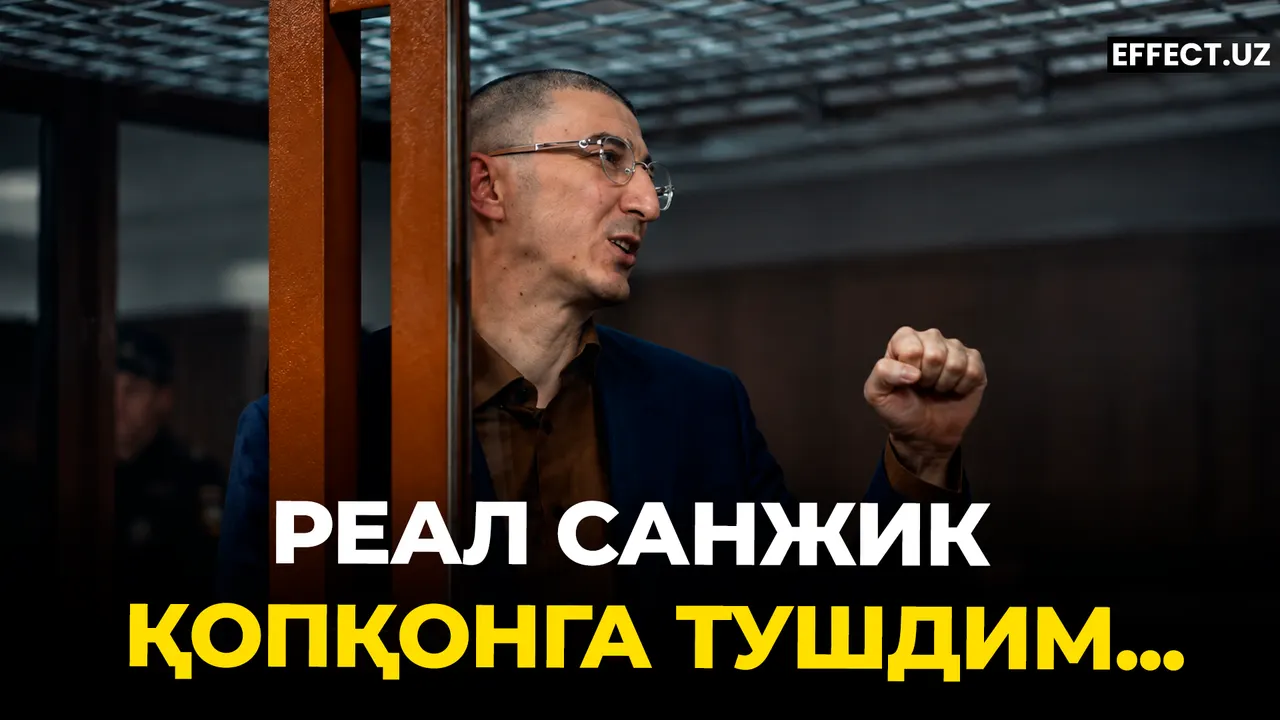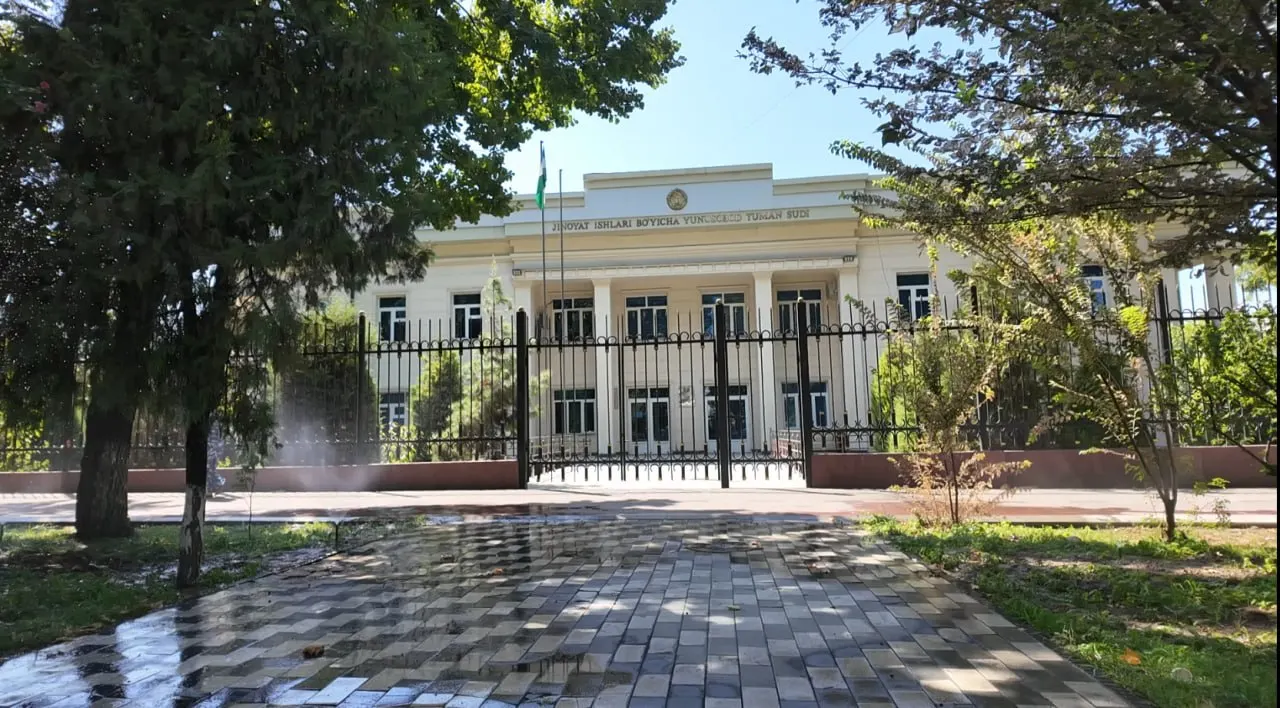
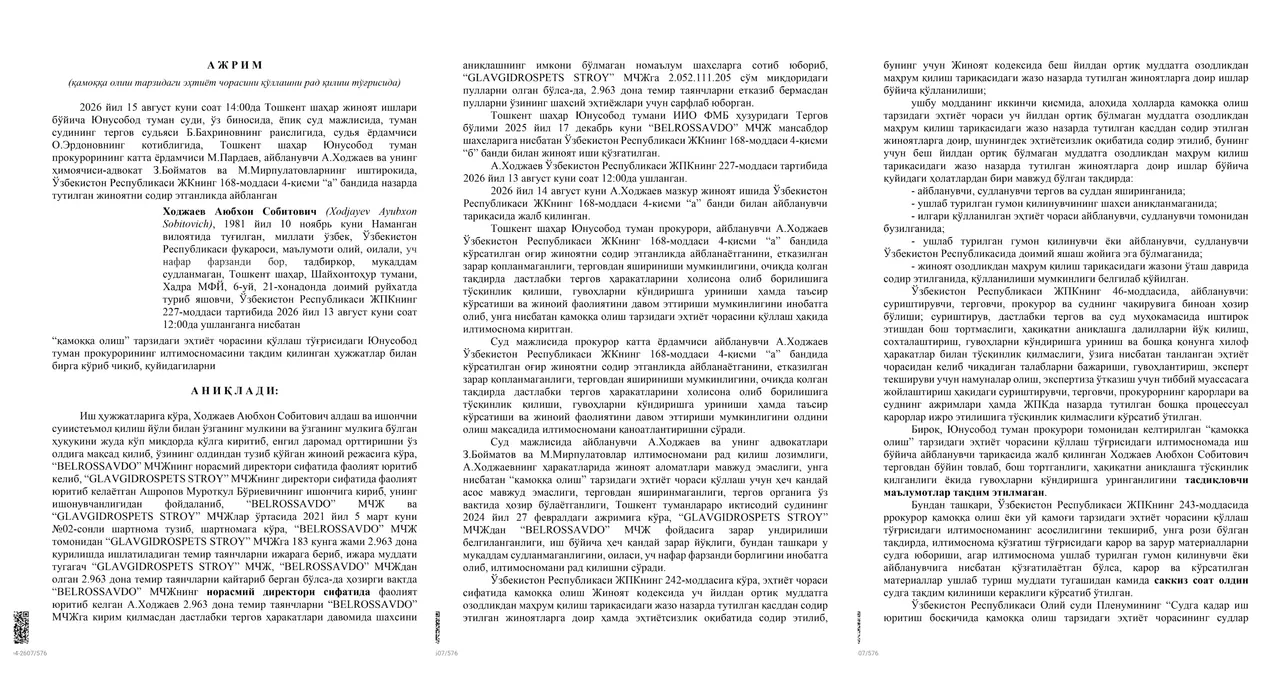
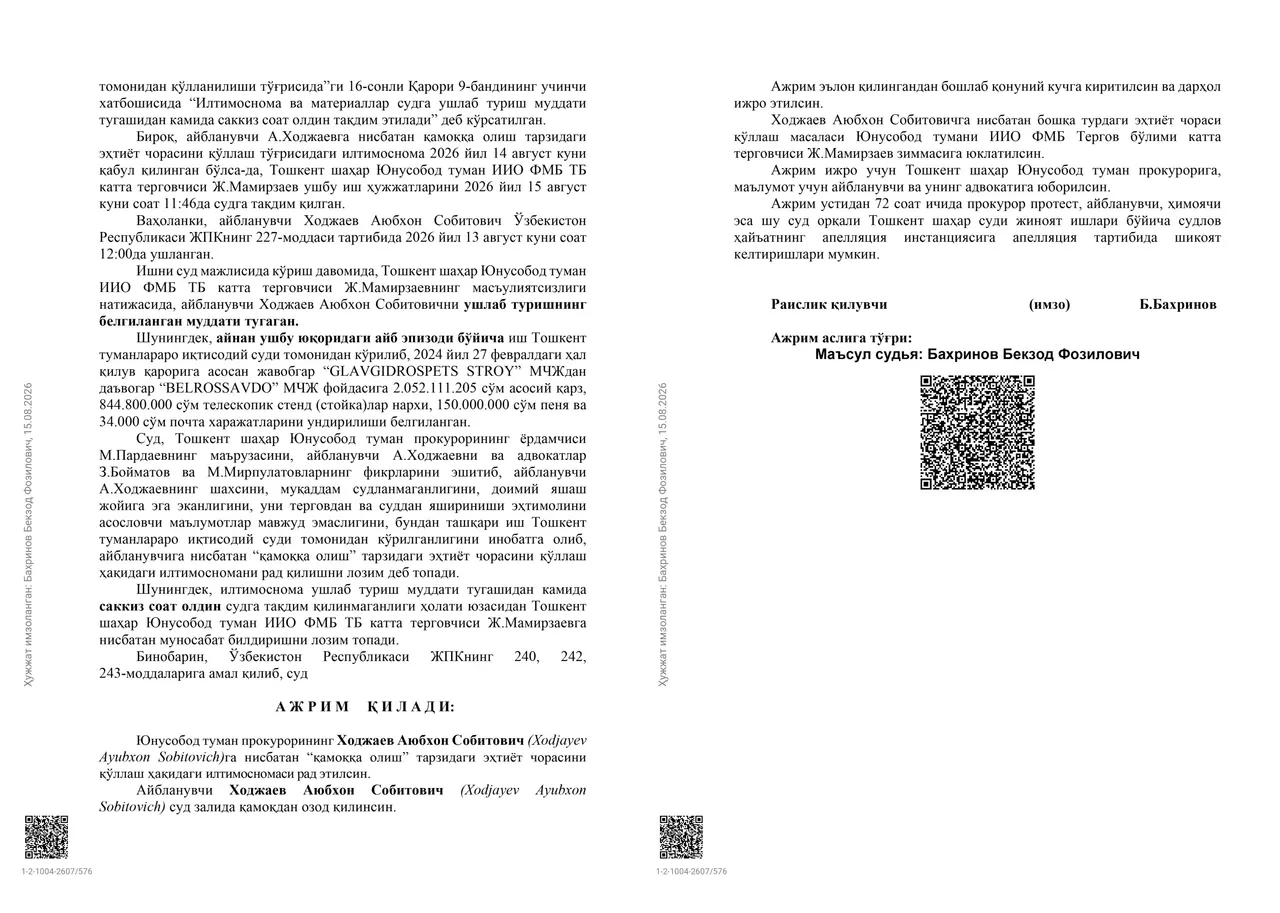
The prosecutor's office motion to apply a preventive measure in the form of detention against Ayubxon Xoʻjayev, a representative of “BELROSSAVDO” LLC, was reviewed by the Yunusobod District Court on August 15. The court did not satisfy the prosecutor's motion and refused to apply the preventive measure of detention against Xoʻjayev. The court document was signed by judge Bekzod Baxrinov.

A representative of “BELROSSAVDO” LLC contacted our editorial office regarding this case. The submitted documents show that the chain of events goes beyond a simple criminal case, demonstrating that a dispute previously heard in an economic court was subsequently turned into a criminal case and ultimately reached the issue of imprisoning the company representative.
What happened in the economic court first?
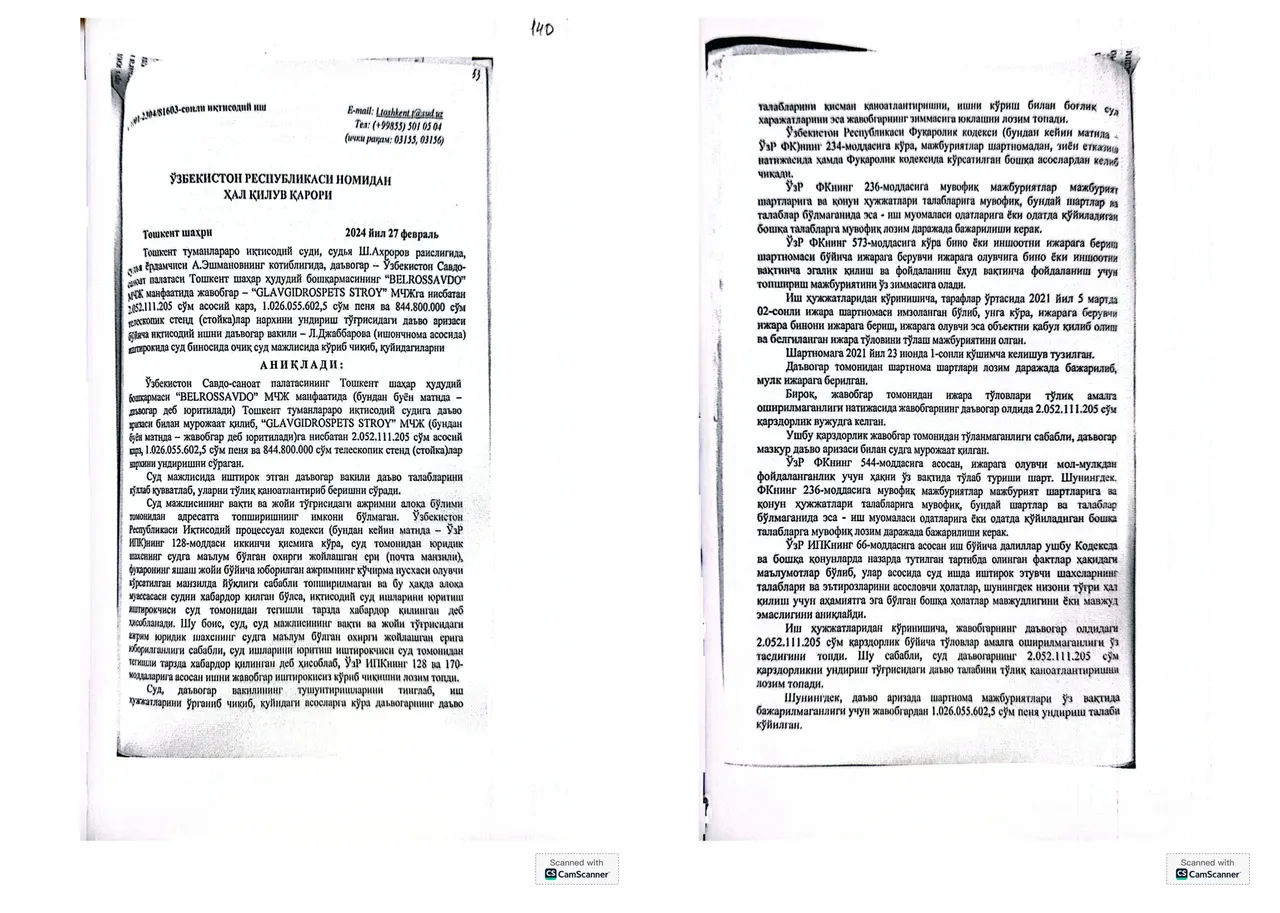
The root of the dispute traces back to contractual relations between “BELROSSAVDO” and “GLAVGIDROSPETS STROY” LLCs. By a ruling of the Tashkent Interdistrict Economic Court dated February 27, 2024, it was established to recover 2 billion 52 million 111 thousand 205 sums of principal debt, 844.8 million sums for the value of telescopic stands, 150 million sums in penalties, and other funds from “GLAVGIDROSPETS STROY” LLC in favor of “BELROSSAVDO” LLC.
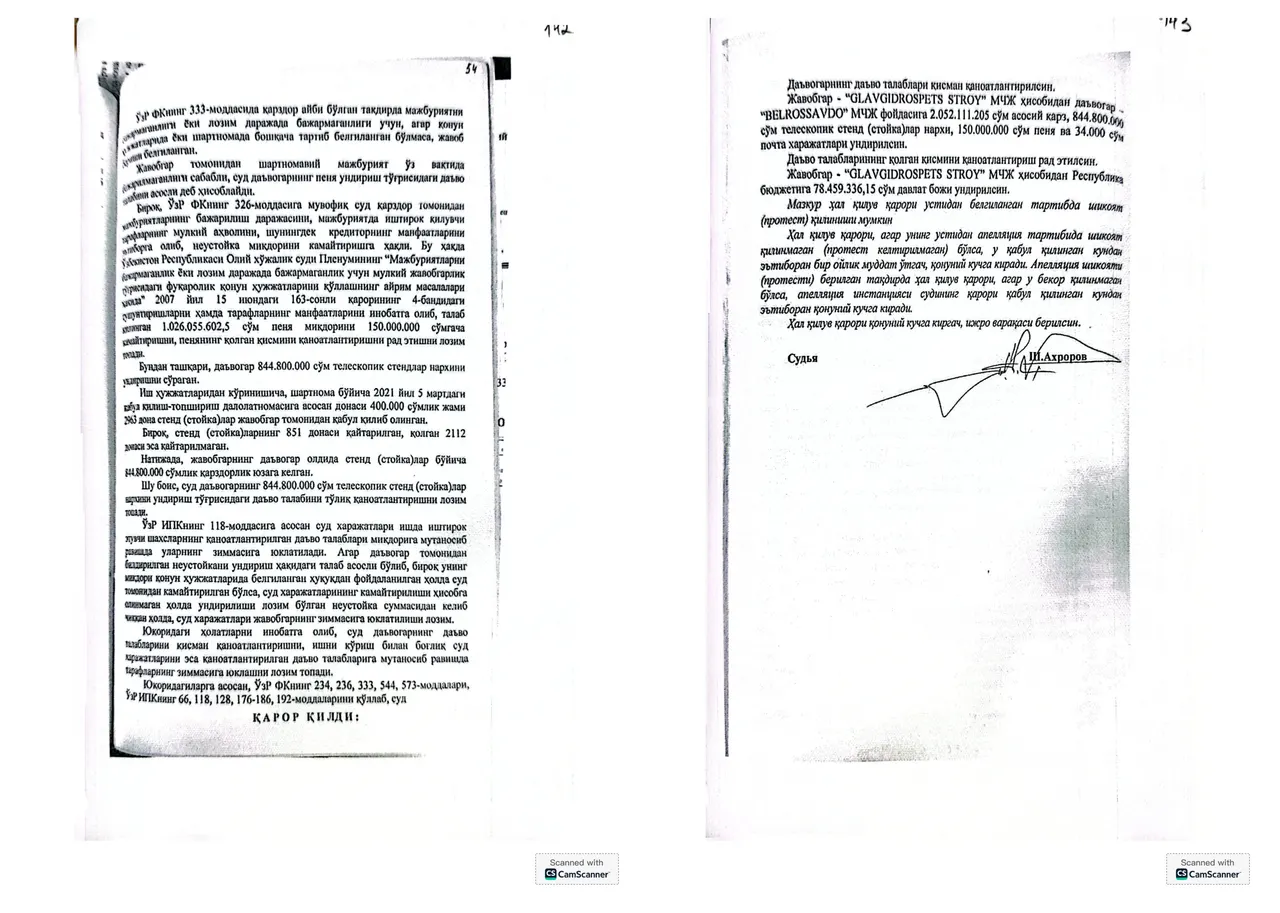
Later, the cassation instance changed the value of the telescopic stands from 844.8 million sums to 422.4 million sums, while the rest of the ruling was left unchanged. Enforcement writs were issued on July 30, 2024.
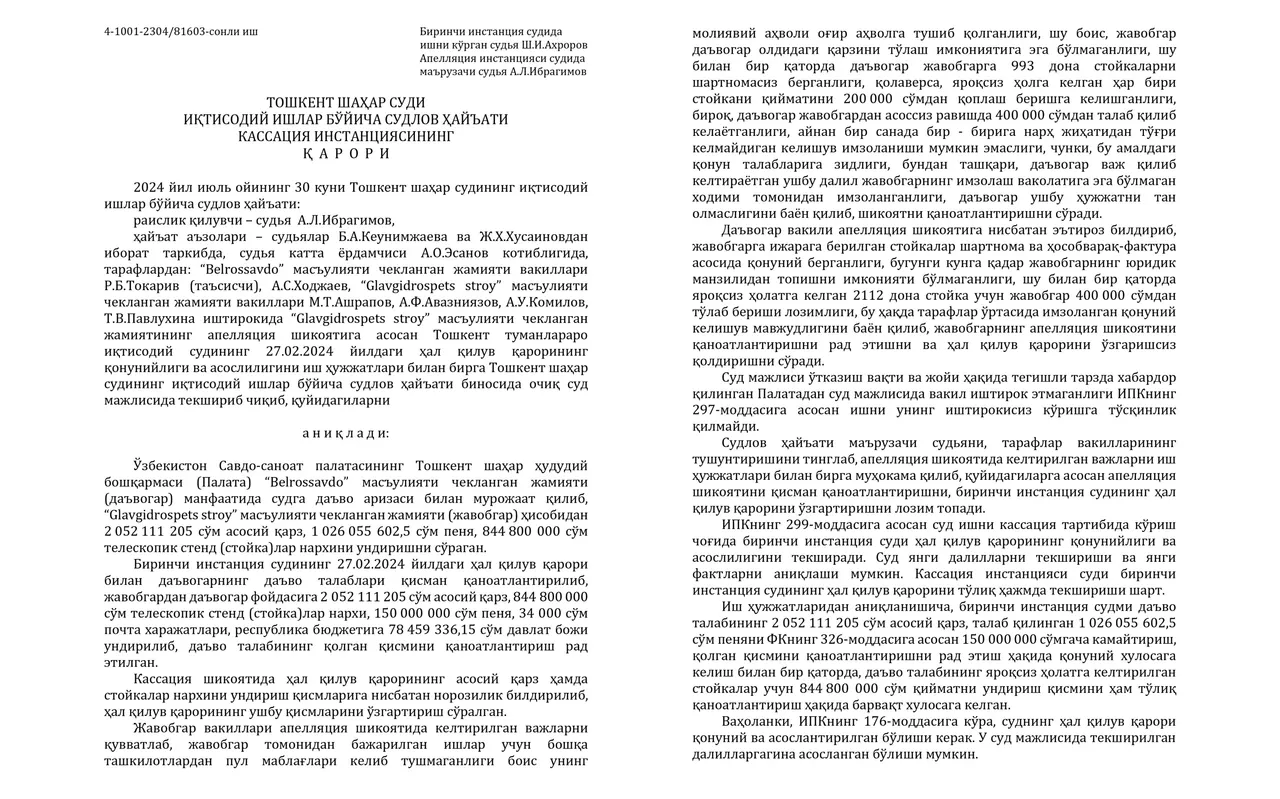
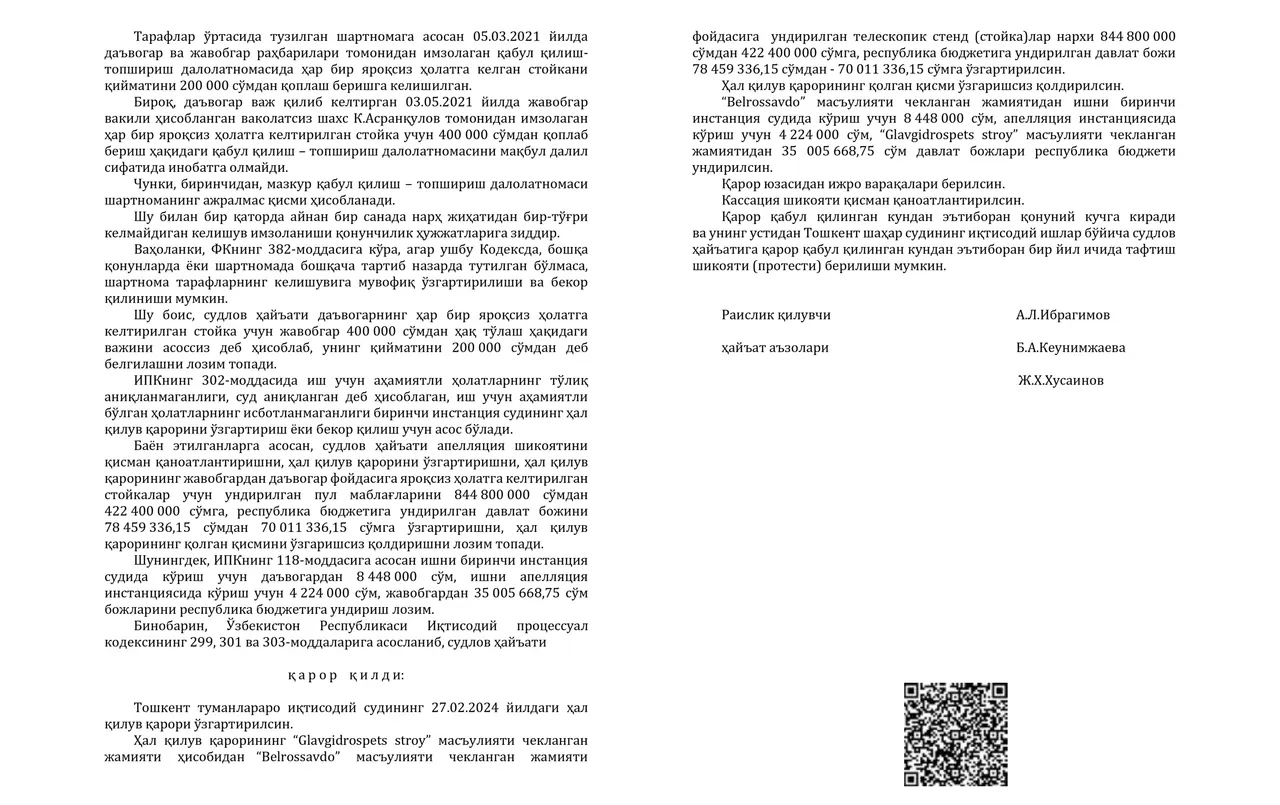
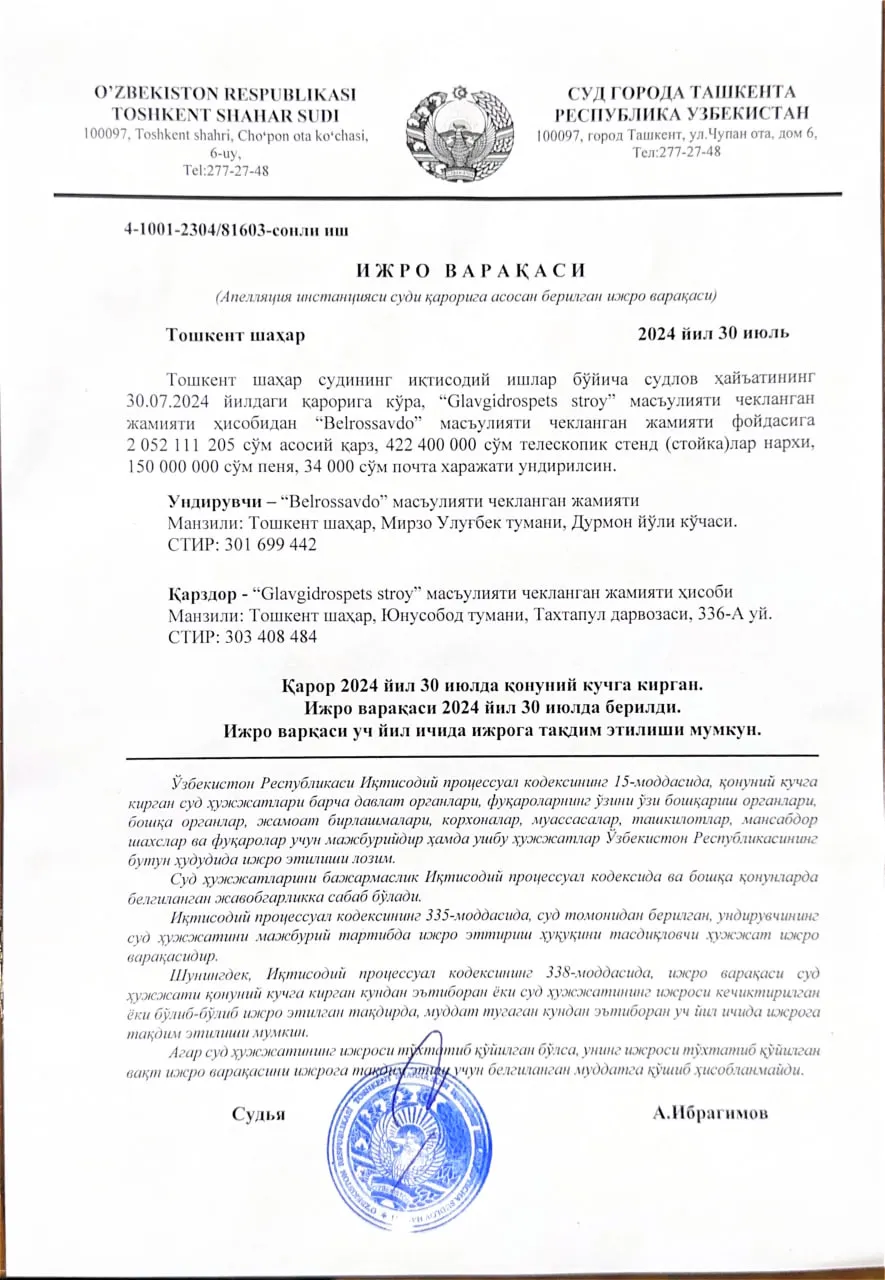
Furthermore, based on the economic court's enforcement writ, the funds were recovered and credited to BELROSSAVDO's bank account the very next day, meaning less than 24 hours later, a freeze was placed on the bank account. By a decision of the review instance dated September 5, 2024, the cassation ruling was left unchanged.
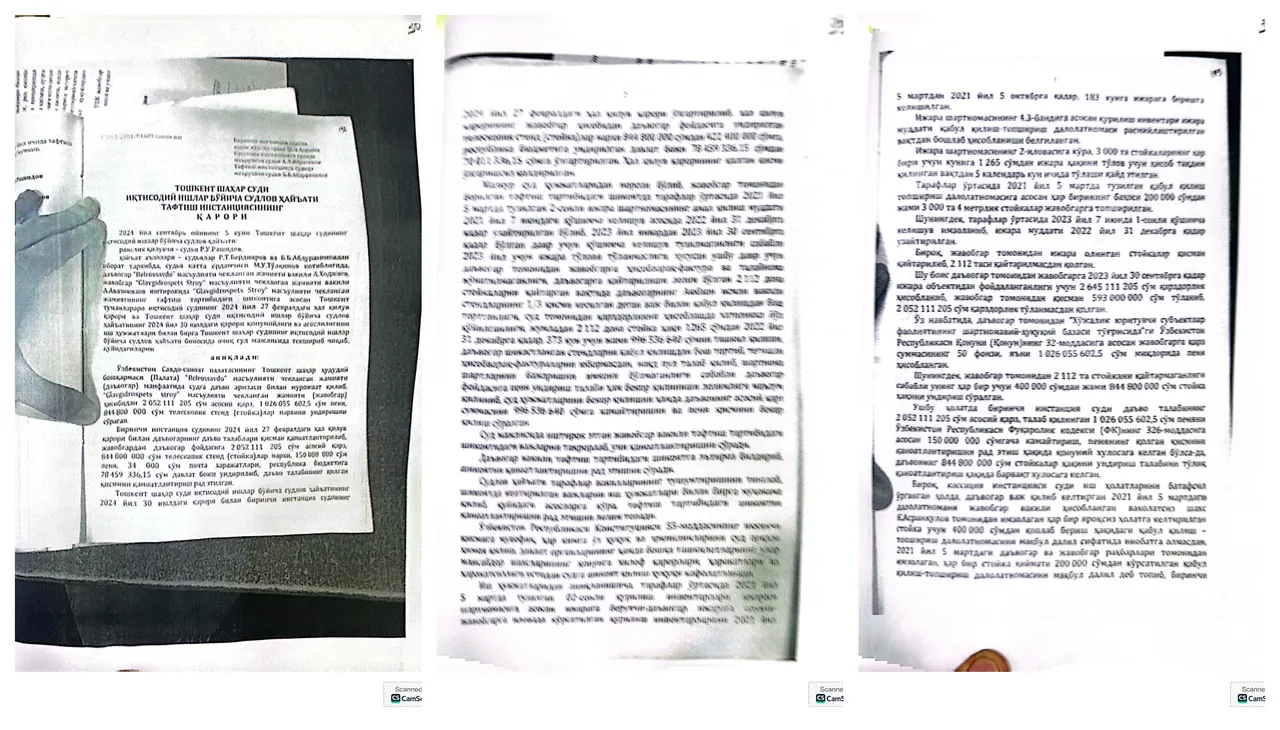
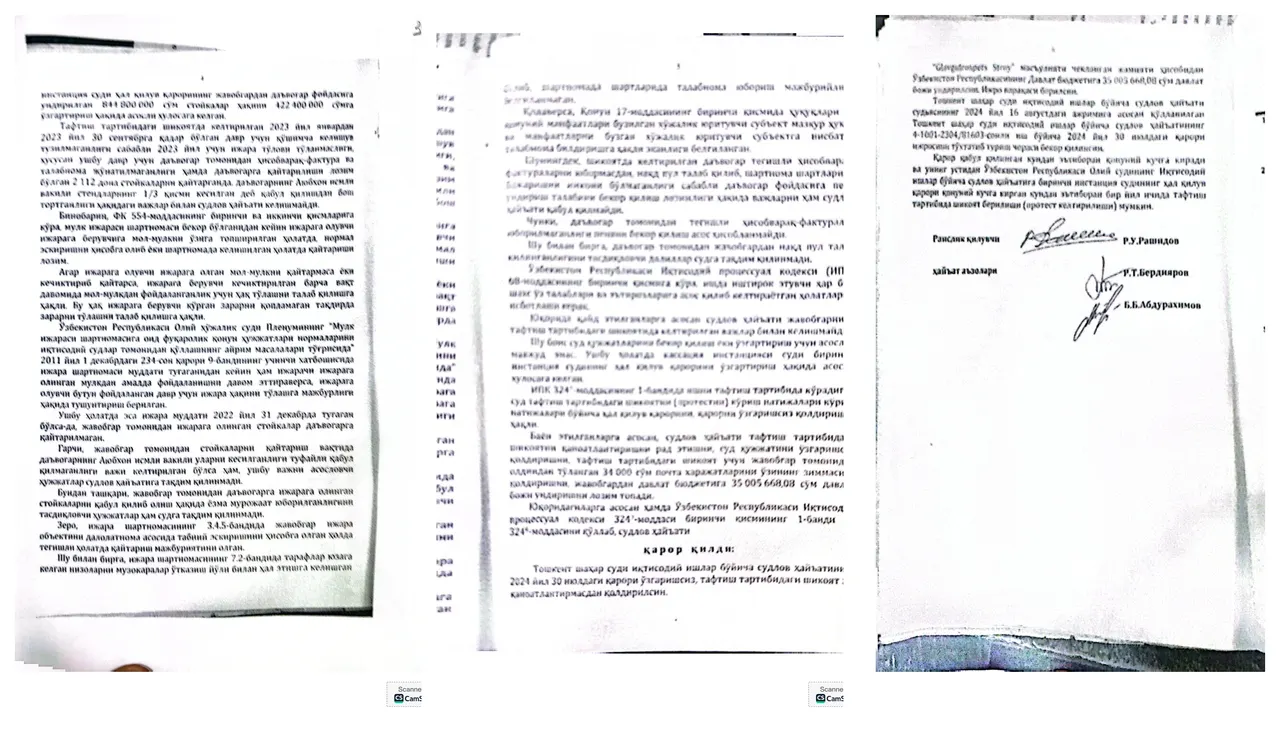
Additionally, as noted in the ruling of the cassation instance of the judicial panel for economic cases of the Tashkent City Court dated June 1, 2026, the ruling of the judicial panel for economic cases of the Supreme Court of the Republic of Uzbekistan dated December 2, 2024, refused to transfer the respondent's appeal in review procedure for consideration by the judicial panel. In other words, the dispute passed through multiple judicial instances, not just one.
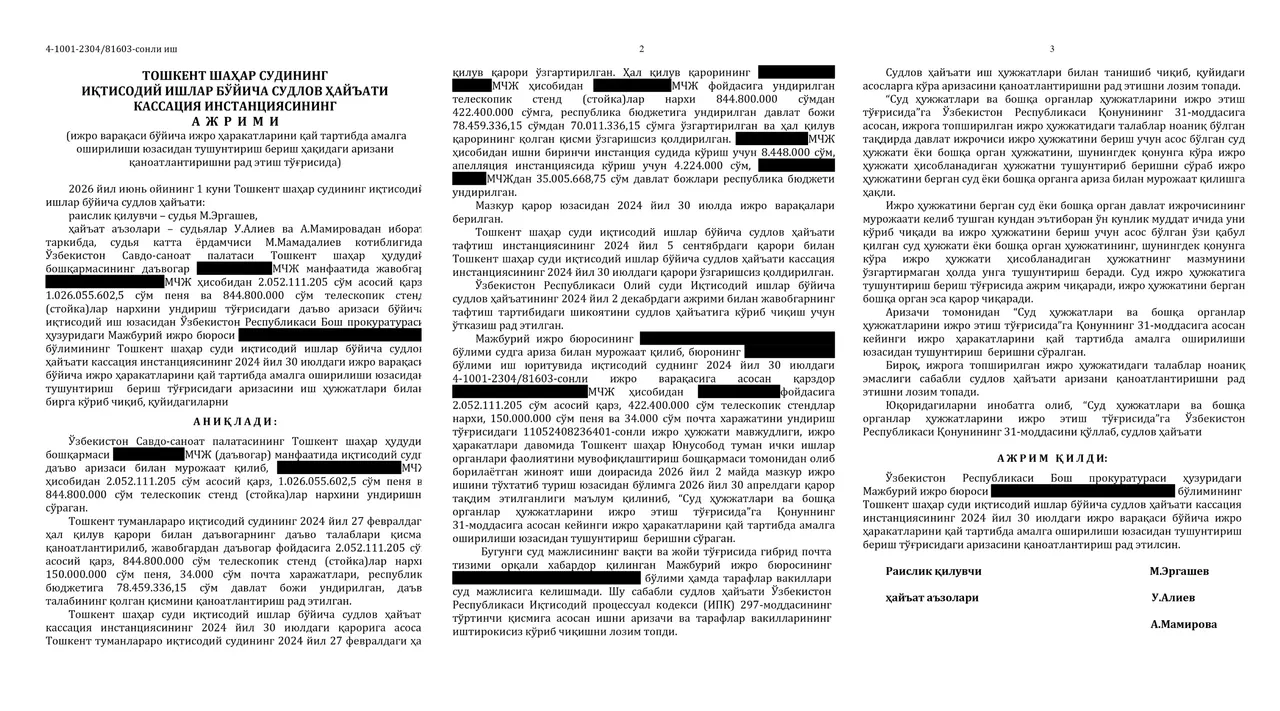
Based on the enforcement documents, it was established to recover over 2 billion 52 million sums of principal debt, 422.4 million sums for the value of telescopic stands, and 150 million sums in penalties in favor of “BELROSSAVDO”.
The economic dispute turned into a criminal case
As stated in the document submitted to the court by “BELROSSAVDO” lawyers, the criminal case was initiated based on an application filed by Murotkul Ashrapov, Director of “GLAVGIDROSPETS STROY” LLC, addressed to the head of the Yunusobod District Internal Affairs Department on November 17, 2025.
Ashrapov's application claimed that a rental agreement for construction inventory was concluded with “BELROSSAVDO” on March 5, 2021, that 2,963 iron supports were delivered and subsequently returned to “BELROSSAVDO”, but the company denied this and submitted false information to the economic court, resulting in a court ruling in its favor.
On this basis, a criminal case was initiated against the officials of “BELROSSAVDO” LLC under Article 168 (fraud), part 4, paragraph “b” of the Criminal Code. However, there are serious objections to the legality of initiating this case.
“Documents were examined in the economic court”
In the motion submitted to the court by Xoʻjayev, it was emphasized that before the adoption of the Tashkent Interdistrict Economic Court's decision dated February 27, 2024, the legality, reliability, and relevance of the documents submitted by the parties were studied during the court hearings.
According to Xoʻjayev's position, if any violations of the law or false information had been identified in the documents submitted by “BELROSSAVDO” during the court proceedings, the court could have issued a separate ruling regarding this circumstance.
Despite this, the investigative department under the Yunusobod District Internal Affairs Department initiated a criminal case on December 17, 2025, without examining the documents submitted by “BELROSSAVDO” and in violation of the requirements of Articles 320², 329, and 330 of the Criminal Procedure Code.
Also, regarding the initiation of a criminal case against a business entity concerning a fact related to entrepreneurial activity, the issue of prosecutor's consent defined in Article 331 of the Criminal Procedure Code is noteworthy.
That is, the Tashkent City Prosecutor's Office did not examine whether there were sufficient grounds to initiate a criminal case, and the case was initiated “with the interference of the Yunusobod District Prosecutor's Office”, “in the interests of a person indicated as the unofficial head of “GLAVGIDROSPETS STROY” LLC.
The criminal case was terminated, then reinstated
Another important aspect of this case is the fate of the criminal case. According to another document, based on complaints filed by “BELROSSAVDO” LLC representative A. Xoʻjayev to the Tashkent City Internal Affairs Directorate and the Tashkent City Prosecutor's Office, the criminal case was re-examined in a supervisory procedure. As a result, a decision was made to terminate the criminal case on the basis of Article 83, paragraph 2 of the Criminal Procedure Code. However, this decision was revoked by the city prosecutor's office.
It was reported that the case was sent not to another investigative body, but again through the Yunusobod District Prosecutor's Office to the investigative department under the Yunusobod District Internal Affairs Department.
Another question arises here: if the criminal case was reviewed in a supervisory procedure and a decision to terminate it was made, why was this decision revoked and what exact grounds caused the case to be resumed?
The proposal to return legally recovered money...
Another document contains a serious allegation. According to it, a representative came to A. Xoʻjayev on behalf of the Yunusobod District Prosecutor's Office and proposed to return 1 billion 300 million sums out of the 2 billion 624 million sums transferred to the bank account of “BELROSSAVDO” LLC based on the ruling of the Tashkent Interdistrict Economic Court No. 4-1001-2304/81603. On the contrary, the amount might be even larger.
Xoʻjayev stated that he rejected this proposal, after which psychological pressure was exerted on him and a motion to apply a preventive measure in the form of detention was submitted.
Another document contains yet another serious claim. According to it, a representative came to A. Xoʻjayev on behalf of the Yunusobod District Prosecutor's Office and proposed to return 1 billion 300 million sums out of the 2 billion 624 million sums transferred to the bank account of “BELROSSAVDO” LLC based on the ruling of the Tashkent Interdistrict Economic Court No. 4-1001-2304/81603. Xoʻjayev rejected this proposal, after which psychological pressure was exerted on him and a motion to apply a preventive measure in the form of detention was submitted. Confirmation or the reaction of the prosecutor's office or investigative bodies to these allegations is considered important for the case, should such a reaction be possible.
Were enforcement proceedings also suspended because of the criminal case?
Effect.uz studies show that the enforcement process regarding the economic court's decision also continued. The Boʻstonliq District branch of the Compulsory Enforcement Bureau stated that enforcement actions were being carried out in its proceedings based on the economic court's enforcement writ dated July 30, 2024.
However, during the enforcement process, a decision to suspend enforcement dated April 30, 2026, was presented within the framework of the criminal case conducted by the Yunusobod District internal affairs bodies.
This situation also raises one of the most important questions in this case: on what legal basis and by what procedure was the enforcement of a legally binding economic court decision suspended? Xoʻjayev's representatives state that the prosecutor's office does not have the authority to directly suspend the enforcement of a court decision. Providing a final legal assessment of this issue also falls under the position of the relevant authorities.
Detention of Xoʻjayev was requested
By August 2026, the case entered a new phase. The investigative body submitted a motion to the court to apply a preventive measure in the form of detention against A. Xoʻjayev. District prosecutor Yahyo Abdurahmonov also agreed with this motion.
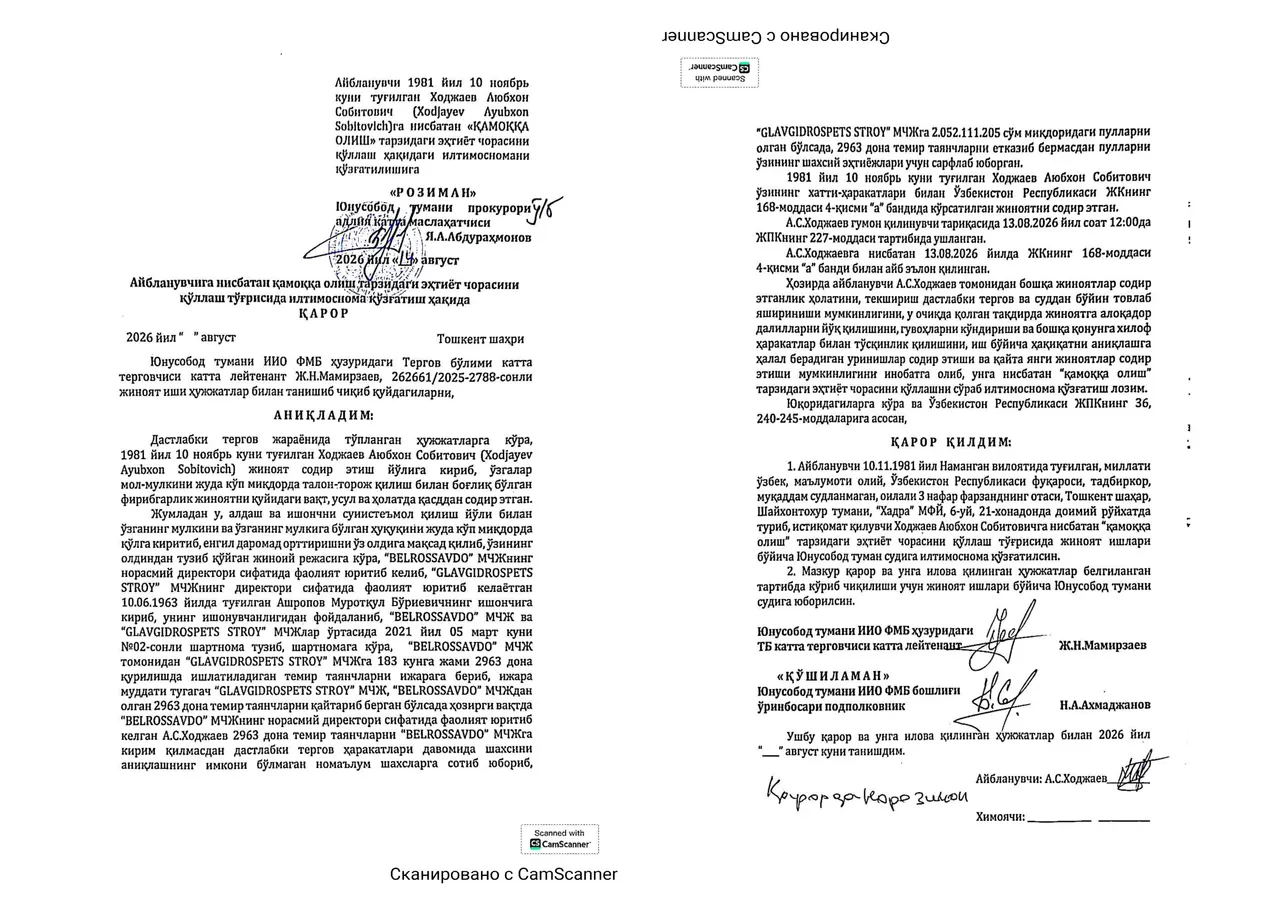
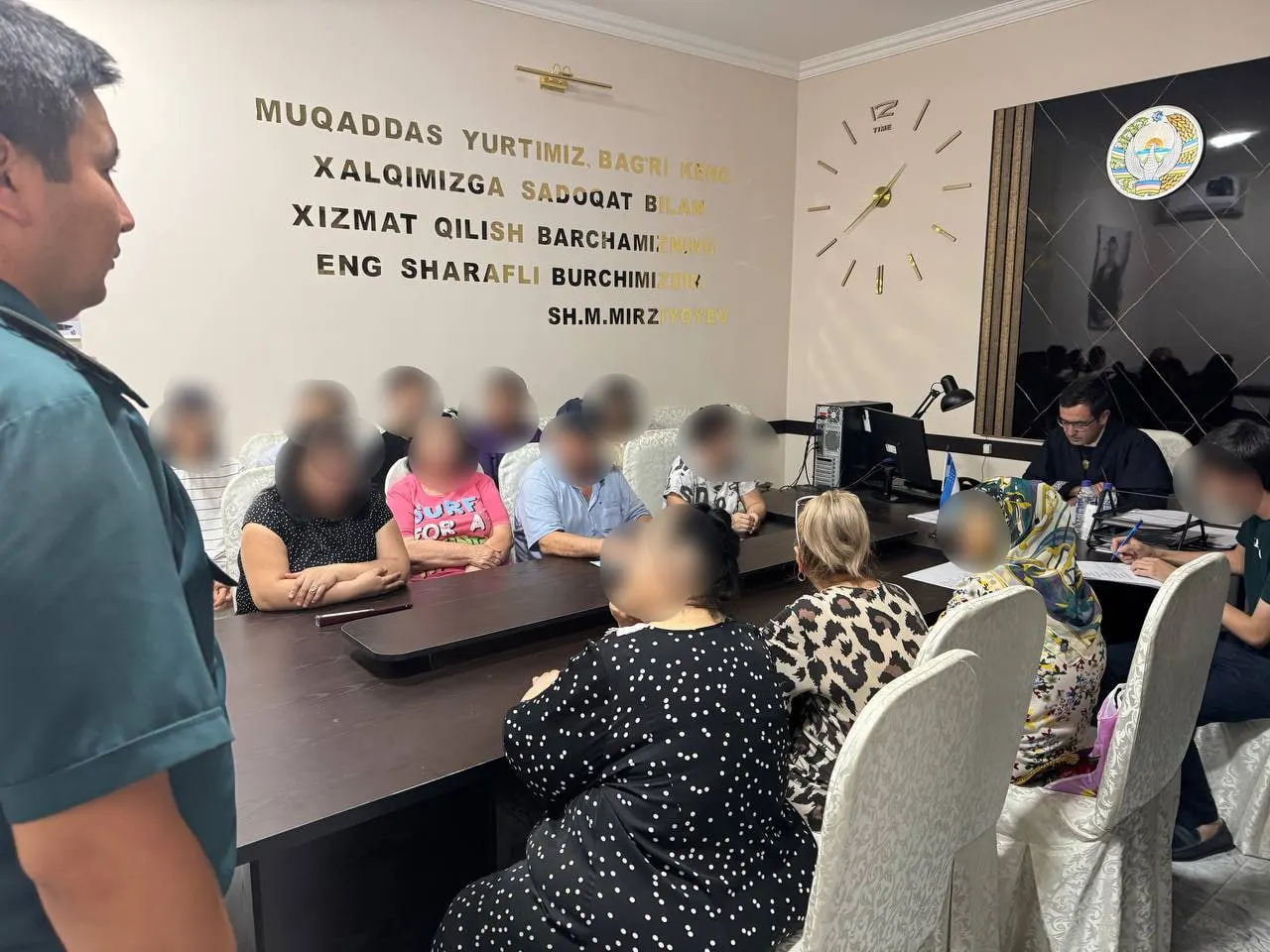
On August 15, the Yunusobod District Court reviewed this matter. As seen from the court ruling, the application of the preventive measure in the form of detention against Xoʻjayev Ayubxon Sobitovich was denied.
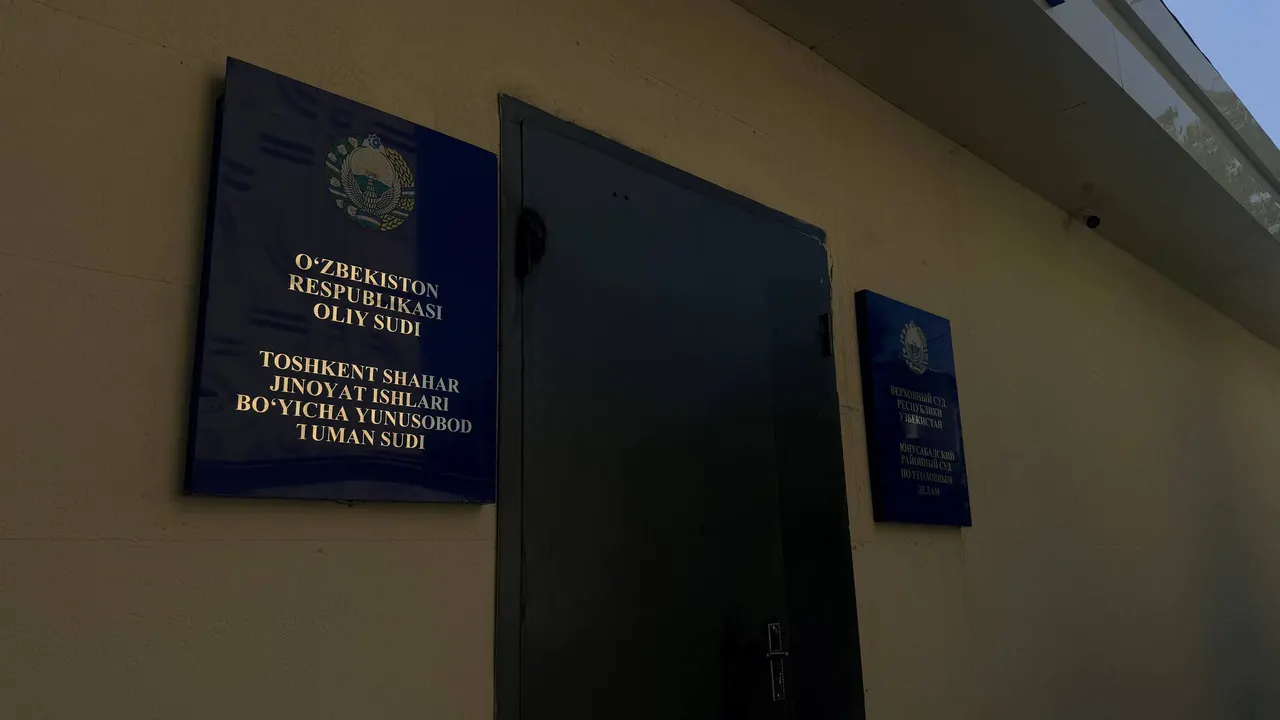
The motion was reviewed by Bekzod Baxrinov, the investigative judge of the Yunusobod District Court for Criminal Cases. It should be noted that the court ruling itself also recorded the expiration of Xoʻjayev's detention period.
Thus, one of the harshest procedural measures requested by the prosecutor's office — detention — was not applied by the court.
What questions lie behind the detention issue rejected by the court?
Now, looking at the chain of events as a whole, several important questions arise.
First, why did the dispute between “BELROSSAVDO” and “GLAVGIDROSPETS STROY”, after being reviewed in the economic court and passing through multiple instances, turn into a criminal case?
Second, if forgery or other signs of criminal activity were subsequently identified regarding the documents examined during the economic court hearings, which exact documents and evidence confirmed them?
Third, with what new or additional grounds was the criminal case, reportedly terminated on the basis of Article 83, paragraph 2 of the Criminal Procedure Code, reinstated?
Fourth, what legal mechanism served as the basis for suspending the enforcement of the economic court decision directed for execution?
And finally, why did the matter reach the point of applying a preventive measure of detention against the representative of “BELROSSAVDO”? Official responses from the prosecutor's office and investigative bodies to these are crucial. In particular, the prosecutor's office must disclose what legal grounds caused the initiation of the criminal case, its prior termination and subsequent reinstatement, the suspension of enforcement actions, and the raising of the issue of Xoʻjayev's detention. Investigating whether there is clear nepotism or cronyism behind these actions is especially the most critical step.
One day after the adoption of the Presidential Decree...
Among these events, there is another notable timing coincidence. The Decree of the President of the Republic of Uzbekistan on the “Justice — 2030” Strategy was adopted on August 14, 2026. The document defines transparency of the judicial system, protection of human rights, and strengthening of judicial control as priority tasks.
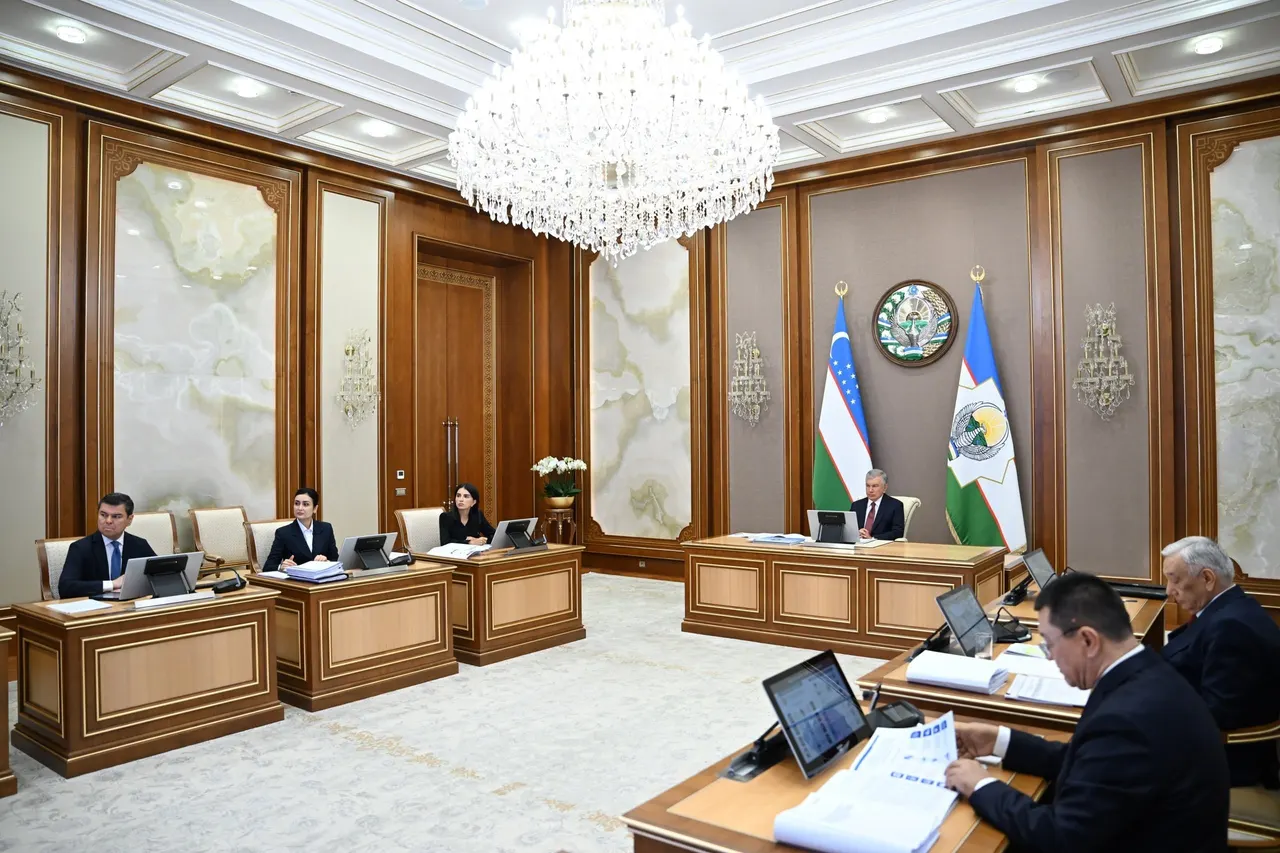
Paragraph 9 of the Decree envisages granting the investigative judge the authority, starting from July 1, 2027, based on the international standard of “reasonable suspicion” — Prima Facie, when considering motions to apply procedural coercive measures, to check the legality and validity of a person's detention, and whether there are sufficient grounds for suspicion or bringing charges. The possibility of requesting additional documents in case of doubt is also established.
Notably, the Decree was adopted on August 14, while the issue of Xoʻjayev's detention was considered in court on August 15. Of course, it is still too early to say that the Yunusobod District Court strictly followed paragraph 9 of this Decree, because according to the Decree itself, this new mechanism is to be introduced starting from July 1, 2027.
However, in terms of timing, this situation is noteworthy: just one day after the announcement of a new standard aimed at protecting human rights at the pre-trial stage and strengthening judicial control, the court rejected the prosecutor's motion for detention.
What does the prosecutor's office plan to do now?
The case has not ended with the ruling on August 15. Under current procedural procedures, there is an opportunity to file an appeal or protest against the court ruling on the issue of detention. Explanations from the Plenum of the Supreme Court provide for such an appeal or protest to be considered by the appellate instance.
Therefore, the interesting question now is:
Will the Yunusobod District Prosecutor's Office file an appeal or protest against the August 15 ruling?
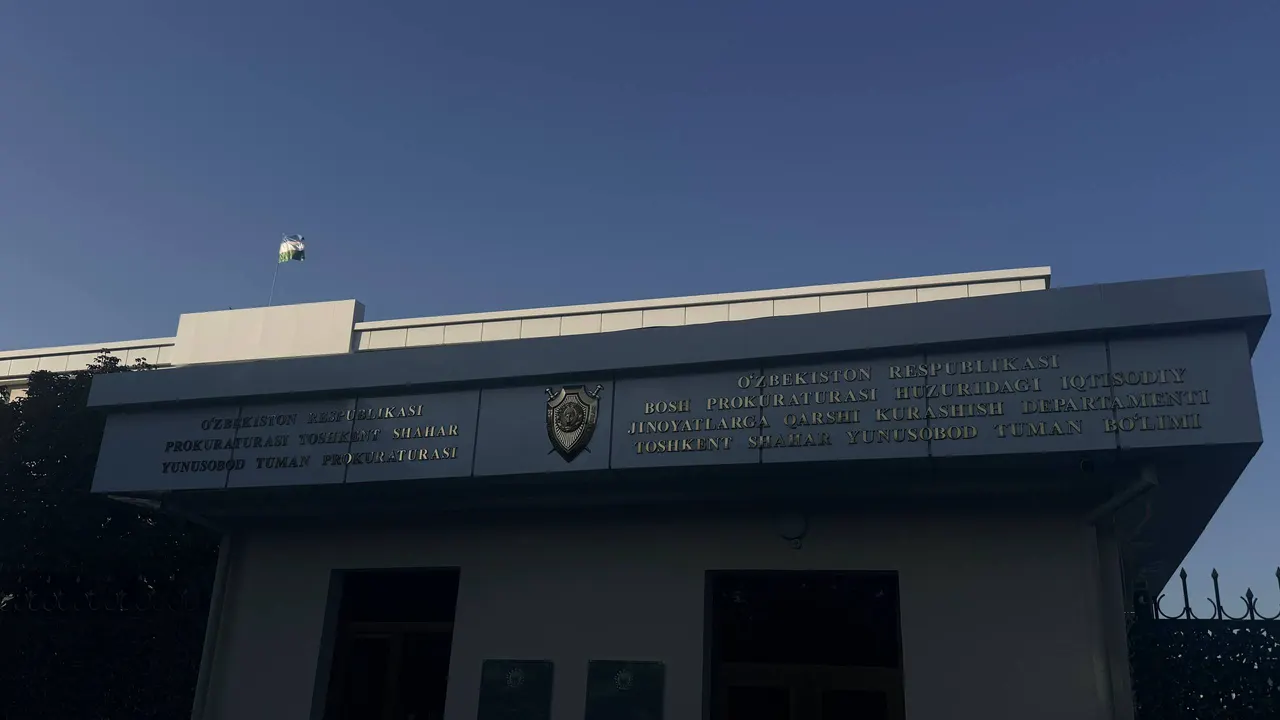
If it does, with what evidence will it justify the necessity of imprisoning Xoʻjayev?
Because the current chain of documents simultaneously contains the following circumstances:
the dispute was reviewed in the economic court;
the court decision was adopted;
the decision passed through multiple instances;
the enforcement writ was issued;
enforcement actions began and were suspended;
a criminal case was subsequently initiated based on this dispute;
the criminal case was reviewed in a supervisory procedure and terminated based on Article 83, paragraph 2 of the Criminal Procedure Code;
the decision was later revoked;
enforcement actions were suspended within the framework of the criminal case;
detention was requested for Xoʻjayev;
however, on August 15, the court refused detention.
The main question — why?
The issue in this case is not just about a criminal case being initiated against a business entity and its representative. The main question is — how did a dispute resolved in an economic court and directed for enforcement turn into a criminal case?
If the investigative bodies have sufficient evidence confirming criminal actions by officials of “BELROSSAVDO”, how do they differ from the dispute examined in the economic court?
If the criminal case is truly related to the submission of false information to the economic court, which information was false and with what evidence was this proven?
And most importantly — why are the prosecutor's office and investigative bodies continuing to act with such persistence in this case even after a decision to terminate the case was made?
Effect.uz is ready to receive official responses from the prosecutor's office and investigative bodies to these questions. Should new court documents and decisions be adopted regarding this case, we will also study them and present them to the public.