Global interest in cultural heritage tourism is increasing year by year. In 2025, cultural heritage tours accounted for 55.6% of the total tourism market. This indicator demonstrates a growing demand for meaningful travel that celebrates history, heritage preservation, and culture.
According to experts, this direction will continue to develop rapidly in the coming years. Projections suggest that the cultural heritage tourism market could grow from 647.5 billion US dollars in 2026 to 937 billion US dollars by 2033. During this period, the average annual growth rate of the sector is expected to be around 5.4%.
In recent years, Turkey has been gaining attention as one of the leading tourist destinations for discovering humanity's shared history. In this country, one can closely get acquainted with a unique historical heritage, ranging from Göbeklitepe, one of the oldest human-made monumental complexes in the world, to the city of Troy, which inspired the great legends of Western civilization.
Today, while preserving its cultural riches for future generations, Turkey pays special attention to creating a more meaningful and immersive experience for tourists. To this end, restoration and conservation projects are being consistently implemented across the country. Among recent initiatives, restoration work carried out at the Andriake archaeological site and the Museum of Lycian Civilizations, as well as the opening of the Syedra Visitor Center, hold a special place.
Following extensive renovation and landscaping work, Andriake and the Museum of Lycian Civilizations, located in the Demre district of Antalya in the heart of the Turkish Riviera, have reopened to visitors. At the same time, Syedra, located in Alanya—one of Antalya's most popular resort destinations—has also started welcoming guests through its new visitor center.
Andriake and the Museum of Lycian Civilizations offer a fresh perspective on ancient Lycia
Andriake maintained its status as one of the region's main ports during the Hellenistic, Roman, and Eastern Roman periods. Today, Andriake allows visitors to closely experience the rich history and maritime culture of ancient Lycia. The well-preserved ruins complex located in the southern part of the ancient harbor clearly demonstrates its historical significance. Particularly striking here are the aqueduct that once supplied clean water to the city, the nymphaeum—a majestic Roman-era fountain—the Harbor Street, the partially preserved boat shelters along the street, and the agora known as Plakoma. These monuments show that Andriake was not only a trade and maritime center, but also one of the important cultural spaces of ancient Lycian life.
Andriake is also significant because it is located along the Lycian Way, Turkey's first long-distance hiking trail. This route has been recognized by leading international publications such as Time Out as one of the most beautiful hiking routes in the world. Recently, it also secured a spot on The Telegraph's list of "Europe's 15 Best Walking Holiday Destinations."
As part of the restoration and landscaping efforts, eco-friendly walking paths made of wooden beams and crushed granite stone were constructed while preserving the historical appearance of the archaeological area. These paths provide visitors with a more comfortable way to explore the complex and a deeper appreciation of ancient Lycian maritime heritage.
At the end of the walking path, inside the archaeological area, the Museum of Lycian Civilizations welcomes visitors in the ancient granary building known as the Granarium. Following recent updates, this restored historical structure has taken on a new look as a museum with modern exhibition spaces.
The museum's exhibition showcases artifacts discovered during excavations in ancient Lycian cities. Statues, sarcophagi, inscriptions, coins, and other unique finds are placed in modern exhibition halls, giving visitors a comprehensive view of Lycian life, culture, and art.
Among the most notable exhibits of the museum in recent years are glass panels and rosettes discovered in Andriake in 2024. Decorated using the Millefiori technique, meaning "a thousand flowers," these finds indicate that the art of glassmaking was highly developed in ancient Anatolia.
The new visitor center has started operations in Syedra.
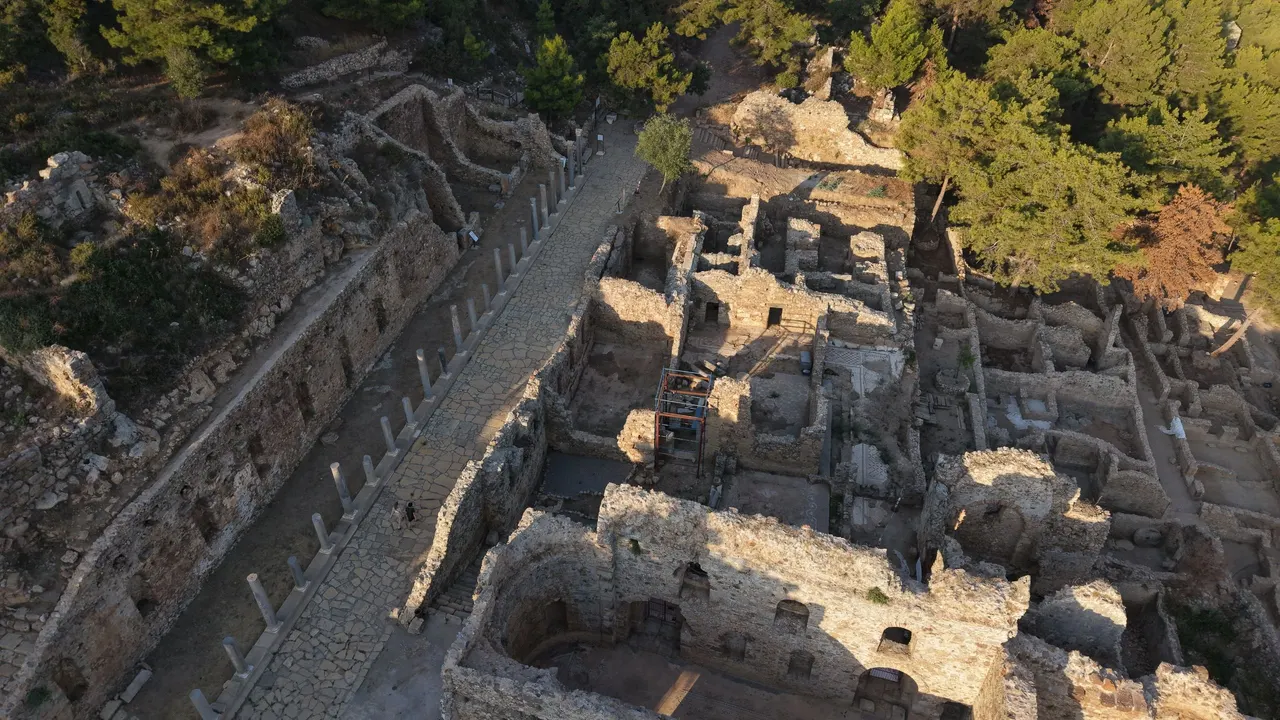
Syedra was built on the peak of a hill known among locals as Asartepe, which offers unique views of the Mediterranean Sea. Archaeological excavations show that the history of the city dates back to the 9th century BC. The periods of Syedra's greatest prosperity fall within the years of Roman and Eastern Roman rule. Many historical structures that have survived to this day are the legacy of these very periods.
Monuments such as the Colonnaded Street, the Great Bath, the Council House, and the Baptism Cave reveal the historical appearance of Syedra. At the same time, the city attracts visitors with its breathtaking natural landscapes.
The famous Syedra mosaic found in the Great Bath is considered one of the rare examples of ancient mosaic art. The depiction of all of Hercules' labors on a single panel further enhances the scientific and artistic significance of this find.
Along with the excavation and restoration work carried out in Syedra within the framework of the "Heritage for the Future" project, landscaping activities were also implemented in the area. As a result, the complex acquired a new visitor center. With its renewed appearance, Syedra now welcomes guests every day from 09:00 to 18:00.