On October 28, I filed a complaint with the Constitutional Court. I asked to check the compliance with the Constitution of the norms that served as the basis for the dismissal of pedagogical employees based on certification results.
The issue was clear: is it possible to dismiss a person from work based on a departmental document that has not undergone state registration and has not been officially published? If such a document cannot be challenged in court at all, does this comply with the right to judicial protection under Article 55 of the Constitution?
A response arrived on November 2. More precisely, a letter resembling a response arrived: a letter from judge R. Ismaylov numbered 02-01/2073.
What is in the letter? Articles 4, 42, and 43 of the Constitutional Law are rewritten in a general manner. At the end, it is stated that citizens «may apply based on the above requirements».
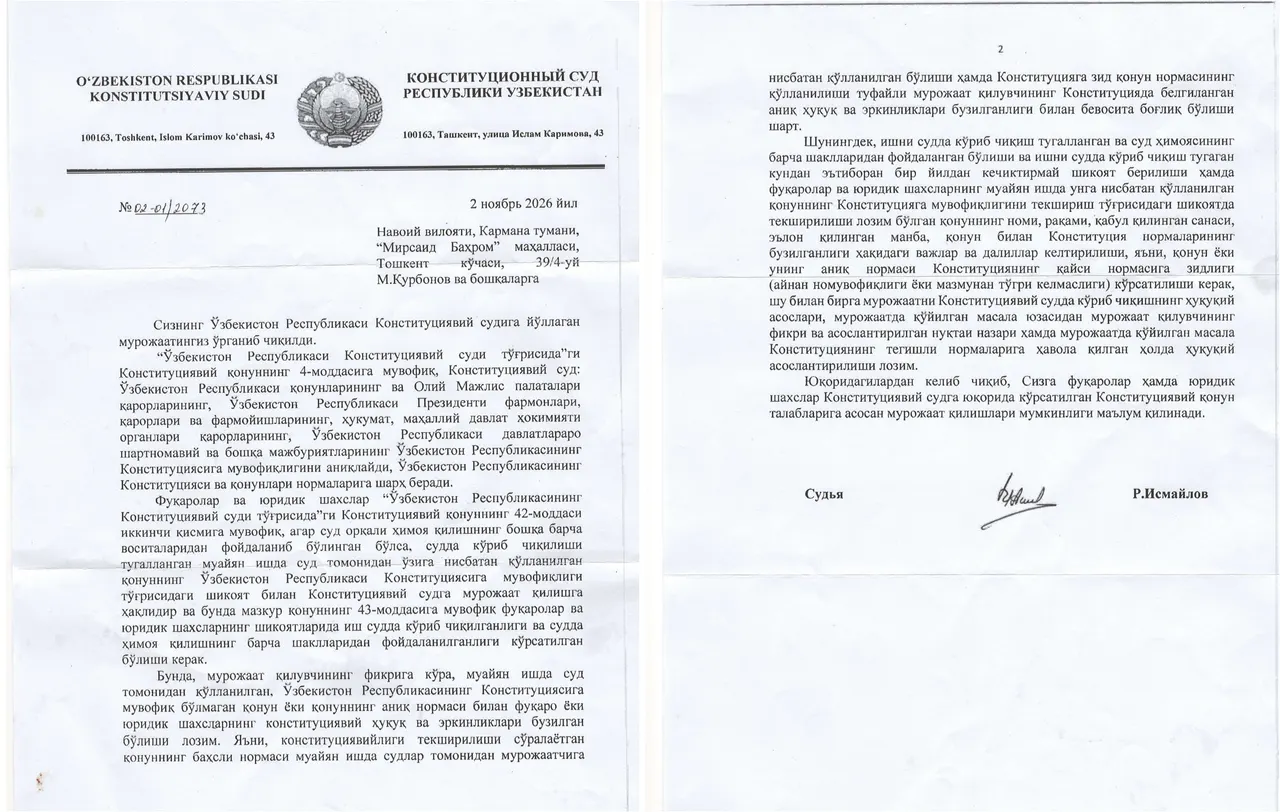
What is missing in the letter? It is not stated whether the complaint was accepted or rejected. If it was rejected, neither the basis for rejection nor the unfulfilled requirement is indicated. The arguments and attachments in the complaint were not evaluated even with a single word.
Meanwhile, the new Constitutional Law, which entered into force on October 15, clearly defines the procedure for this work:
the complaint undergoes mandatory preliminary review, as a result of which a conclusion is prepared and considered in a court session (Article 49);
rejection can only be based on one of the seven grounds listed in the law (Article 50);
a ruling on acceptance or rejection is issued within one month, and a copy of the rejection ruling is sent to the applicant within five days (Articles 50, 51);
this issue is decided not by a single judge, but by the court collegially (Articles 21, 24).
The letter I received does not answer any of these requirements. It is neither a ruling, nor a decision, nor a conclusion, meaning it is not considered an act of the Constitutional Court under the law. Even the deadline is indicated incorrectly: the letter states that the one-year period is calculated from «the day the consideration of the case in court ended», while according to Article 102, this period starts from the day the final court act is adopted.
As a result, my complaint is nowhere. It has neither been accepted nor rejected by a reasoned ruling. There is no document to appeal against, because the official document itself does not exist.
This is not just about my case. The Constitutional Court is the last hope of a citizen. The new law was adopted precisely to consider appeals openly, reasonably, and in a timely manner. If complaints are answered with letters providing general information instead of rulings, the practice will remain old even if the law is new.
I am asking the court for nothing more than what is written in the law: to consider my complaint in the established manner and issue a reasoned ruling.
Lawyer: Şavkat Mavlyanov