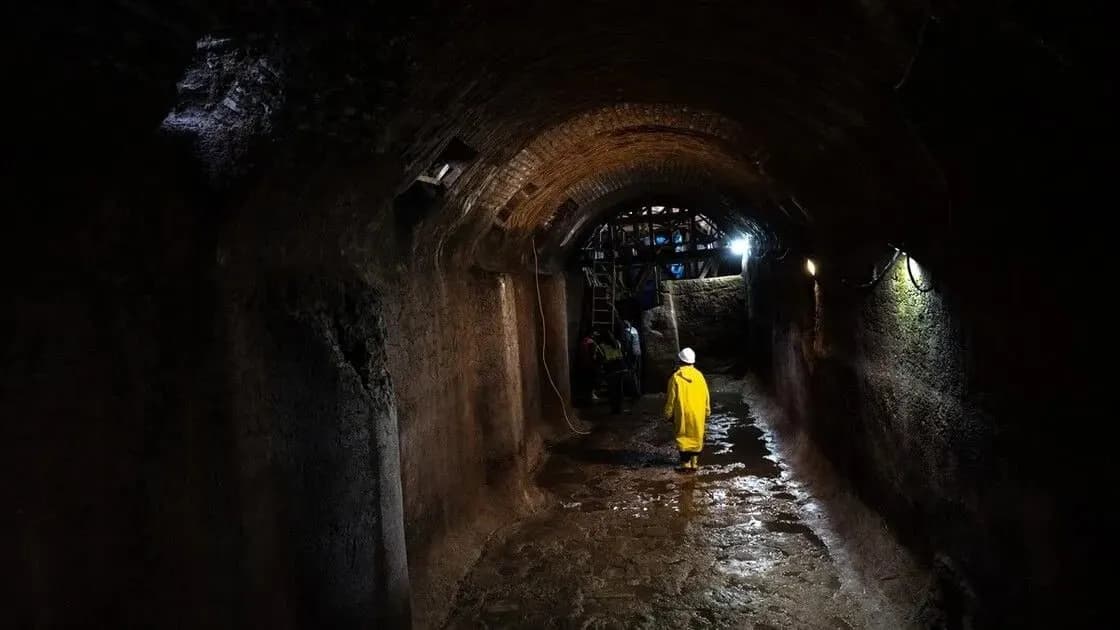
Restoration work continues at the Hagia Sophia Grand Mosque in Istanbul. Significant results have been achieved in the cleaning, excavation, documentation, and strengthening of historical tunnels and underground spaces beneath the structure. During the restoration process, a 420-meter-long underground tunnel corridor was cleaned. Research is currently underway to identify the historical water supply system and remnants of structures from various periods.
According to Professor Ahmet Guleç, a member of the Hagia Sophia Scientific Committee, cleaning work in the hypogeum (underground burial structure) located in the northeast part of the structure and its surrounding areas began nearly two years ago.
He stated that structures whose upper parts were destroyed and filled with soil over time have been cleaned, and historical underground spaces have been reopened. To date, 6 underground spaces and 9 tunnels have been discovered in this area.
According to the scientist, some spaces and tunnels may date back to the Roman period. It is assumed that they were used in subsequent periods with various modifications. Research in this regard continues. Recently, tunnel number 2 was also opened, and work to study its internal parts has begun.
“We are taking a series of samples from here and analyzing them. Based on the analysis results, we will gain additional information about this structure. For now, we can only say that this place was one of the components of the Roman-era atrium (courtyard) infrastructure,” Guleç said.
Tunnel leading south goes directly to the Basilica Cistern
Ahmet Guleç noted that research work has been carried out on a more than 200-meter-long section of the longest tunnel in Hagia Sophia. Historical sources contain maps reflecting that the ancient Roman street extended from Little Hagia Sophia to Sarayburnu. However, the scientist noted that this direction has not yet been fully confirmed.
During the research, a tunnel extending toward the Basilica Cistern was also found. Once the designated area boundary was reached, work in this direction was suspended. In addition, another tunnel extending northward and then turning westward was found.
The professor said he received information from experts working at the Basilica Cistern that there is another tunnel leading from inside the cistern toward the Hippodrome (Horse Square).
“We first opened the tunnel located close to Hagia Sophia. The tunnel heading south leads directly to the Basilica Cistern. After cleaning out the silt that had accumulated in the tunnels over the years, we managed to determine their direction. There is a tunnel here with a slope of about 3 percent, and water is still flowing from under Hagia Sophia. This water may be coming from a natural spring that flows into the Basilica Cistern or from the water distribution network of the Valens Aqueduct. Its exact source is currently unknown,” Guleç said.
Nearly 3,000 tons of soil and construction debris removed from underground structures
According to Professor Ahmet Guleç, during the restoration, nearly a thousand cubic meters, or approximately 3,000 tons of soil, silt, and construction debris were removed from the underground structures. These materials had accumulated over the years and were used to fill previously damaged upper structures and level the ground surface.
As a result of the cleaning of these layers, historical structures that had long remained underground are being reopened. Guleç touched upon the issue of opening the tunnels to tourists.
“Much work remains to be done before opening these places to visitors. No final decision has been made on this matter yet. Both our minister and we are in favor of opening these historical sites to tourists. However, it is necessary to study a number of issues related to ensuring the health and safety of visitors and take necessary measures. Currently, serious work is underway in this direction, and discussions among experts are ongoing,” Guleç said.